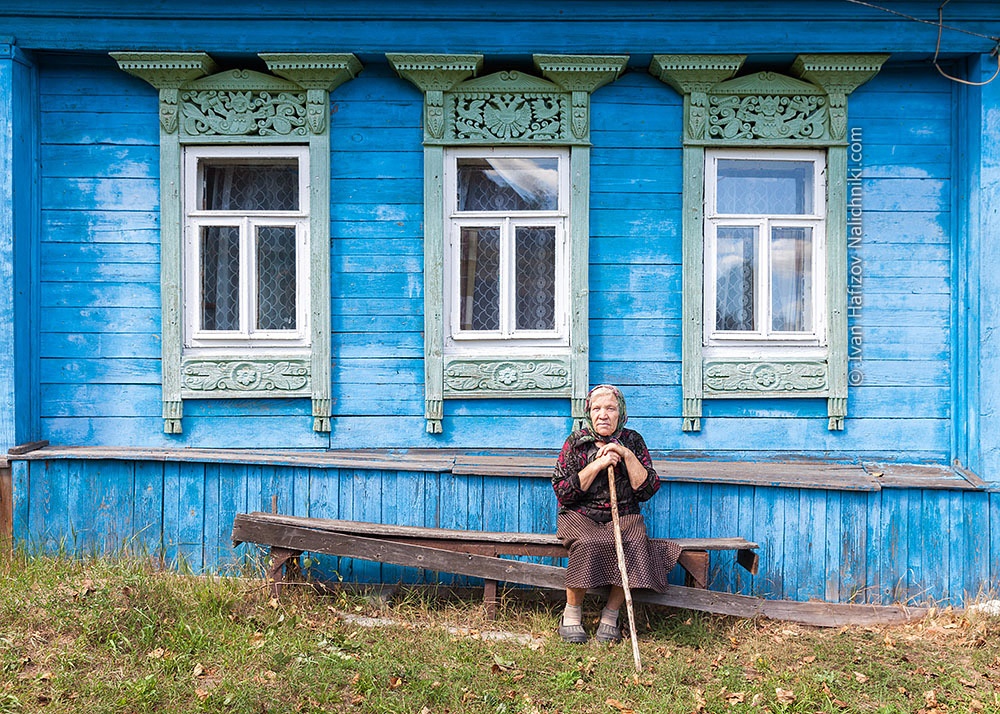
—…Well yes, there was a woodcarver here once… well, a woodcarver, more of a blowhard really, and he’s been dead seven years now. His name was Vladimir. And this — the new owner did this to the house. You should’ve seen it before!
— What was it like?
— Like a shed. And his son — when the old man died, eighty he was, the son was left behind. An alcoholic. Never worked anywhere. Drinks and drinks.
(She says the last word in her own particular way, softly, with a melodic drawl: dreenks.)
Word about this house had spread far beyond the Bryansk region — people were sending me here from neighboring cities, calling it the eighth wonder of the world — but no one could give me an exact address, and so in Klimov itself I’d wandered for a good while. My only landmark was a white carved horse and dragon on blue gates. Who could have known those gates had long since vanished, and that the house had been green for years? Nobody in Klimov had heard of a woodcarver named Vladimir Akulov either.
But after a couple of hours, the search is over. I photograph the house for several minutes, and drawn by my presence, the owner of the well-kept garden next door comes out: an older, smiling woman, probably accustomed to questions about the house and its carver — but her account of him is nothing like what you’d expect.
— They were dirty people. Vladimir — there’d be a slop pail right here, and right beside it he’d be eating. He didn’t even have shoes for his feet. Always boasted about being rich, rich — but when he died, there wasn’t even money for the funeral. His son was the same. And that son — he was almost dead too. But while he was alive, some young man came along and agreed to look after him, to care for him for life. And the old man left him this house. But it was unpainted, unfinished… covered in iron like a garage, rusted iron. And now this new young man is looking to sell it.
— And Vladimir — had he worked as a carpenter somewhere?
— Oh, no! — the woman waves her hand and laughs. — Never worked a day in his life. He was a night watchman at the fire station — they threw him out for stealing hoses. Then he made barrels — keelers. Do you know what keelers are? These little wooden pails with handles, and little holes in the handles. People used to water their cows from them in the villages. Made them, sold them. Then — they wouldn’t take him anywhere because he stole and ran his mouth too much against the bosses. Then he started picking chanterelles. He’d pick chanterelles and sell them, haul them to Moscow. In barrels. Salted mushrooms, hauled them off to sell…
I’m surprised she knows all this in such detail and ask how. The woman spreads her hands: “I live right next door — I know everything about them.” We stand in silence for a few minutes, looking over the carving. I notice the letters A and V on the gable — most likely Akulov Vladimir — and decide to ask:
— And this carving — was it done by the new owner?
— No, all the carving is old, everything Vladimir carved. Sasha only touched it up, repainted it. And now he’s selling the house. The house itself… the logs, the actual house, are good. Because Vladimir’s wife’s father was a forester, and they… back then, you see… she built it in seventy-three… in those days timber was only cut in winter! These days you put up a house, buy the lumber, and in two years it’s rotted away — because they cut it in spring or summer — but back then, only in winter. The house itself, the logs, are good — but work is needed. In the middle of it there used to be some kind of… gorsteklo…
— Glass? Maybe orgsteklo — plexiglass?
— I don’t know… it was called gorsteklo, something like that. Blue, awful-looking. All sorts of faces on it. Not pretty. And he ripped it all out, plastered everything, redid it all. The floors were parquet. But the dogs urinated all over them, scratched them up, so he pulled them out. Pulled them out and scrubbed the floors clean, washed them, painted them… he carted seven trucks’ worth of rubbish out of here…
She looks over the house, sighs for some reason, then turns away with a wave of her hand and goes on — as if she’d been speaking not about the new owner at all, but about Vladimir, the woodcarver who used to live here:
—…but most of the work here was done by this Vladimir’s late father — he did the carving. All of this carving — that was him. And Vladimir was just a talker, a braggart.
— Wait — and the paintings? Inside — I’ve seen photographs — there were paintings, murals, antique-style furniture, the parquet?
— No, the parquet — that was him, I won’t lie, why would I lie, what’s in it for me? But the dogs ruined everything. Seven years he’s been gone now, the new owner has done a fine job, but back then you couldn’t go in there! People came from Belarus, made straight for the trash heap by the fence — I thought: what are they running for? “Oh, ma’am, excuse us, could you spare some boiling water?” I thought: what do they need boiling water for? They’d been made sick. “If you could — just a tea bag…” Oh… you couldn’t go in there — stand in the house in your own clothes, go home, and your wife would say: “Where on earth have you been?” Now it doesn’t smell anymore, he cleaned it all out. Now it’s just a nice little house — come and live in it! And that’s what he’s looking to sell now. The paintings that were in there — those were also his father’s. Filipp Artyomovich. He was a house painter — he did the carving and the painting too. And Vladimir all the while: “I this, I that…” Made up stories about foreigners visiting, Frenchmen, who wanted to buy the house for a million euros but he refused. And you — where are you from?
— From the Moscow region, — I said, caught off guard by the sudden shift.
— Listen, once a young man came too, drove up, and Vladimir wasn’t home. And I’d stepped outside, and he says: “Ma’am, could I trouble you for a moment?” I say: “Yes?” “Would you let me rest inside — I’ve come from far away, and I want to learn this carving.” Well, he had his tools and everything. I said: “Well… go ahead…” I offered him tea, said: “Would you like some tea?” He said: “I wouldn’t mind.” So he settled in. That woman over there in that house — she lived alone — she took him in as a lodger. He asked me at first: “Can I rent a room from you?” I said: “No, well, I’ve got a husband and children, little children, grandchildren running about…” That was back then — they’re all grown now, but the grandchildren were little… So he settled in with that woman, rented a room. And came to Vladimir. And the dogs bit him — oh, the dogs bit him badly…. “I had no idea there were so many dogs,” he kept saying. Now the new owner keeps the gate locked — but back then it was never closed: drunks wandered in, women drinkers, all sorts… So. And he taught him carving. But this man could already carve himself — he carved, and Vladimir sold it and gave him not a kopek, drank every cent. And then he got another idea — stole all the man’s tools. Robbed him clean. When the man left — he was a teacher somewhere — he didn’t even go down the main road. Went the long way round just so he wouldn’t have to see him… Not a good person… not a good person, of course… he had some skill with his hands, I won’t say otherwise — but in his character, he was not a man. He was. No longer — seven years now…
I step to one side and take a few more photographs.
— And by the way, you could call the owner if you want to look inside — I have his number, though whether he’ll come out I don’t know… Only there’s nothing carved inside now. Floors painted, walls all plastered. In the bedroom there was a naked woman painted above the bed. Vova did that. But now — nothing. Nothing at all. So look from the street. Inside there’s nothing… Back then you couldn’t go in — the stench, everything — and he cleaned it all out. Seventeen dogs he had. They stole chickens. Mine, the neighbors’. Wherever they ran, they stole. He didn’t want to feed them. And when he died — gone, just like that. Scattered somewhere — have to eat. He lived alone. His son had lived in a little shack, but then the shack was taken from him for unpaid child support — he moved in here, and soon died too. None of them left now. His father used to say: “I’ve lived to see a good pension” — when he turned eighty. And he didn’t get to enjoy it: got his first payment and died. Drank himself to death.
…
P.S. Photographs taken during the lifetime of Vladimir Filippovich are from: https://sites.google.com/site/mikheevgennady/pisma-iz-glubinki/pisma-iz-glubinki-9/klimovo