
 Well, friends, you've written so many interesting things, and even things that I didn't realize (and for what I actually conceived this survey), that I could barely resist starting to comment yesterday!
The question was, what is the property/rule that applies to all nalichniki, regardless of the floor, region, and religion of the carver?
I must say right away that the answers are like: The nalichnik is a window decoration; The nalichnik is made along the outer perimeter of the window, the nalichniki are attached to the windows; The window is inside the nalichnik; One nalichnik corresponds to one window — I cannot count this as the correct answer, since this is the definition from which we all proceed.
Now, about the wrong answers. All the responses from different social networks are grouped here (not verbatim). It's much more interesting to read from!!! There are 29 different wrong answers!
And in the end, the right answer, or rather, the right answers!
- A template is needed for manufacturing: no, relief-carved nalichniki were often made without even a drawing, even without a drawing at all.
- the upper part is a symbol of heaven, the lower part is a symbol of earth: no, Soviet and post-Soviet nalichniki do not have such an interpretation. And not all of the earlier ones.
- the trim is made of wood: no :) Gum and many other buildings, including many houses in the village, are decorated with stone nalichniki. And there are thousands of metal ones in Tatarstan!
- They are all rectangular: of course not :) The nalichniki have any shape. And the windows on which they are fixed can be either rectangular, vaulted, pointed, or even semicircular!
- Everyone has a "crown" and "earrings", no. It's easy to see this by looking at the nalichniki that I posted over the last week :)
- The trim has a functional purpose, it closes the gap between the frame and the wall: no, on modern buildings, especially stone ones, there is no such functionality.
- The nalichnik is a protector, an amulet in the sacred sense: no, most of the nalichniki made in the last 70 years do not carry such a meaning.
- They are all beautiful: unfortunately not))
- All of them are wooden, they were made by hand: no, they have been made by jigsaw for a hundred and fifty years. And in the last ten years, the milling cutter and the laser have also joined.
- They have legs: no))
- The widest part is at the top: nooo, there are a lot of them so that the width at the bottom and top is the same. But you made me double-check it!
- Symmetry: no, not really. The bottom of the trim does not reflect the top.
- When they are dismantled, they are the last to be torn off: no, because tens of thousands of windows have never been torn off (and I hope they won't)
- There is a "cocoanut" — the upper part, and "towels" — the lower part. I thought about it for a long time. Of course, everything has an upper hand, so you can say about the iron. But the iron will not have a "cocoanut" and "towels". And not everyone has nalichniki.
- The nalichnik is designed to protect against dark forces: no, this property does not apply to all nalichniki now, since, for example, everything that was carved in Soviet times did not have this background.
- The nalichnik has openwork carving — but openwork carving just means it's cut all the way through the board. And there's also relief carving and applied carving :)
- The right angle between the horizontal and vertical parts is a laugh. Of course, the horizontal comes to the vertical at a right angle, this is not a property of the nalichniki))
- This is a self-contained work, not a fragment that can only make sense in the context of the whole house: no, this is not the case for all nalichniki, although I also thought so for a long time.
- The upper part protrudes forward: no, very often flush.
- Protects against noise, dust and drafts: no, historically there was such a function, but now there is no more.
- The trim allows you to express your personality. — It allows it, but, like people, not all nalichniki have this individuality:(
- The aspect ratio is 4:3 — I was surprised. I tried it on. No :)
- There is no elongation at the bottom. There are many without them.
- The upper part of the nalichnik dominates the composition: if Russia did not have the Ivanovo region, then yes. But it's not like that :)
- Nalichniki fall under the golden ratio rule: alas, no. Most of it unfortunately))
- Nalichniki are made with soul and love: no, I talked with carvers and I know for sure that many of the nalichniki were made simply by artisans and just for the money. That was the case 20 years ago and 50 years ago. And maybe 100 years ago, too.
- The nalichniki are painted in lighter colors than the walls of the house: no. Although it would be possible if they were all painted. But many people don't paint at all.
- The nalichniki are protected from rain or snow: no, although they should be. But most do not have such protection, as they are simply protected by a protruding roof.
- The presence of carvings on the nalichniki is not present: four boards around the perimeter of the window are already a nalichnik!
Correct answers:
- Axial symmetry! — this is exactly the property that I had in mind.
- The trim protrudes above the window surface. — This is unexpected, but I really don't know any nalichniki decorated deeper than the glass surface.
- The nalichniki are closed. Also an unexpected property! I've probably met exceptions to it, but there are very few of them.
To all the winners — those who answered correctly and reposted — I'll send the new nalichniki calendar!
Please write your address in a personal message!
For everyone else, we urgently need to study the nalichniki :)) That's what the calendar is for: https://planeta.ru/campaigns/nalichniki_2017
And thank you all for such unexpected and amazing answers! :)
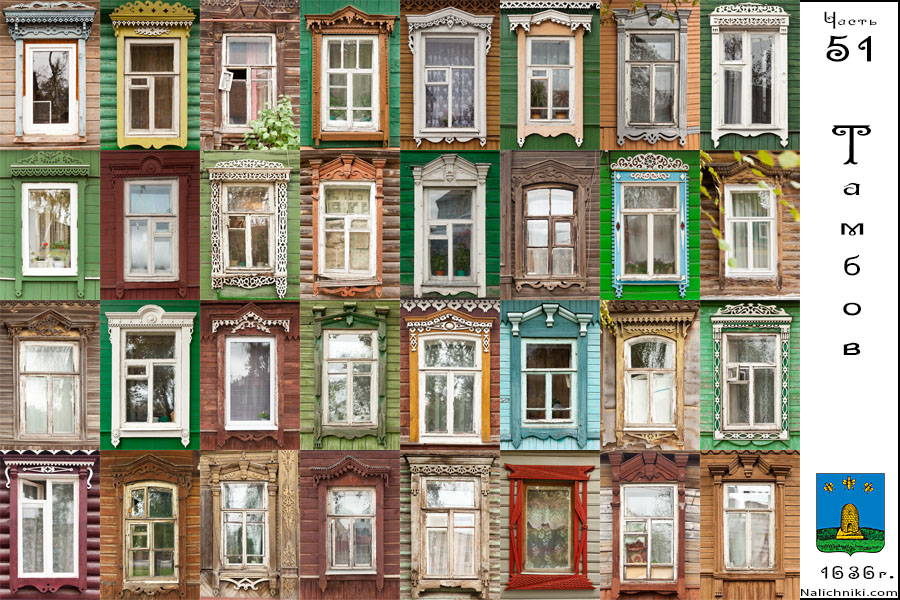
PS In the photo there are unique, breaking all the rules, asymmetrical nalichniki from Tambov!
#nalichniki #wooden_architecture #Tambov



1 comment