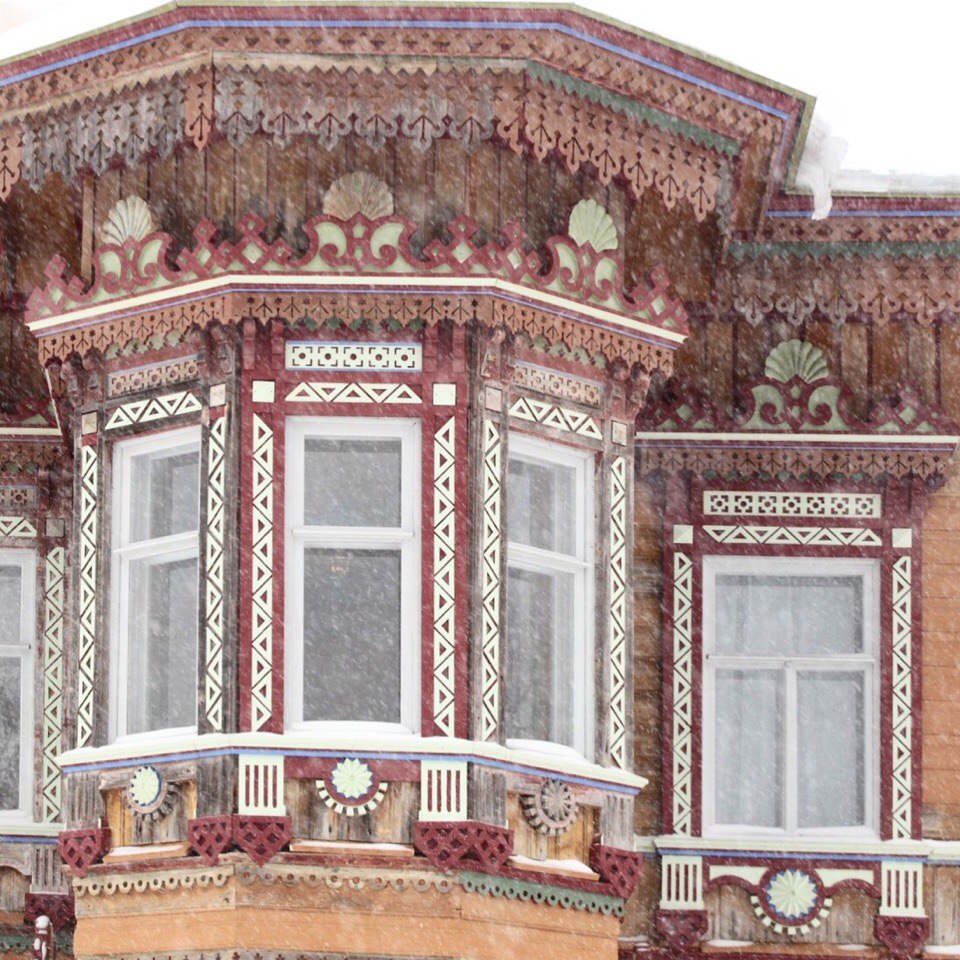
…Another attempt to speak with the owners of the previous house also came to nothing: the nalichniki had been stripped before they moved in, and they haven't touched the modern addition — not out of any love of beauty, but simply because they haven't gotten around to it.
"How can this be," I think, "there can't be a house on the whole street where the owners have changed and no one knows anything…"
The fence ends and from around the corner a house comes into view, surrounded by trees, set slightly back from the road. All around there is sunlight, but here there is shade, a faint smell of damp, and the lime trees creak, though there is almost no wind… And the house looks promising: old, but solid, two-storey. A house like this, I feel, must be home to solid, substantial people…
"Hi there!" — a male voice cuts across my thoughts.
A tanned young man in tracksuit bottoms and flip-flops, bare-chested, peers out from behind an IZH motorcycle. There's a speaker on the ground beside him; the music is unfamiliar, and I can't even place the genre.
"Yes… hello!" — I pull myself together. — "Do you happen to know how old this house is?"
The young man shakes his head.
"Nah… No idea."
He stands up, stretches his legs. Looks at his oil-covered hands, then at me, with what seems like doubt. And adds:
"But I know who does."
And before I can even feel glad about this, he crouches down, turns the speaker volume down, swings his head toward the house, and hollers:
"Maa-a! Come out here, someone to see you."
Great, I think — now I'll have to explain myself to some stranger (who's almost certainly annoyed at being pulled away from her pots and pans) about what on earth I'm doing here.
But against all my panicked expectations, a pleasant, athletic-looking woman in a black business suit and blue suede shoes comes out to meet me.
"Yes?" She's looking at me, but clearly waiting for an answer from her son.
"They're asking about the house, Mum — when was it built?"
"Hello!" — as so often happens when I've clearly interrupted two people at once, guilt comes over me and I start gabbling to justify my appearance. — "I photograph nalichniki, and wooden houses. For the nalichniki museum. And your house is very interesting, very unusual. And in such good condition. Do you know how old it is?"
The woman smiles warmly:
"You've come to the right address. This house was built in 1913. Though according to the documents it was recorded as 1917."
"Really!" — I'm surprised. — "And why is that, do you know?"
"Why wouldn't I know? I know. The archive papers were lost. Or burned, or something — it was a murky time. And the house was subsequently registered as 1917. This kind of thing happened — I don't know if it was only here, but I've been looking into it more recently and I suspect it wasn't just here. And this house was built by my great-grandfather (she gives the name, but I didn't catch it at the time, and it would have been wrong to invent one) — and my grandfather remembered very well how it was when they were building it. He was sixteen years old when construction started. There was a lot of building going on along this street at the time."
"Oh, these!" — is all I can say, while I'm thinking to myself: "Must remember to ask who the great-grandfather was who…"
"And my great-grandfather worked at the factory here." (I'm obviously thinking very loud.) "There were shoe factories here, famous the world over… You know about them? Have you been to our museum yet?"
"Not yet," I say, — "I've only been here a couple of hours."
"You haven't! Do go. Be sure to go. There's a young fellow there, a guide, very engaging."
"I second that!" — a hand suddenly appears from behind the motorcycle, holding a spanner — and with it, the young man's voice. (And it's only now I realise he turned the music down not only to keep out of our way.)
"What's his name?" (I'm not quite sure who she means, but the woman is addressing her son.)
He doesn't even look up:
"Alexei, I think. Or Sergei. Can't remember, Mum."
"Well, do go anyway — if I'm not mistaken, he's the only young one there now."
"Thank you!" — I smile. — "I'll come back for the museum. But they definitely won't tell me about your house!"
"No, but they will tell you how Kimry became a city. Did you know that story?"
"No," I shake my head. "Honestly, it never occurred to me to wonder…"
"And yet it's an important story, one that sheds light…"
(She launches into her account, and out of the corner of my eye I notice her son go still — fists on the fuel tank, listening.)
"…shedding light on the history not just of the town but of the country as a whole. For the understanding of it, you know?" ("You know, you know!" — she repeats it twice and adds: "That's what I'm saying, isn't it?") "In a word. Kimry was a village until 1917. But not just a village — a very wealthy village. You could even say extraordinarily wealthy. Consider one fact alone: the local merchants bought out all the serfs fifteen years before the abolition of serfdom. They bought their freedom on credit, mind you, and were still paying it back for forty years after the abolition… But they were allowed to, which is the important thing. And what merchant arcades they built here! (She looks at me intently, apparently not finding the response she'd hoped for.) You probably haven't seen them yet? The red ruins in the town centre. There was a remarkable building there — in style, rather like the Historical Museum in Moscow, if you can picture it!
"Wow!" (At that point I hadn't even seen the ruins yet, but what I imagined turned out to be still not grand enough.)
"So, Kimry was a village, despite having all the appearance of a real town. And all for one reason: villages paid a completely different tax than cities. And the locals naturally did not want to pay extra into the treasury. My grandfather said that under the old regime, Kimry would never have become a city, because there were — as we'd say today — 'vested interests all round.' Corruption, of course. That's nothing new. What it took was a change of government: and it was only the Provisional Government that issued a decree granting Kimry the status of a city. Almost the only decree, so they say, that the Provisional Government actually managed to sign."
She pauses, and I'm not quite following:
"So in 1917, with a revolution on, and a war, and all the rest of it — Kimry becomes a city?"
"Can you imagine!" — she nods. — "And my grandfather was one of the first Communists here. And then one of the first to be repressed, because he was still considered 'one of the former.' I always say there should be a film about him — 'The Irony of Fate.' He was the first Communist here, and then — probably the only one who wasn't dekulakized, even though this house — a big one; in houses like this they were settling four families, sometimes six — was already standing…"
The woman hesitates, and I manage to ask:
"So they didn't dekulakize him because he was a revolutionary himself?"
"What kind of revolutionary? He wasn't… You know, I haven't studied this professionally, I've just read a little about those years, and I don't think he was the sort who wanted to overthrow and shoot everyone. A Communist, yes, he truly believed… But anyway. In this house… he was denounced by a neighbour, who reported that his family was still living alone in their own house, when all the other ‘former people’ had already had workers moved in alongside them. Grandfather would laugh telling it — he'd seen the piece of paper and knew from the handwriting who had written it. But nothing came of it: because by that point twenty-four people were already living in the house. There was simply nowhere to squeeze anyone else in."
"But they repressed him anyway, you said?"
"That was later, in the late twenties, yes, when the NEP ended — they took a lot of people then…"
"So — it dawns on me — your family has been here the whole time, from when the house was built before the revolution, right up to today?"
Perhaps I'm so surprised because I've never met anyone like this before; perhaps because even the most powerful people in the country have not managed to keep property from the time of tsarist Russia to the second decade of the twenty-first century… Whatever the reason, this fact astonishes me.
But the woman shakes her head:
"Not quite. The relatives multiplied over the years, and by the nineties it had been divided into nearly thirty shares: some with half a room, some even less. But no one actually lived here except us and one other family — distantly related, we knew there was some connection somewhere, but we had no contact at all. As a family, I mean. As neighbours — of course. And then, when I decided to gradually track down and buy out the shares, they were willing. And so the house is back in our family. The ancestral home, you might say."
I look at the house with different eyes.
The woman catches my gaze, but reads it as critical rather than admiring:
"There's still a lot to be done, of course. Paint it, sort out the eaves, replace the roof…"
"Have you thought about getting it listed as a heritage monument?" — I say, to my own surprise. — "After all, the house has quite a history."
She only smirks:
"I can see at once you've never dealt with that."
I nod: fair enough, I haven't.
She goes on.
"When we started replacing the floors, the joists were exposed — and they ring. A hundred years old, but solid as new ones, if you can believe it. Then for a pipe, when we were laying on the gas, I needed a small hole at the bottom: we broke three circular saws, apparently. The sparks were flying so badly I was afraid we'd burn the whole house down. I didn't know what was happening, so I asked, and the men said: 'There's probably rebar inside.' As if — " she wrinkles her nose — "a hundred-year-old house would have rebar. Brilliant… And then when they'd finally cut through, it became clear it was simply larch that had turned to stone. Not the whole house, of course — just the lower courses of logs — but still!"
"All the more reason, then," — I still don't follow — "all the more reason to get it listed as a heritage building, so it's protected!"
"But you didn't let me finish! In our country: if something's a heritage monument, repairs are forbidden — only restoration. And what does restoration mean? Money, because you can't just give the work to anyone, only someone with a licence. And more than that: to start with, as the owner, you don't even have the right to replace the floor yourself. Or fix the nalichniki, for that matter. Only through an accredited organisation. We have two of them: they charge ten times the going rate, and then subcontract the same ordinary lads who helped us, for three kopecks — they just need the money and they'll do anything. They don't know the techniques, they don't know the building codes… And in the end you'll have paid far more and it still won't be a proper restoration. I know this well: I've worked in property for many years. So I'd rather look after my house and repair it myself."
She stops abruptly, as if cutting herself short. For a second there's an awkward pause: I suddenly remember how someone told me a similar story in Krasnoyarsk, and I hold myself back from recounting it, because somehow that one ended badly…
And a second later, something in our conversation gives way, and she simply adds "Well, good luck with your search" — and goes in.
I thank her, take a couple more photos of the house under the interested gaze of her son. Belatedly I try to commit the details to memory — middle of summer, Thursday, to the right a long damp grey fence leaning sideways, all around sunlight, but here shade, a faint smell of damp, and the lime trees creak, though there is almost no wind…
And I walk on to the next house.
PS In the photos — Kimry's remarkable rooftop structures. The more I travel, the more convinced I am that this local variety is absolutely unique.
PS2.
On April 19–20 I'll be giving a lecture and workshop in Samara,
April 22–23 — in Smolensk.
And May 6–7 in Moscow, at Sokolniki, at the woodworking festival.
Come along wherever you can :)