

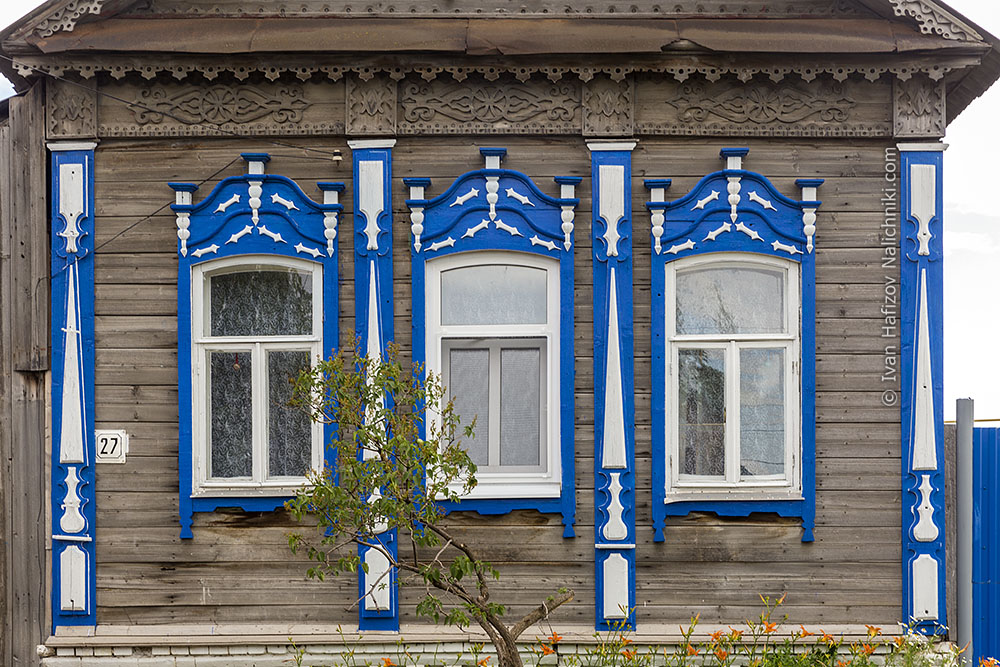
Khvalynsk, July, around six in the evening. I approach a house with vivid nalichniki, in front of which, sitting in a striped old deckchair, a tall thin man of about forty is dozing: shorts, a T-shirt, dark glasses. Fine, I think — I won't make any noise, I'll take a few shots and slip away quietly. I get a few clicks of the shutter and notice that the nalichniki on the side of the house are a little different. At that moment the man lifts his glasses, and I realize he may not have been asleep at all.
— Could you tell me — the nalichniki on the side there are different? Do you know why? — I decide to go on the attack, since remaining unnoticed is out of the question anyway.
The man, in a low pleasant baritone that doesn't quite match his thinness, asks:
— You're from somewhere far away, it looks like?
— From outside Moscow, — I say.
— Maybe some tea? — he surprises me, and from under the deckchair produces a small stool with a little teapot and two — which at that moment strikes me most of all — cups.
Taken off guard, I fumble for an answer and for some reason decline, mumbling something about still needing to get to a lot of places before dark. The man nods understandingly and asks again:
— So — about the nalichniki?
— The side ones are different from the front, — I say. — Do you know why?
I have no definitive answer; in different regions people had given me two versions. The first: the front nalichniki are more expensive and elaborate — homeowners often cut corners on the side of the house. The second: the front ones were generally replaced about fifty years after the house was built (in the 1920s in some places, after the war in others), while the ones not facing the street were left as the originals. My current conversation partner's answer, however, reveals a man of considerable life experience, who has thought about this question more and more deeply than most. Slowly, almost singsong, enunciating every word clearly, he says:
— The way I see it, a house is an archetype of a person. Take the head: on the sides it's different from the front, isn't it? You have ears there…
I can't hold back — I nearly choke with laughter, but after a few seconds I collect myself and ask the first thing that comes to mind:
— So you think there's a connection?
But my companion is not going to be knocked off his chosen jester's register by such banal questions. He continues in the same calm, professorial voice:
— I don't think, in general — God didn't give me intelligence at birth. I simply cogitate. A thought is thrown to me and I interpret it…
At this, for a second I see through his lowered glasses those lively eyes with a hint of mischief — and belatedly, even if late, a thought is "thrown to me" as well: he's simply pulling my leg. But at that moment the man's face takes on a perfectly good-natured expression and he launches into a proper account.
— On the side it's simpler — although the house isn't really facing the road with its front. It stands parallel to the road. Not "here's my face, look at me" — it's the side. But look how it's done… There's Yin and Yang. One part thin, the other in the same spot rounded out like so. And that's how this house was made — for two households.
— What do you mean? The house was built for two owners from the start?
— According to legend — yes. A merchant had this house built for two sons. Though I've only been here since the mid-seventies, so about what came before — I really can't say: I wasn't living then… But I haven't changed anything inside — only took the stove apart. Though a little bit of the stove is still left in the cellar. The stove was a historic one, very remarkable, very strange. I looked into it — masons simply don't know about stoves like that.
— Wow! What was unusual about it?
— Well, usually… a stove stands there, all its interior workings, and then the flue goes up to the roof directly.
— To the attic? Not straight outside?
— No — first to the attic, then through the roof and up. And in there — he waves toward the house — it turns out that where the flue exited to the attic, the other half of the stove exited there too. Some incomprehensible device. There was something like a ventilation system. There was even a little hatch, but this hatch was always stuffed up with rags of some kind. I still don't know its purpose. It must have had one — because why build something for no reason?
And then suddenly, without any pause at all:
— Around here almost all the houses are like mine: built somewhere around the turn of the century — end of the nineteenth, beginning of the twentieth. And before that, the whole history — as if it never existed… Either everything burned or something happened.
— I read that the city was small, but when the reservoir was built — when the water level rose — people came from all the nearby villages and the city grew enormously, almost tripled.
— Right, yes — the Petrov-Vodkin Museum was the last building before, and behind it was open fields. Have you been?
— Yes, I went already — it amazed me!
We're quiet for a few seconds: I photograph the nalichniki, the house, the flowers in front of it. This man never gets up from his deckchair and reacts to my movements not at all. But when I'm already about to head off, he suddenly asks:
— And you only — strictly — nalichniki?
— No, — I say — the house too, of course. That matters for the history: the interplay of color and form. Especially in your case.
— And you know, there's something else interesting? You can actually classify houses by suit — playing card suit. There are diamond-suit houses… Have you been around the corner?
— Y-yes… — I confirm, uncertainly. And I remember: on the pediments over there were "spades."
— You saw the spade house? — he can already read it in my face. — And there are diamond ones, and heart ones.
— And did this mean something here? Was there a reason for it?
— Well… — He gives me a puzzled look, as if I'm asking something obvious. — People are all divided by suits… I mean, it's the soul of the house. The owner of this house should be more or less of that suit. Of course things change — owners move on somewhere, houses get sold — but generally speaking… if the owner isn't of this suit, he won't get along in this house…
— And what suit is this one?
He suddenly goes silent, gazes at me with a brooding expression, and I begin to wonder if I asked the wrong thing. But I've nothing to lose, so I ask again:
— Does your house have a suit? Or does that not apply to every house?
At this he turns away from me on his deckchair and mutters, now almost to himself:
— I'm not going to say anything. Not going to say anything…



15 comments