And it's more from Mstyora — yes!
These two types — this one and the one from the previous post — appear in roughly equal numbers.
Though of course "roughly equal as of 2013" (when I was photographing) doesn't say anything about what the ratio is now, or what it was half a century ago, when nalichniki were still being actively made. I was told that an elderly carver lived in one of the rented houses — a man whose father had also been a carver, also making nalichniki.
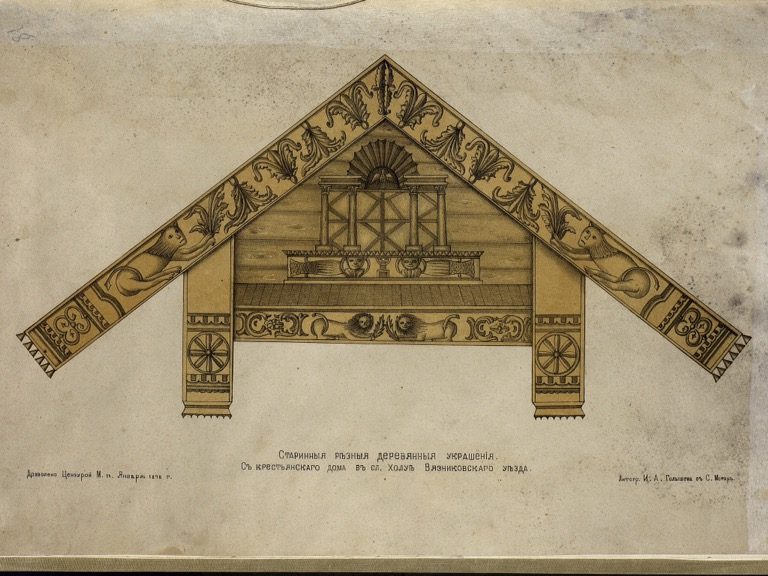
Mstyora, by the way, is the birthplace of Ivan Golyshev — the first person, as far as I know, who took an interest in house carving as a phenomenon, began sketching it, and published a catalog of the fascia boards he encountered. (These are the long boards, decorated with relief carving, mounted above the nalichniki but below the pediment. They are found mainly along the Volga.)
Ivan Golyshev is also a man of an extraordinary biography. Born a serf in 1838, he turned his fate around so completely that by the age of twenty-three he had opened a print shop, a library, and a Sunday drawing school. Over the following years he published eighteen books, mostly on his great passion — archaeology — which earned him honorary citizenship of the city by the age of forty-three.
And by 1896, when he died, he had been awarded the gold medal of the Imperial Russian Archaeological Society and was a member of the Moscow Archaeological Society, the Kiev Historical Society of Nestor the Chronicler, the St. Petersburg Literacy Committee, the Imperial Geographical and Archaeological Societies, the Society of Lovers of Spiritual Enlightenment, and an honorary correspondent of the Imperial Public Library. (I have seen it claimed that he was also an honorary member of societies in Paris and Warsaw — but I can't now find confirmation. And even without that, he was quite a man.)
PS These nalichniki are more elaborate than the previous ones — probably from the 1950s.
You can recognize them by:
1. The characteristic shape of the ochelia: a gentle arch on wide shoulders.
2. A window sill divided vertically in two.
3. Applied carved half-columns on the uprights to either side of the window.
4. Two-color painting.
And it's the combination that matters — each of these features can be found elsewhere on its own.