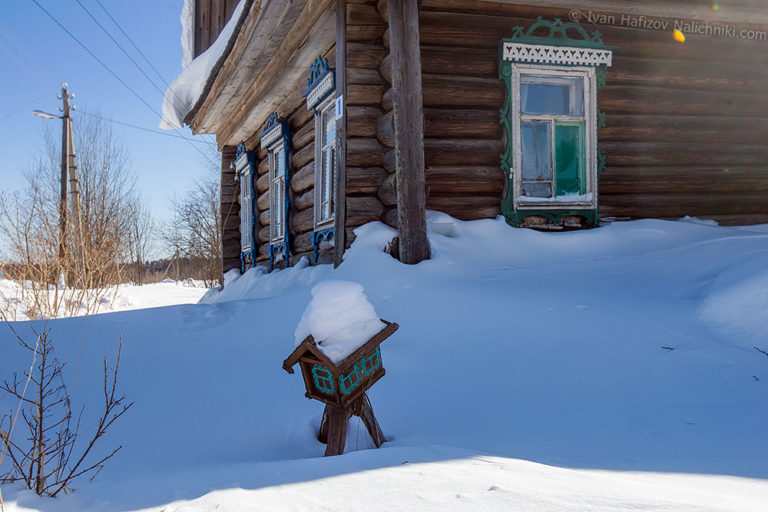
I’ve never liked knocking on a stranger’s door. Even if I know the woodcarver’s grandson lives there—someone who, in theory, should understand my love for nalichniki—it still feels awkward.
I can already picture the scene: the man sits down with a bowl of steaming borscht, opens his favorite book, or maybe he has a hobby, a model railway he’s setting up, tiny trees made from moss ready to go… And then, just like that—unannounced.
"Hello! We’ve come all the way from Moscow—seven hundred versts—to ask about your grandfather."
Forget everything, drop it all—hurry up and greet your dear guests!
Like that old joke: "What do I need the Bahamas for? My sink’s leaking!"
That’s roughly what I think every time I ring a stranger’s doorbell or knock on their gate. And even though I have this deep, almost urgent need to talk to people—to touch a life so distant from mine, so strange and fascinating—secretly, I hope no one’s home. Then I could slip back into my car, my burrow, and drive away without speaking to anyone.
From the other side, though, I hear movement—clearly someone is there. Half a minute later, a man steps out through the gate. After introducing myself and handing him a calendar, five minutes later, we’re talking about Fyodor Silin, his grandfather.
— Is it true — I ask, getting straight to what seems to me the most important thing at the moment — that he was the one who decorated the administration building in Zlynka?
— He worked on it, yes. He was part of the team. There were a lot of people involved. My grandfather was a stonemason.
— A stonemason?! — I can’t hide my surprise.
— Of course. Zlynka—this was a town of stonemasons.
— But the carvings on that building—they’re all wood!
— Yes, yes… Well, there were some… About ten or so, who specialized in that. The rest just cut. Because, as they say, no one person could possibly carve that much by hand. The patterns were handed out, and people cut them.
— So these ten master carvers came up with the designs, and the rest just cut the pieces?
Alexander Yakovlevich nods.
— When the stonemasons came back for the winter season—see, they didn’t work in winter, only in summer. They traveled, from Warsaw all the way to Siberia—to Omsk, to Tomsk. So in winter, well… some of them—he chuckles—just lay there on their side, doing nothing. But most kept busy. Some worked on the carvings too.
— Do you know how many nalichniki your grandfather made? Feels like half the city is covered in his work.
— Not just his. Back then, as they say, all the carpenters—the ones who built the houses—made nalichniki too.
— So there weren’t separate joiners for that?
— No, the carpenter did everything—he built the log house, did the finishing work… And most of them made the nalichniki as well. See that house, third from here? It has three nalichniki—all my grandfather’s work, no question about it. But the one on the far side, that was done much later, completely different. Looks similar, but the carving is rougher, simpler.
Then, as if realizing there’s no need to stand here talking, he cuts himself off.
— Come on, I’ll show you.
We step into the yard. Near the house, a magnificent pink rosebush, taller than me, fills the air with such a heady fragrance that if I were a bee, I’d be blissfully drunk on this scent. Alexander Yakovlevich points to three finely carved nalichniki and a fourth, clearly done in the same style but somehow clumsier, less assured.
— These, — he says, motioning to the first three, — my grandfather’s. And this one, — he grins, looking at the fourth, — I carved it myself, when I was about twelve. Did what I could!
— Tell me, — I ask, — about the patterns. Did your grandfather have a single style, or was there variety?
— No, no, it depended on the house—size, proportions, the kind of carving that fit… If the space above the window allowed for it, he’d do one design; if not, another… After the war, people had a hard time. Nalichniki were cheap back then because everyone was poor, you see—practically everyone. They couldn’t afford much, so it wasn’t worth making them. The work was intricate, but if you asked for too much, people simply wouldn’t order. You see how it was…
He nods slightly, and I do the same.
We fall silent for a moment, and, as often happens in these pauses, sounds I hadn’t noticed before rise to the surface: the wind, the low hum of some engine somewhere, bees thick around the rosebush, women’s voices softly drifting on the edge of hearing… Alexander Yakovlevich exhales, almost to himself:
— No getting away from it…
— This nalichnik here, — I break the silence, pulling him back from thoughts drifting toward a distant and difficult past, — did your grandfather make it after the war? I’ve seen similar ones, but with shutters on wrought-iron hinges—seemed pre-revolutionary.
— Maybe… Back then, you see, even the very poorest old woman—a real pauper—still wanted things to be at least a little bit pretty… You’ve seen the administration building, the music school? There’s still the old police station, the forestry office… — he lists the remaining wooden buildings in town.
— You know, they should make this place a heritage site! — I try to joke.
— Nah… That reserve isn’t long for this world either… — Alexander Yakovlevich smirks, and his meaning is clear enough.
— I heard there’s some kind of book around here — do you know about it? A woman told me: “People came from Bryansk and showed me a book with my house in it.”
— Yeah, there is one… A local historian wrote it, but not specifically about this. You can find it in our library… Gorkov, I think? An architect. There are still a lot of old houses like this—if you go past the pharmacy, down that street… Oh, you just missed it… My grandfather’s podtashek, a wooden sunshade often carved with intricate designs—gone now.
— What was there?
— A podtashek—a wooden canopy over the bench and gate, all carved up, so people could sit out of the rain.
— Oh, and those big gates across the street—do you know how old they are?
— There? — He points exactly where I mean. — My grandfather’s work. I used to have the same kind. I redid them later. They were narrow—built for horses, two meters ten or so.
— A car wouldn’t fit?
— No way! They were built back when Zlynka had maybe two or three cars, back in my childhood…
— Tell me—how did so many wooden houses survive here? Were there any battles?
— Battles? Not really… They set things on fire. Burned things, yes… went around burning. And who knows who even did it—maybe marauders, covering their tracks, maybe the Germans… Why did the fire start from this very house—from ours, right here?
— Why?
— That’s just it—why?! Not from the edge of town, but from this house, right in the middle. The wind was from the south, and it spread from here all the way to the last house on the street. All these little houses—everything burned down. Only the very last house was left standing. And who did it? Nobody was here—everyone had gone into the forest. When the Germans announced they were pulling out, people naturally all fled into the forest. Took what they could carry. Whoever had a cow—and many did—led her out by the horns into the woods. About a week, I think, people lived in the forest. Plenty of room for marauders to help themselves. Who knows.
— And how old was your grandfather during the war?
— Close to seventy. They didn’t take my father in ’41—don’t even ask me why, nobody could figure that out… In ’43, he and the others were hiding from the Germans, hiding under the women’s skirts, so to speak. Then, when our forces came back, they drafted them—no gear, straight into battle. The city was liberated on the twenty-sixth of September, and by early October they were already thrown into battle near Gomel. Well, most of them… Almost all of them fell. Only a handful came back. About my father, we got word he was missing in action. But then later, when some of those who did return were asked, they said my father had been wounded on the left side—his arm was just dangling, but he was still running forward, shouting. That’s… his last moments. And then he fell. Since they hadn’t even given him any gear, maybe they just buried him somewhere, as they say. And if he was only wounded—why was his arm just dangling like that?—that means he was hit somewhere on the left. And that’s usually where people keep their documents. So maybe there aren’t even any documents left. In short, nobody knows what, where, or how. He never came back, and that’s all. Word came through later that he’d been wounded in battle somewhere, around the twelfth of October. What happened to him after that—nobody knows. Maybe they couldn’t get him to the hospital in time, maybe the wound was too bad… In short, war is war.
The carver’s grandson tells all this in the most matter-of-fact way—no film over his eyes, no gaze fixed on some distant point—in exactly the same tone he used five minutes ago to tell me how to find the forestry office: “Turn right, go to Karl Marx Street, you’ll find it.” It’s hard to believe his father had barely had time to hold little Alexander in his arms.
— So you were born in ’42?
— Officially in ’43, unofficially in ’42. So there you go… You know, back in the day it was the custom to register boys a little later. Universal conscription had been around since Tsarist times, and the service was hard—twelve years, then seven. Hard service. So people always tried to send their sons off a bit older, more grown-up. Nowadays they take boys at eighteen. What do you get out of that? A year of service. What comes of it? They’re still children—ordinary children. And I’ve read somewhere that they take them at that age precisely because they don’t yet understand, they don’t have that fear of… They don’t yet understand what death is—that it can actually happen to you. So they have no fear. Even after the war they were drafting them at nineteen!
He sighs, stretches out a broad, calloused hand, and gives me a firm handshake.
— Well… Guess I’ve talked enough.
— Not at all. Thank you—for keeping this memory alive. This is a treasure.
— Well, it’s mine, isn’t it? No getting away from it. Someone’s gotta keep it. When I’m gone—who knows. There are a couple of fellows, sure, but… not nearly enough… not nearly enough…
P.S. Friends, if you love carved nalichniki, if wooden architecture speaks to you, and you’d like to find a way to help preserve it for the future—follow this link: https://planeta.ru/campaigns/okno2018. I’m raising money there for a print run of T-shirts with nalichniki designs, because I believe it can help spark wider interest in them. You can also simply support the project there. Thank you!
P.P.S. The photos show the pink rosebush and the Zlynka administration building.