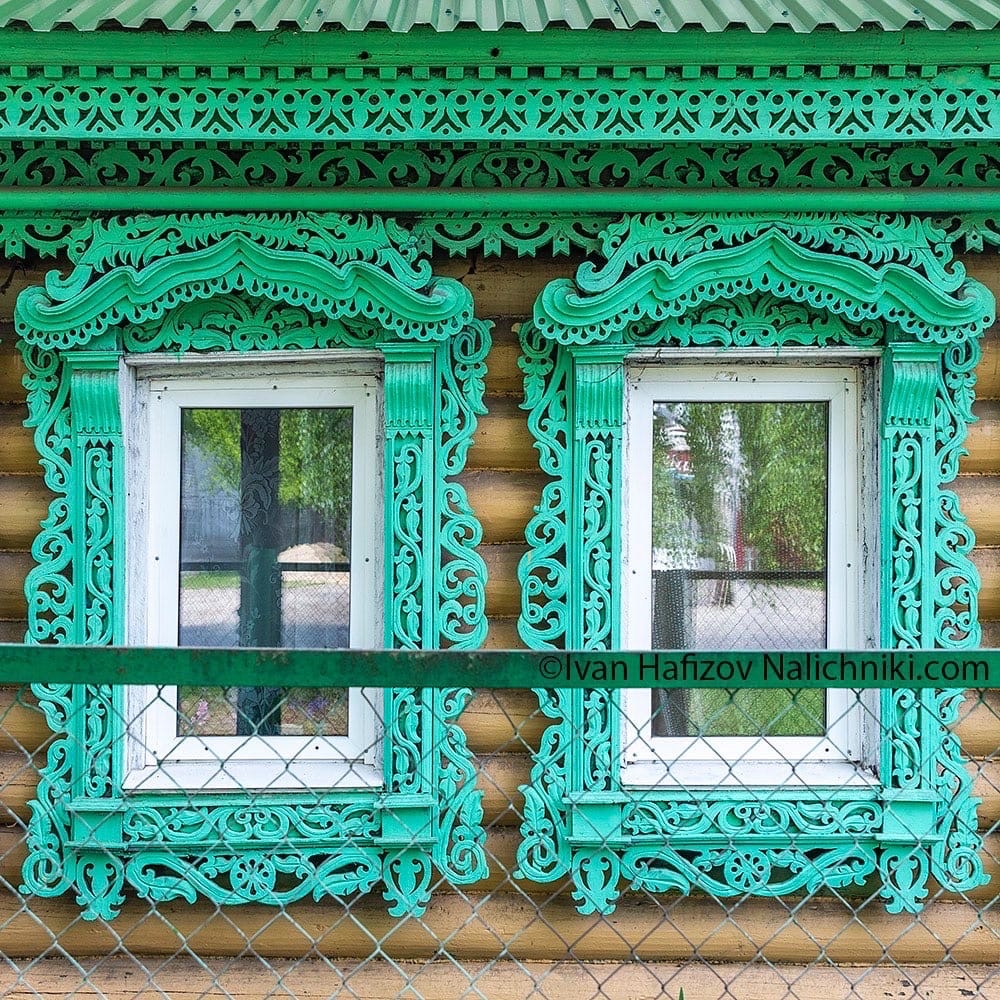
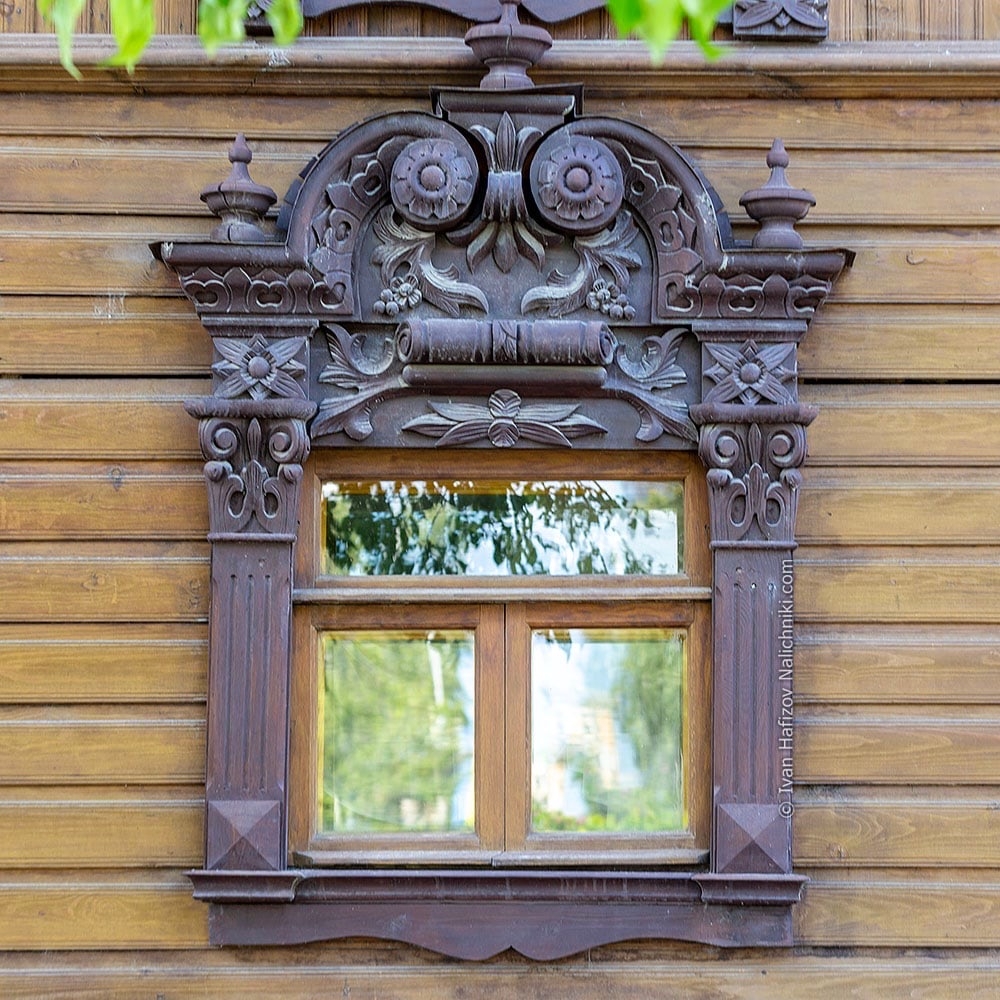
— And what did you want?
A man in his seventies scowls at me from the gate.
— I... — I stammer in surprise. — Hello! I was photographing the nalichniki... I hope that's all right?
— Ah, the nalichniki! — He straightens up. — Beautiful! Lots of people film here — but not usually for that. — He nods at my camera, spots the second one hanging from my belt, and lets out a whistle. — Well, I'll be! With those you could probably count a fly's legs!
Then, out of nowhere:
— The nalichniki aren't going anywhere, are they? You know how they say — "Need firewood? No. Wake up — and the firewood's gone!"
— No, — I laugh, — I'm only after the image.
— Come in, come in. It's easier from inside.
And, opening the gate, he steps back.
I come in.
Truth be told, I'd already photographed the house from the street — the yard is narrow, the angle not ideal for the nalichniki — but how do you refuse when someone invites you in? It's trust.
I sit down on a bench to change the lens. The man extends his hand — enormous, I suddenly realize; I hadn't even noticed how tall he was, well over six feet:
— Vasily!
— Ivan, — I say.
He lowers his voice:
— Vanya, shoot away. I'll step around for a minute. There's a lilac bush in the corner — just don't break it, I barely got it to grow.
And he disappears around the corner, leaving me alone.
I look around.
A house like any other. A gable roof with a slightly clipped "snout" — locals say it keeps the wind from lifting the roof. And the nalichniki. Good ones.
Though honestly, they all look good to me.
I manage a few shots before the owner's voice floats around the corner:
— These nalichniki, by the way, — he reappears, already mid-sentence: — a local craftsman made them. Uncle Zhenya. Not old at all, but they look old — he made a copy, one-to-one. And my grandfather taught him how to carve, even though grandfather himself never carved a thing!
— How's that?
— Simple! My grandfather had pen pals everywhere; they'd send him magazines with drawings, and he'd take them to Uncle Zhenya... well, and that's how grandfather taught him. Though however old they look, — he interrupts himself, studying the nalichniki — it's still the year fifty-five... they'll be seventy soon. That's history too.
For a moment three questions fight it out — about the carver, about grandfather, about the magazines. Grandfather wins.
— And what did he do, generally?
— The grandfather? — Vasily leans a shoulder against the house, watching as I settle in near the lilac bush (hardly any leaves on it — I'd never have guessed it was so prized). — My grandfather was a legendary man. You don't find them like that anymore.
— Well, that's always true! — I smile.
— No, seriously. For one thing, he was a non-commissioned officer in the Tsarist Army. He fought in Europe and took a through-and-through head wound in '16. What do you make of that?
— That's something, — I say.
And I'm thinking: even if that were the whole of his life, it would still be something.
— But that's not all! After he recovered, he turned communist and organized one of the first collective farms! Sharp as a tack — always absorbing everything. He read in three languages and corresponded with friends in Europe almost to his dying day. Gone in '62. He was ninety-three. And on his feet to the end.
— That's incredible.
— And when the war started — the Great Patriotic War — he was already too old for service, plus the old wound. But he had his own moment: when his former White Guard officer friends came through with the German troops and asked him to guide them through the forest — roads were too dangerous — he told them his eyesight was completely gone and he'd never find the way. They punched him square in the face for that and left.
— Was all this right here? He lived here?! — I'm still trying to piece this grandfather together while standing in this perfectly ordinary house.
— No, — Vasily shakes his head. — He was in the Bryansk region then. I couldn't track down exactly where. But here's what I keep thinking... those friends of his in quotation marks probably got lucky, because even with his eyesight shot, he knew every path in those woods — he could have led them into swamps they'd never come out of. He just didn't go. And he lived to see Gagarin's flight. He was very proud that he'd known Gagarin's father — wrote to him afterward, wanted to arrange a meeting the next time we came to Moscow. It never happened.
Vasily gets it all out in one breath, and you can feel it: given the right setting, this story could go on for hours.
— That was him, my grandfather... But he refused to take the subway whenever we came to Moscow. Wouldn't even go down — worked himself into a temper and said he'd be underground soon enough.
Vasily turns toward the house, clearly remembering my original question:
— And the nalichniki... that was my father's idea. The house was moved here from somewhere nearby — it was already in place by the time I was aware of anything, but I was small and had no interest in any of it. Fishing — now that was something! — He smiles in a particular way and rubs his palms together conspiratorially, as if he's about to head to the river right now. — So my father decided to dress the house up with nalichniki, but he couldn't manage it himself — you know the type, people who can turn their hand to anything? My father was the complete opposite. He could always come to terms with people, they valued him for that later — but with his hands, nothing at all. He was sensitive about it, actually. People laughed at him. They barely trusted him with any job.
Vasily pauses as if he's finished, then catches himself:
— Oh, but he came to an arrangement with Uncle Zhenya, a local craftsman. Grandfather found him some blueprints somewhere, and he cut them out — though he'd never carved wood in his life before. And then it came easily... He's also got a house across the street — his work. And that one at an angle. And... or have those already been taken down? Yes, it seems they've gone — there used to be a lot of his carving around here.
— And your father — what did he do?
Vasily smiles:
— That's not easy to explain. He was listed as... well... I just wanted to give you a sense of the level, where he started... In short, he worked in the city party committee. But when he first came back from the war, nobody would hire him anywhere.
— How could that be? — I don't understand. — You'd think men were in short supply then, especially veterans?
— In general, yes, — Vasily spreads his hands, — but not in every case. The thing is, when my father came back he didn't come straight home: he'd been in captivity, so he was sent to a camp first and didn't get back until '49. I didn't really know him — none of my friends had fathers; when he came home he was withdrawn, and then there was this whole business...
Then the meaning of his last words hits me, and I can't help interrupting:
— Vasily, forgive me, I won't forgive myself if I don't ask — how old are you?
He laughs:
— Born in 1940! Don't look it?
— I wouldn't believe it in my life! — I say honestly.
Tall, cheerful, with that angular jaw — and that firm handshake! You couldn't call him elderly, and yet it turns out... How old would that make him? — I'm calculating furiously. — Seventy-eight?! (This conversation was in 2018.)
— I can show you my passport. It's all sport and the sea! — He grins, clearly enjoying the impression he's made.
— The sea? — I repeat, uncertain. — Why the sea?
— That's another story! — He makes a chopping gesture. — Or I'll never get back to my father. The sea, yes! Here you have, young man — the rank of captain, second class! — He straightens an invisible cap, and I involuntarily want to stand at attention.
He must have been absolutely devastating in uniform.
— So my father, — he continues, eyes twinkling, — I don't know the details for certain, but they say my mother went to the collective-farm chairman to vouch for him, and the chairman — himself a veteran — refused. Father comes back, they won't hire him anywhere, mother goes to the chairman, gets refused too. And she herself was in a position... yes, she was already working as an agronomist after graduation. So she goes to the district, talks to someone there, and the chairman gets a call from above — comes charging over, doesn't even stop by the office, straight to us — my brother and I were home, I remember it clearly, — Vasily suddenly sharpens, as if seeing it right now, — evening, red as a boiled crab, the truck pulls up at the gate, he knocks quite politely and right from the doorstep: "Anna Semyonovna, I'm sorry, I didn't know. And you, Nikolai" — to my father — "please forgive me for treating you that way. My fault. If you wouldn't mind... that is... please come in tomorrow, we have a position for you, everything will be arranged." And he left. My father laid into my mother: "What did you say to him?" And she: "I don't know a thing." Well, we don't know — maybe she did say something but didn't tell us. Later, when I dug into it, there were different stories: that she had a school sweetheart in the district committee, that she'd gone to the newspaper to say veterans weren't being given work... I genuinely don't know. No one does. And there was talk that she knew something about medals — though that's unclear too: if father didn't know yet, where would she have heard it?
Vasily pauses as if waiting for me to answer, but I have nothing; I just ask:
— About medals?
— Well, yes. A month after that conversation, the paperwork came in for a Hero's Star for my father. I hadn't mentioned that, had I? I must have left it out. Yes. No one knew, but she supposedly did. It's unclear what she actually said — but that's how he got his first job. And before that they wouldn't have him.
— What was the Star for? — I almost can't believe he'd leave that out.
— That's a whole story too! — (I had no doubt.) — How did my father end up in captivity? Three of them stayed behind to cover their unit's withdrawal. Certain death: the regiment was pulling out... well, what was left of the regiment. And three men stay to return fire, hold the position a while longer. Just like in the movies: for several hours they kept up the impression that a hundred men were still in the trenches. They stayed. The regiment broke through the encirclement, and naturally all three received posthumous papers for the Order of the Red Star. It just so happened that two of them died, and my father was concussed — the Germans dug his shell-shocked body out, took him prisoner, sent him to a camp, where our people found him in '44. And from there he was sent first to a filtration camp, then to our own camps — for treason to the Motherland, as required.
— Yes, — I put in, — I've read that almost everyone from captivity went through that.
— Well, not all of them, actually, — he shrugs. — And my father never blamed anyone for it. There was an investigation: how he was captured, how he behaved in the camp, whether he collaborated or not... but he was the only one taken alive — go and check! No witnesses, already suspicious. And then the camp interrogations — everyone was questioned, standard procedure — and someone saw that he seemed to be in some kind of privileged position, or something like that. What actually happened there — God only knows. But they put two and two together, suspected collaboration, and sent him. Maybe it was true, maybe it wasn't; it was never clear: he never touched on the subject. But he didn't say it was without reason, either.
So a month after that conversation, when the papers for the Hero's Star came in, people started saying that mother had known and gone to the district to tell them what it would look like — you're not giving work to a Hero of the Soviet Union. That alarmed them. But she didn't know, of course. She couldn't have.
— So your grandfather was the collective-farm chairman?
— No, my grandfather was in the Bryansk region at the time — no one even knew if he was still alive. He came later. Mother brought him over; that's her father. Well, and there it comes. — Vasily finishes unexpectedly, glancing over the fence, and indeed, drops begin pattering one by one on the tin canopy.
— I'd better run! — I hurriedly pack the cameras into my pack, wishing I'd asked more.
I stand up, adjust the straps...
— Vasily, thank you — so much — for an extraordinary story! You ought to write books. Do you write, by any chance? How do you remember all this so well? Is that a story too?
— Almost right! — He comes over, we shake hands, and start moving — I all the way out the gate, he stays in the doorway. (I catch myself thinking we're standing in exactly the same spots as ten minutes ago, but everything is completely different.) — Mom told us all the stories and told them again many times. By the way, she threw away the death notice — didn't believe it for a second — and told my brother and me that Dad was coming home. She had no doubts at all; she was certain he was alive. Even though she kept everything, remembered everything. My father always said you need to train your memory; he read constantly. I never once saw my mother reading — and my father read all the time. He always said: if something's going wrong in life or something isn't clear — read a book. If the answer isn't there, find a better one. I'd say: how do you know which one's better? And he'd say: you always know which books are better. Everyone knows. They still read junk anyway.
And do you know what his favorite book was? He had a whole hierarchy of books, but above all he held Stepanov's "Port Arthur." Because all the answers are in there. In general, about any book: if you think it's too deep for you — that's exactly the one to read. All right, go on, go on.
And we shake hands for the third time, this time for good.
PS The photos show several extraordinary mezzanines from Velikodvorye, in the Totemsky district of the Vologda region.