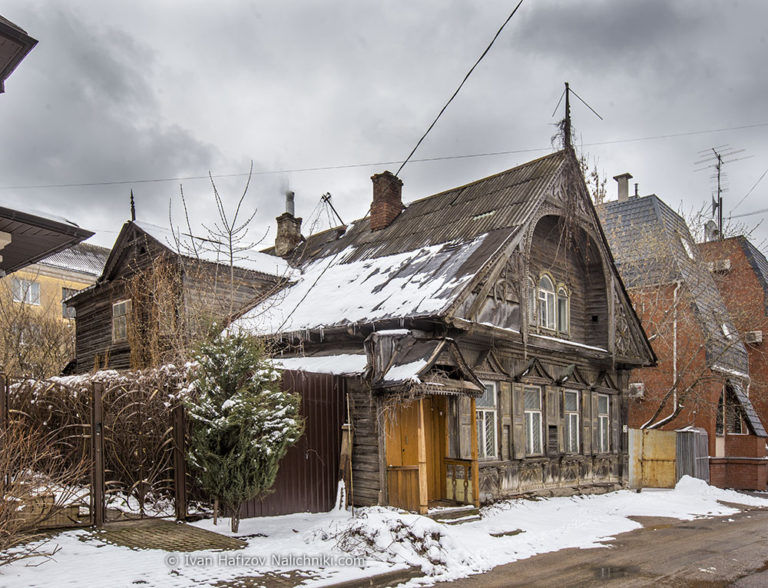
— …Malinovskaya lived here in this house. And then in '39 she sold the top floor, the ground floor, and the cottage. The cottage had been built as a laundry house, no less — that was the sort of thing. She sold it in three parts.
— Was she from the nobility?
— Of course, of course.
— And is her first name known?
— Sofya. Sofya Malinovskaya. Yes… And so she sold up and left for Petersburg, and of course she perished there during the war, during the Siege. Yes… And then the top floor was taken away… She sold us the lower story — and such a gracious woman: we had no money since both parents were teachers, and she said: "I'll draw up the papers, and you send whatever you can." Imagine how gracious. Well, Father kept sending money, and then she died over there, and we never quite finished…
— You didn't even finish paying?
— Didn't even finish paying. And the top floor was bought by some man who opened a — some kind of private… a photography studio maybe… But that was forbidden, you couldn't do that then.
— Why not?
— Well, nothing was allowed back then, it was Soviet times, and that was private enterprise. He opened his own little shop. So they took him away and the house became state property. What happened to him I don't know, but in any case the upper floor was confiscated and made state-owned — first they put a people's court up there, and then it became a housing management office.
— So your family was living here and above you was the people's court?
— Yes, and in the cottage there were always a lot of people. Some Tajiks bought it recently. Then the housing office moved out and now the second floor sits empty. They stripped everything out: radiators, gas lines — everything… Just standing empty.
— Oh, that's bad for a wooden house…
— Yes, seven rooms up there, empty.
— And the second floor is empty while the ground floor is occupied?
— Yes, the second floor is state property — the stairs didn't suit them, too steep and crooked — and the ground floor is private, ours.
— You ought to expand!
— Oh, how?
— Can you not buy it from them? From the state?
— With what?!
— Well, maybe the same way — little by little, payments over time, maybe the state will come around the way Malinovskaya did…
— Oh, come now… — she laughs — oh, really! The state only wants to extract something from someone — don't expect any graciousness from them… Don't expect it.
We fall silent. April snow is covering the street, which is empty except for the two of us and the passing cars, which we have to keep raising our voices over. It's approaching six o'clock; I've been shooting in Tver since morning and only now realize this is the first person I've actually spoken to today: the wooden historical center of the city is almost entirely deserted, and the few people I have seen were talking to each other in some southern language I didn't recognize.
— I was quite young then, of course. I know they were gracious people, and they left for Petersburg, she had relatives there. And what did they do before? What did people do before? Oh, they didn't do anything! — my new acquaintance says with a laugh. — But the whole house was theirs, and they sold it off piece by piece. When they left I was just a tiny child.
— And she wasn't persecuted? I mean, being of noble origin — how did she survive the thirties?
— I'm amazed she wasn't persecuted, because here they mainly confiscated houses, but hers wasn't confiscated.
— So the entire house belonged to her outright all the way until the forties?
— Yes, yes. So… when they evicted that man with his private shop, they moved in several families — seven rooms up there, after all — workers of the NKVD. NKVD workers and their families lived upstairs. Well, they were decent enough families. Normal.
— And when was the photographer evicted?
— Before the war.
…
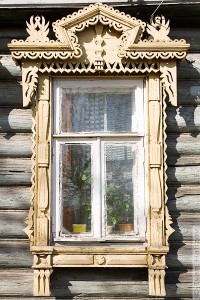
— These first two rooms from the porch, the ones with the flowers — those are mine, and then beyond that it's other people's… My windows are cleaner, although the other people are well-off, they'll probably be putting in new plastic windows. Though the house is protected as a historic monument and they said nothing could be changed. But maybe he'll find a way: go and open the gate later — it opens — and you'll see: he's already added a separate entrance for himself. And when they were restoring a corner, they pulled back the boards and found leaflets hidden under the cladding! Lots of them. But the fool — instead of letting us look at what was written — he took them and burned them. Yes. That Malinovskaya was a good woman, a gracious one — (someday I'll get used to these sudden leaps in conversation, but for now it takes me a few seconds each time to catch up, losing the thread and not quite understanding what just happened) — And what sort of relatives she had in Petersburg I don't know, but they said there was some connection to the Decembrists. Even.
— Well, I'll look that up — maybe there's something written about it somewhere.
— No, it's all sunk without a trace… All of it gone. But look — even up top so many of the nalichniki have broken off… fell away. Because people lived poor. It needed to be painted. In Soviet times everything was in short supply — even paint was hard to come by. And especially if you needed to paint something, there was nowhere to get it, only if you stole paint.
— Come now! Steal paint? — it's my turn to laugh.
— That was the only way. There was nowhere else to get it.
She's standing on the porch steps and I'm on the sidewalk beside her, and even so she's slightly below me. She looks off into the middle distance with a faint smile, and steps easily over half a century as if it were nothing.
— And by the way, there was a competition for the finest carving, and our house won first place. They gave us a prize.
— Well, that's news! And when was this, what year?
— That was maybe… some years… Well, after 2000, maybe eight years ago or so. "The Most Beautiful Carving." I was given first place. Presented with a certificate, two thousand rubles. But back then everything was cleaner, better painted. So first place, because the carving really is beautiful — there's no other like it. Second place went to some other grandmother somewhere across the Volga.
— And where, do you know? I'd find it.
— Oh, maybe the paper is around somewhere, maybe I'll find it… I have such piles of things in there right now, I can't find anything. And they wrote that the carving was done by craftsmen who were still apprentices, still learning their craft… She looks at the nalichniki and changes the subject again, obeying a chain of thought known only to herself:
— Down here too it's all falling off… everything needs to be redone, but there's no strength left to repair everything… Do you know how old I am?
— Seventy? — I attempt a clumsy compliment.
— Going on eighty-nine! — she gives me a reproachful look.
— Well, that's not much, — I smile.
— It is. It is. In another year and a half I'll be ninety. You know, it says in the Gospels that a human life is seventy years, and if the health is good — eighty, and that is the limit. But doctors say a hundred and twenty is the limit of the human organism.
— So you have at least twenty years left.
— Oh no, I feel that I won't live that long…
We both fall quiet. I — because I don't feel I have the right to argue. She — for her own reasons.
— Well, all right, I won't keep you any longer — she raises her eyes.
— May I photograph you? — I ask this often, but rarely get permission, very rarely. And she is no exception.
— Oh no, please don't!
— It's just that the snow has settled on you so beautifully… And with the nalichniki behind you… — I can see she's still wavering, so I raise the camera and add — I'll show you, and if you don't like it, we'll delete it! — then click the shutter several times, crouching a little so the camera is level with her eyes.
— There, look!
— Oh, I can't see without my glasses…
— I'll enlarge it!
— Oh, it's awful, oh, oh! Well, if you need it…
— You're a beauty, what are you saying!
— Well, if you need it, you can keep it…
— Thank you! You know, I want to say a great thank you. I've been walking around the city all day, but the snow keeps falling and no one comes out…
— Don't mention it, don't mention it. My last name is very rare: Blagoveshchenskaya. A church surname.
— And your first name?
— Maria.
— And mine is Ivan.
— Oh! My husband was Ivan. He used to say, "Ivan and Maria — that's us." But here it's Maria at every other house. There's Marya Vasilyevna, over there in that house Marya Mikhailovna, Marya Petrovna… Oh, everyone…
And suddenly, with a visible shiver, as if transforming from the anonymous old woman of one of Tver's streets into Maria Blagoveshchenskaya, keeper of extraordinary stories, she says, already turning back to the door:
All right, I'm going in: it's cold! All the best to you, Ivan.