— Hello! You wouldn't happen to be Viktor?
— I am — yes, hello! — the man opens the door in surprise.
— A woodcarver from Krivandino told us about you...
Andrei Lisitsyn, with whom we'd set out after nalichniki through eastern Moscow Oblast, had done his research ahead of time, and we knock on the gate of one of the most elaborately carved houses on the Shaturskoye Highway already prepared.
— And she also said you were looking to sell the house and couldn't find a buyer... — Andrei continues.
— No, no... — Viktor smiles, seeing our cameras and having probably guessed that we weren't asking this out of any desire to buy. — No, no... I live here... Come on in! — and he throws the gate wide open.
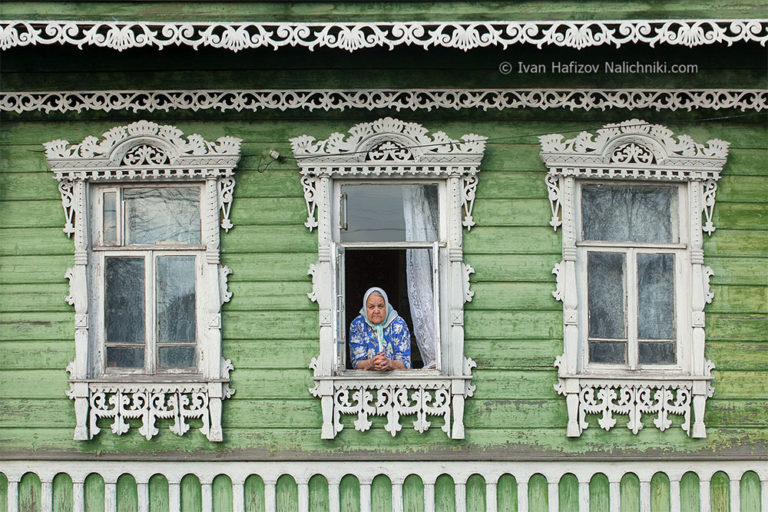
We step into the yard. Of course I'd already looked over the house and the nalichniki from the other side of the highway, and shot what I could over the fence — but when you actually cross the threshold, the white foam of the wooden lacework still knocks the ground from under your feet.
— When this house was built, there was no road here yet, — the owner begins, smiling at our bewilderment — the road ran far over that way. This was built in the thirties...
Viktor is about sixty. Blue tracksuit bottoms, a plaid shirt... Easy to picture him equally as an engineer, or a factory director, or say a driver.
— And when did you... — I gather my thoughts — How did you come to decide to decorate the house? What was the first thing?
— Somewhere around 1990, — he remembers. — 1991... Just like that... The house was built by her grandfather. My wife's grandmother's. — He nods toward the window, where a blurred silhouette shows through the net curtain. — She's still with us, ninety-two years old. Can't see or hear anything anymore, unfortunately... Ninety-two years...
— And how old are you, if you don't mind?
— Sixty-seven. So I've been quietly decorating the house for twenty-seven years now, it turns out. And what started it... Well, I just liked working with wood. Made some frames. Come on, I'll show you.
We pass through the dim porch — taking off our shoes — and find ourselves in a living room, where a woman comes out to meet us, surprised by our appearance. She says hello, but looks at our host reproachfully:
— Hello. The whole place is a mess, and you're bringing people in...
— Well, never mind about that, — I jump in — we stopped dead in our tracks, struck by the beauty of your house!
— And what are you here for? — her voice warms a little.
— For the nalichniki museum! — I smile. — For beauty, basically.
— What's there to see here? Everything's on the outside...
I'm about to answer something, but Viktor's quiet words steer the conversation elsewhere:
— Well, here there's the furniture, so to speak — all my furniture...
Only now do I understand that the living room is entirely amber-colored wood, and everything here is literally carved...
— You made that too?! — I gesture at the room in general.
— Yes, all the furniture is mine, — he confirms modestly — in oak. I don't make furniture out of anything else: pine, all that — this is all oak... The table, the chairs, it's all mine...
— Can I photograph it?
I'm almost sure of the answer, but decide to ask again, and Viktor, to my pleasure, simply nods.
Andrei, like me, makes straight for the nalichniki on the inside of the window:
— You know, nalichniki from the inside — we really need a hashtag for this, #NalichnikiFromWithin!
— I used to have them finished like natural wood, — Viktor tells us — but now I thought: let me try gilded ones! A bit of a splurge! Well, it came out fine. The frames I also made myself. The armchairs too — they're all mine, I made all of it myself.
— Good grief, — I say — all of this by hand?
Viktor smiles shyly:
— Well, with an electric scroll saw, of course.
— Makita? — Andrei, more well-versed in such matters, asks.
— The Makita burnt out, — Viktor shakes his head. — Now it's DeWalt. Holds up. Holds up fine, yes. It's expensive, but I cut a lot of work...
He and Andrei talk about tools for a while as I shoot video, and only a fragment of their conversation reaches me:
— ...And this table here, and the samovar...
— A samovar?! — I can't believe my ears, and step closer to the table. — A wooden one?
— Yes, — he confirms with pride — this samovar here, like for tea. It's oak!
Viktor looks at us as if apologizing, probably both flattered by the attention and thinking we're being excessively amazed by ordinary things — though neither of us has ever seen anything like it anywhere.
— Well it's, sort of, — he introduces the samovar in a roundabout way — actually I just had nothing else to do... These frames here for the photographs I also made myself. And these little plates here. They're oak. Well, I made an armchair, an armchair. Made a stand here...
— So your workshop is actually right here? — it hits me.
— Come on, — Viktor simply turns toward the door with a smile.
— Mind your head! — he warns us going into the workshop.
I duck, and when I look up, what opens before me is probably the tidiest workshop you could imagine.
— Wow, — I say, surprised — everything's so neat and clean here!
— Well, I work here. — Viktor offers this as self-evident. — Here's my lathe. I built the lathe a long time ago. Back then you couldn't get anything. Here's the sander. You clamp the piece, turn it, you want legs, you want — whatever you want...
— Tell me, by the way — when you started decorating the house, were the nalichniki already there?
— There was still something there... Well, from the 1930s — sixty years nobody had maintained them. There was almost nothing left by then. Some elements I restored, some I made myself. I had an old photograph somewhere, and I worked from that photograph. Even now about thirty percent of the original is still there. Thirty percent maybe. On that side I replaced more, on this side less. Where the sun wasn't as strong, they were better preserved. Up top it's covered by an overhang, so that's in better shape. Everything on the roof had to be new — nothing was left.
I look at the workshop and realize I won't forgive myself if I don't take the opportunity.
— May I photograph you here? Right in the workshop?
— Go ahead, — agrees this remarkable carver. And continues:
— I love looking at nalichniki. They dress up the house. It stands there like a bride. It becomes so beautiful.
Then he waits a few seconds while the shutter clicks a couple of times, and asks:
— So? Did it come out?
— Look. — I show him the little screen.
— Well, that'll do. Alright, that'll do. — And, laughing, he adds — Third grade's not defective!
And a second later:
— So what else can I show you? The banya — I built that too. It's a good size.
As we walk over, he talks about the patterns:
— You see, I have somewhere... They gave me books, to cut with them — laser! But I don't like the designs in there. They're uninteresting! I'll put it plainly: uninteresting. My designs are complex to execute, but at the same time interesting. I worked at MosEnergo my whole life. With machines. But evenings, weekends — always carving. But my design is, well, rich. In the books it's calculated for production. One-two-three and off you go — nothing like what I do, nothing this complex, it's just not there. I hired a guy to put it into a computer drawing — he said it's incredibly complicated! Impossible. For them it's profitable to just bang it out, one-two-three and go. But here you have to keep rearranging the composition — it's very hard. The whole problem is with the blades, the blades... Those blades, they come in different types... Good blades got expensive. They went way up in price. The ones I need, they run about 170 rubles each.
— And they don't last long? — I ask.
— Depends how you work, — Viktor smirks. — It's all about how you work. It does wear down eventually when you keep cutting. Especially when you start cutting oak. On the lathe I work oak, I turn it. I have carbide cutters, but they wear down too! Faster than on metal! I have to keep sharpening them...
He opens the banya door and immediately, bypassing all the usual channels and going somewhere deep inside me, waking pleasant memories, comes the smell of heated wood, steam, birch branches, eucalyptus, and for some reason lemon...
— I built this banya myself! — he says proudly, stroking with his fingers the apparently long-painted and now peeling surface of the board by the door. — In winter we're in the banya, I made the ceilings high in there. And the kids are in the house. Kids want to be separate. Especially girls, seventeen years old! They need this, that... And then the internet!
Viktor points indignantly but with a laugh at me, busy at that moment looking up in my phone photographs of nalichniki similar to the ones decorating his house.
— Can't do without it! — I nod. — Can't go anywhere without it!
— The thing is, here's what amazes me: they'll just lie there — there's a wide bed — they lie there and communicate by phone! "Are you coming to eat?" "Coming!" She can't even be bothered to move her tongue to ask! It's just... What a thing, huh!
We walk the yard a bit longer, examining carving details, photographing, finding where the old pieces are on the nalichniki and where the new ones, and then, just before saying goodbye, Viktor suddenly brings up the internet again:
— Still, — he says, as if the conversation on the topic hadn't been interrupted for ten minutes — a television always brought a family together! But the internet divides a family. Divides... That's how it is — human communication, it's stopping! Well, three granddaughters. They're texting each other on the same bed, huh! Well how is that, huh!