

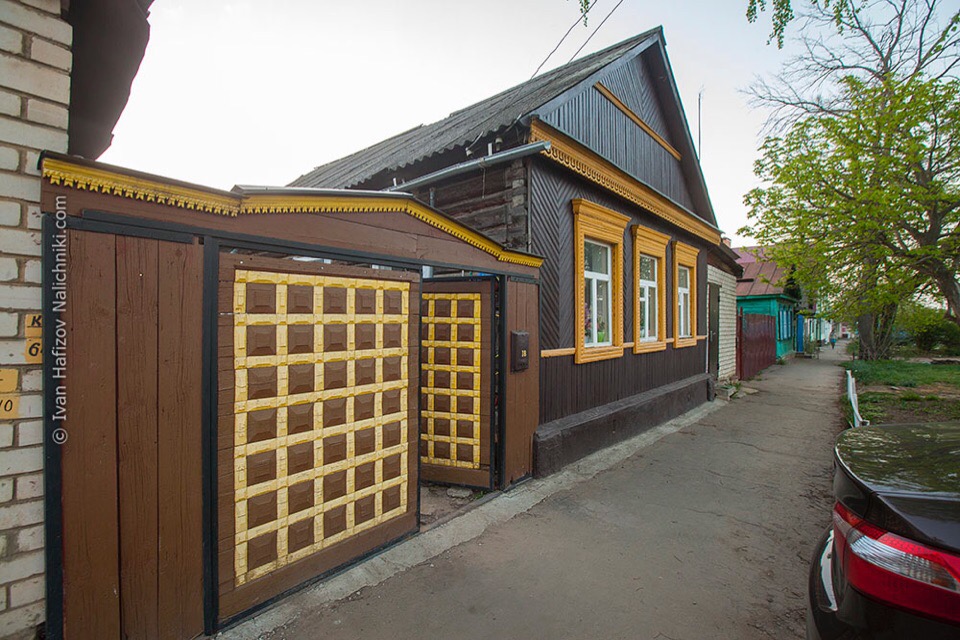
…A woman coming out through the gate happily confirmed my suspicion that this really was the only carved house in Livny, but cheered me up with the news that the carver himself had lived here:
— It was before our time, we bought it. Some uncle carved all this… Ordinary fellow, just chipped away at it by hand, did everything himself. Because his wife was still alive when we bought it, we were curious, and she said: "Everything in there is handmade — he did it all himself." That was a long time ago. A long time. — But the house is postwar? — Of course! Of course! The house is postwar, and he did all of it by hand.
I step away for a couple of minutes to photograph the carving I'd gotten distracted from by conversation, then turn back to find the homeowner has remembered my mention of heading to Yelets next.
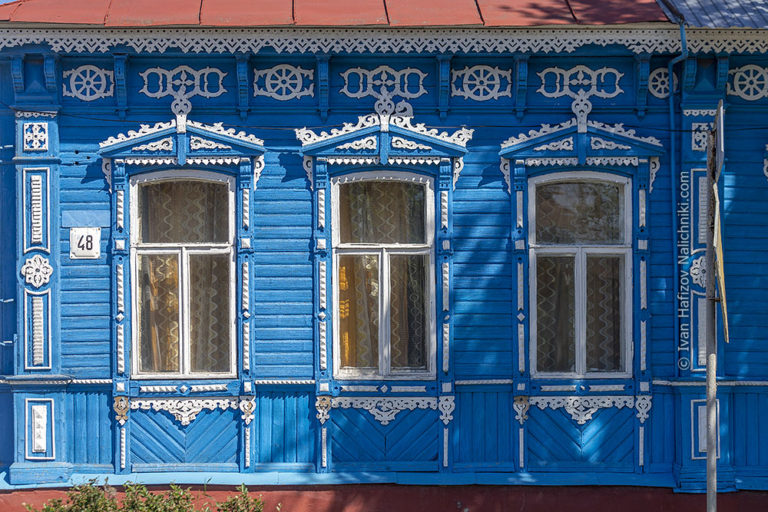
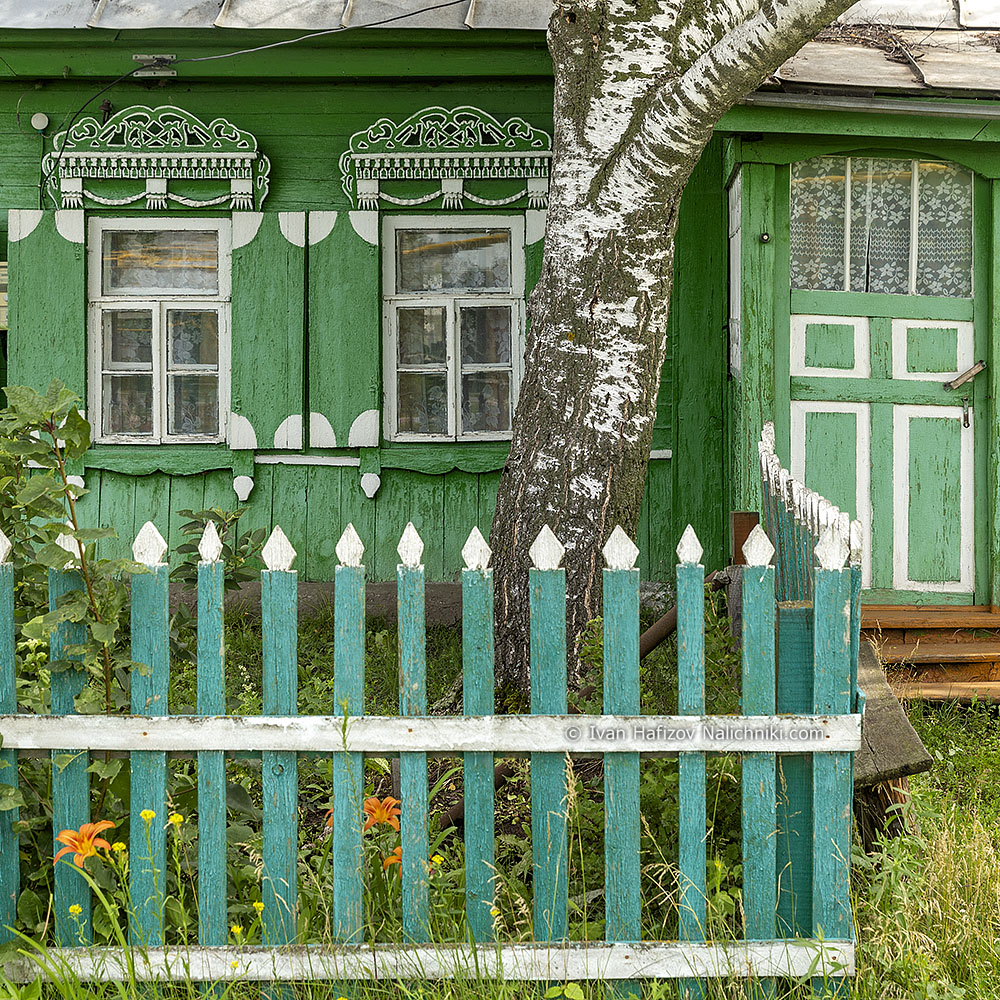
— In Yelets you'll find nalichniki everywhere! Isn't that right, Nikolavna? — A deep, low voice answers from the neighboring gate: — Yeah, — says a stout woman of about sixty in denim shorts and a t-shirt, a bag slung over her shoulder and fishing rods in hand. — Especially in the Zasosnensky district, they're all over the place! They're all wooden there, and beautiful! Here we've got just the one house.
— And how did that happen?
— Well, for one thing, — the fishing-bound woman rumbles on, — all the houses around here are from the fifties and sixties. Poverty years. And this one was built before the war — nineteen thirty. The deed on my house goes back to thirty as well, so they went up around the same time.
— So it's prewar? — Yes! Of course!
— Really? I thought it was postwar! — the homeowner chimes in. — You know, Nikolavna, I never knew that! And here we bought it thinking it was built in sixty!
— Oh, forget it! — Nikolavna just waves her hand. — These two houses… there was one over there, the Sundukovs got it as party members. The old man lived there…
— And she was telling me her grandfather was the one who carved it… — the homeowner murmurs.
Nikolavna just spreads her hands, smiles, and says nothing. I catch her mood and laugh too. The homeowner chuckles along, nodding and muttering: "Well, sure, sure." Nikolavna continues in her remarkable chest voice, carrying and full:
— He was the district party secretary. Listen, I'm explaining how apartments were handed out… There were kulaks, and then collectivization. A kulak — what was a kulak? Someone who worked, really worked, and earned a bit more… while owning the same one horse as everybody else. Or another way they'd kulakize you: — here she uses the word "kulakize" to mean "dekulakize," which only registers with me toward the end of the conversation — you've got three cast-iron pots? Time to kulakize! … Third version — Sundukov told me himself: he'd been a land surveyor, out in Central Asia, and he said: "You know how they kulakized people in Central Asia? Kazakhstan? A man has five, six wives — must be rich." In other words… yet another approach…
She suddenly sets her bag down on the sidewalk and, smiling, announces the reason she's kept her examples so brief:
— Listen, if I keep talking I'm going to miss the whole fishing trip! This would take forever to explain properly!
The homeowner and I both laugh; she tells me to let Nikolavna go, but I suggest we walk together to the river — I really do want to understand who, how, and above all why anyone was kulakizing polygamous kulaks in Central Asia. But she's clearly decided to leave, so she swings her bag back onto her shoulder, adjusts the strap, and sends me off with:
— When you drive to Yelets, you'll see lots of those houses along the road, beautiful ones. Yelets is an old city…
I interrupt:
— But Livny is old too, and yet…
— Listen! — She stops me sharply, impatiently pulls the bag off her shoulder again and sets it down hard on the sidewalk. — You understand, they were building everywhere, collectivization happened everywhere. They demolished churches everywhere, didn't they? — she gives me a questioning look.
— Well? — I nod, impatient.
— Well, why did Yelets have thirty-three churches and still have thirteen left…
At that moment she glances over my shoulder at the road, where a motorcycle engine happens to rev especially loud, and calls out: "Serving Russia, my friend! Catch anything?" I turn around: a man of about thirty is parking his motorcycle beside us, also with fishing gear on his back. He kills the engine, and then — or as much as that powerful voice ever allows — she adds with a laugh:
— There's a young man here who's interested in history and so on and so forth, and I'm telling him fairy tales of the Vienna Woods.
The motorcyclist doesn't betray a flicker of surprise and only asks:
— Valentina Nikolavna, are you coming or going?
— Going only. I'm a traveling frog! — she announces cheerfully to the motorcyclist, who's already starting his engine again, and carries on about the churches:
— They demolished every last church in Livny. Every one. But in Yelets twelve are still standing! There are more all over the region. Bolkhov — also Oryol Oblast — that's a city of churches too. Soviet power was there as well. So does it all depend on the local population? On local people? Not on Soviet power! On the people themselves! Get it? All right, bye!


5 comments