

What is there to do when, despite all efforts to promote the museum of carved nalichniki, only 14 people have responded to the crowdfunding so far and only 2% of the necessary sum has been raised? Keep showing the beauty of our nalichniki. And today: Tarusa! The railway, which had such a beneficial influence on the industrial development of other regions, bypassed Tarusa. That this was fortunate only became apparent a hundred years later — as with Myshkin. Today Tarusa is one of the most "unhurried" cities I've had the pleasure of visiting. A permanent siesta seems to have descended on this city.

Tarusa is quite small — you can walk it without any difficulty. Population-wise, it's about the size of Suzdal. But where Suzdal is touristic and decorative, Tarusa is its opposite — very introverted. No postcards, no tourist center, and the best eatery is the "Oka" canteen with a view of the river of the same name.
If not for the rhyme, the third slot in the slogan "Russia has three capitals: Moscow, Petersburg, Lukhovitsy" should by rights belong to Tarusa. I haven't been to Lukhovitsy, but Tarusa has everything needed to be a capital.

To be more precise — Tarusa resembles a "former capital" of a country. Small, but very proud. And the number of cultural figures who lived here at various times is simply staggering!

Here at various times lived — intermingled, for variety's sake — the Polenov family, the Tsvetaevs, Borisov-Musatov, Vatagin, the Vinogradovs, and also Paustovsky, Brodsky, Chekhov, Akhmadulina, Novikov-Priboi, Tarkovsky, Solzhenitsyn, Ginzburg, and many others.

The Tsvetaev museum, if I'm honest, didn't particularly move me. What moves me far more is the thought that since they lived here, practically nothing in the city has changed.

And the nalichniki certainly stayed the same.

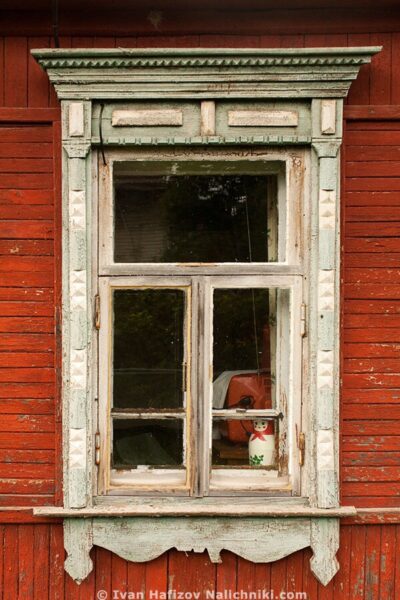
A traditional Tarusa nalichnik is right before you. Three slightly decorated boards — at the bottom and two sides — and a more lavishly decorated characteristic crown.


And such a form of decoration exists nowhere else: curtains cascading to either side, and what looks like a hanging amulet in the center.

Here — the same details. One can only guess: were there originally more elements at the top, or was it designed this way from the start?

This is a later nalichnik, from the mid-20th century. Yet its upper section is quite in line with the carving traditions common in Tarusa.


And this is the strangest nalichnik I've ever seen. I don't know what was done to it, but most of its details are broken beyond recognition. And this is the best-preserved one on this building.


What was pleasing was how hospitable the people of Tarusa were. Perhaps because quite a few tourists come here in principle. Perhaps for other reasons — but somehow it happened that everyone tried to help and advise on where to find more beautiful nalichniki and how old they were.

On the topic of house carving, the question of correctly determining a nalichnik's age comes up frequently. Most often the house's owners can answer with near-certainty.

But not always. Then one can get one's bearings from the average age of the neighborhood, street, or block where the house stands. The age of the street will often coincide with the age of the house and its nalichniki.

If even that is unknown, one can get an approximate sense from indirect signs: sometimes from the condition of the house or nalichnik; sometimes from the shape of the window opening; and sometimes even from the type of carving — fretwork nalichniki are as a rule younger than those with applied or relief carving.

Unpainted nalichniki in regions where all are traditionally painted are either very old (like this one, about 130 years old) or very new. The latter can be spotted by the condition of the wood.

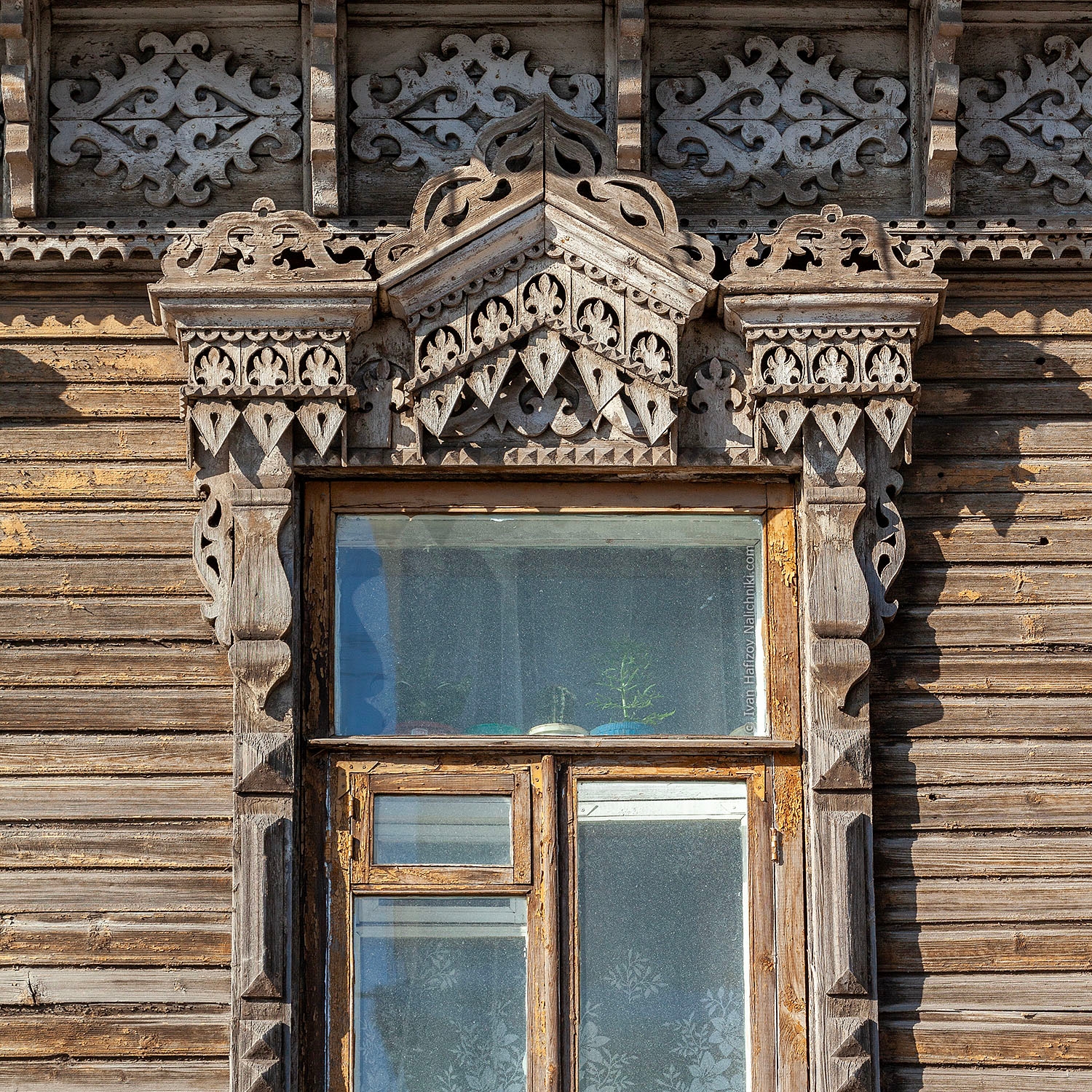
Here is yet another nalichnik characteristic of Tarusa. All of them date to the late 19th century.

The last ten nalichniki I'll leave for you to look at on your own. Without commentary.


Finally — a picture to remember: the most popular element of house carving in Tarusa.


7 comments
Чудные наличники.
И тем что раньше творили, и тем, что сейчас не забрасывают это дело.
То, что они сохранились - и ваших рук дело тоже :)
Так что вам спасибо!