

A mosaic of Povorino window nalichniki
In the search for interesting nalichniki — in the search for the origins of this or that curl in the carving — you sometimes end up in a city you've never heard of before. Povorino is exactly that kind of place. Even the spell-checker in my word processor has never heard of it. But in Voronezh they said: "Go — there are nalichniki there" — and so I went.
And I was not disappointed. Because it was this town in Voronezh Oblast that turned out to be the birthplace of the "crab" in the nalichnik crown I'd been hearing about in Voronezh. What's more, the Povorino nalichniki proved interesting for having absorbed the traditions of both Voronezh and Saratov Oblasts.
I also learned something in Povorino: people building new wooden houses will often travel to abandoned villages, take nalichniki off old ruins, restore them, and hang them at home. That way the nalichniki get a new life — and we get an unsolvable mystery of provenance. Because there's no village left, and there are no roots to trace.
I arrived in Povorino from Bobrov, on a train coming from Ukraine bound for Kazakhstan. I remember walking back after a fifteen-kilometer outing, arriving at Bobrov station at 12:25, and finding the ticket window closed from twelve to one for lunch.
"What am I supposed to do?" I asked the staff.
They shrugged: "Well, you're not a child, are you? Work it out with the conductor."
So I was essentially required to offer a bribe to the conductor.
But waiting for me in Povorino was a feast of nalichniki, preserved in large part because the city was not burned to the ground in the Second World War — unlike nearby Bobrov or Voronezh, where little survived.
Also waiting was a disappointment with local dining, which came in exactly two forms: a restaurant hosting a wedding (not for me); and a humbler establishment hosting a wake, which took me in and gave me the most wonderful borscht. For which I remain deeply grateful.
But I digress. The Povorino nalichniki are, almost without exception — crabs.
Not actual crabs, of course, and really not crabs at all — but the first curl I encountered in a nalichnik crown was exactly this shape. See for yourselves.


There it is at the top — the crab, the first one I met.

Here too — something like that crab, though less immediately recognizable.


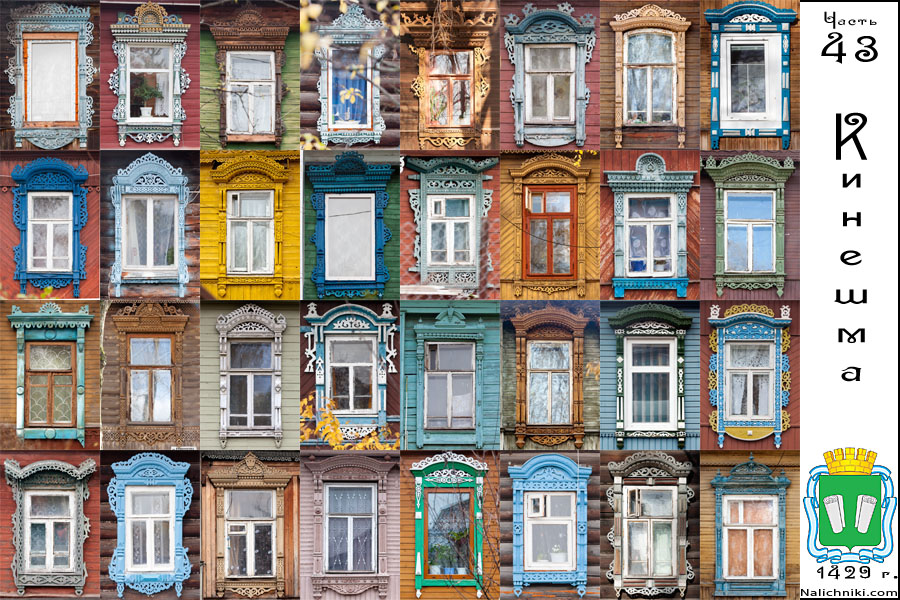
The attentive reader will also have noticed another feature of the Povorino nalichniki: their color. The overwhelming majority of owners have painted them blue and white. Most — but not all. This is only part of the Povorino collection.


Single side columns are also very widespread here — not double like in Kostroma, but single.


Sometimes the crab degenerates into two figure-eights like these. None of the locals I spoke to had any idea what it might mean.


An unexpected nalichnik, non-traditional for Voronezh Oblast. I can't say anything about its origins yet.


The columns again — a five-row frieze at the crown, and that impossible crab, which here is clearly of botanical origin. Also note the very bottom of this nalichnik: triple and quadruple tassels are another popular detail.


This nalichnik is also not local. Looking a little ahead, I'll say that its relatives turn up in Saratov Oblast.

If I haven't mentioned it yet: arrows and diamond shapes like these appear everywhere, because this is one of the oldest solar symbols. So I don't particularly search for their homeland.


It's interesting that while most cities paint their nalichniki a single color, the people of Povorino use two, traditionally alternating them or highlighting the projecting elements.

Putting this together I noticed yet another Povorino feature — the motif used in the lower section here, for instance. And it appears in different parts of the city.


A little more blue and white.


And with that, the tour of Povorino comes to an end — though not all the nalichniki photographed here made it into this selection. I hope one day to organize an exhibition where every last one of them will be on show.


5 comments
А шторы - это вы правильно подметили - это вообще целый мир! По ним многое сказать можно... Вот здесь кружевные в пол-окошка, а там серые, засаленные... А в ином месте и вовсе газетой заклеено...
Я люблю смотреть на наличники ,иногда беру какой то орнамент для себя ,чтобы выпилить!Это целый мир и он мне нравится!
Это распространенное заблуждение. Многие жители Кемерова уверены, что оно не склоняется. И в Поворине та же история и в Одинцове. И каждый второй работник Домодедова тоже уверен, что оно не склоняется.
Но правил русского языка никто не менял — все топонимы заканчивающиеся на «о» склоняются как обычно.
Если погуглить, то можно раскопать, что отсутствие склонения — это канцеляризм, просочившийся из военных документов, когда вместо "полк стоял возле Поворина" писали "полк стоял возле г.Поворино", потому что если склонять, то не ясно как назывался город "Поворин" или "Поворино".
Но это бумажный язык, а не живой, в нормальной человеческой речи всё склоняется :)