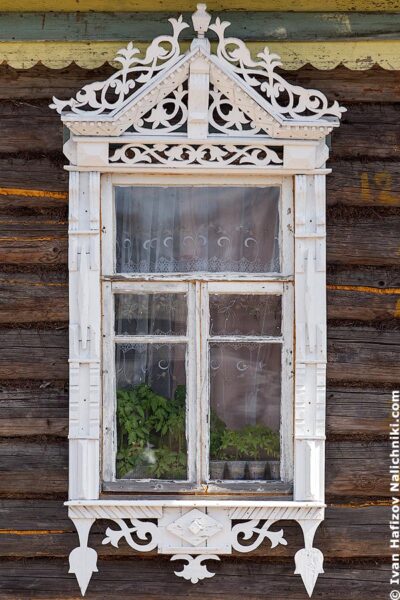
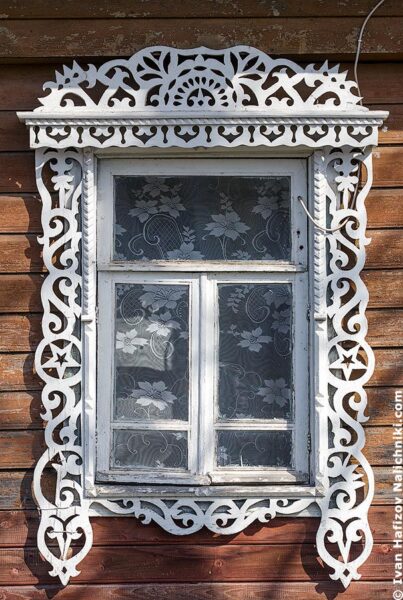
I was just thinking — I usually try to show contrasting nalichniki from different regions or of different types, and always as different as possible from each other. Ivanovo after Udmurt nalichniki, or Mari El after Buryatia, for instance. Sometimes "colourful" follows "unpainted," but that's more the exception. But there are other axes along which nalichniki contrast.
One of these axes is time!
The Tutaev ones are from the early 20th century, and these — the 1950s, and from neighbouring Poshekhonye (yes — the place the famous Poshekhon cheese is named after! :) I particularly love spotting birds on nalichniki — in some cases they're not at all obvious!))
It's worth pausing on something we usually overlook when looking at patterns: there are two ways to create a 'picture' in wood. The first is when excess wood is removed and the image is formed by what remains. Birds and leaves are carved this way — it's by far the most common approach.
The second is rarer (I'll show it tomorrow) — the pattern formed by slots, not wood.
As for birds: after 1949 the dove became especially associated with peace — though it had that meaning long before, as anyone who knows the story of Noah's Ark will recall. But most of these nalichniki date not from the Flood but from the 1950s :) And as a bonus — the last one in the gallery, which is clearly from an older era. The birds there are something else entirely. P.S. Alongside the Poshekhonye birds, a reminder: two days left to pre-order the Non-Nalichniki 2024 calendar — I'm sending it to the printer on Monday. Are you in? :)
The link is here: https://planeta.ru/campaigns/nenalichniki-2024
And don't say later that I didn't warn you :)