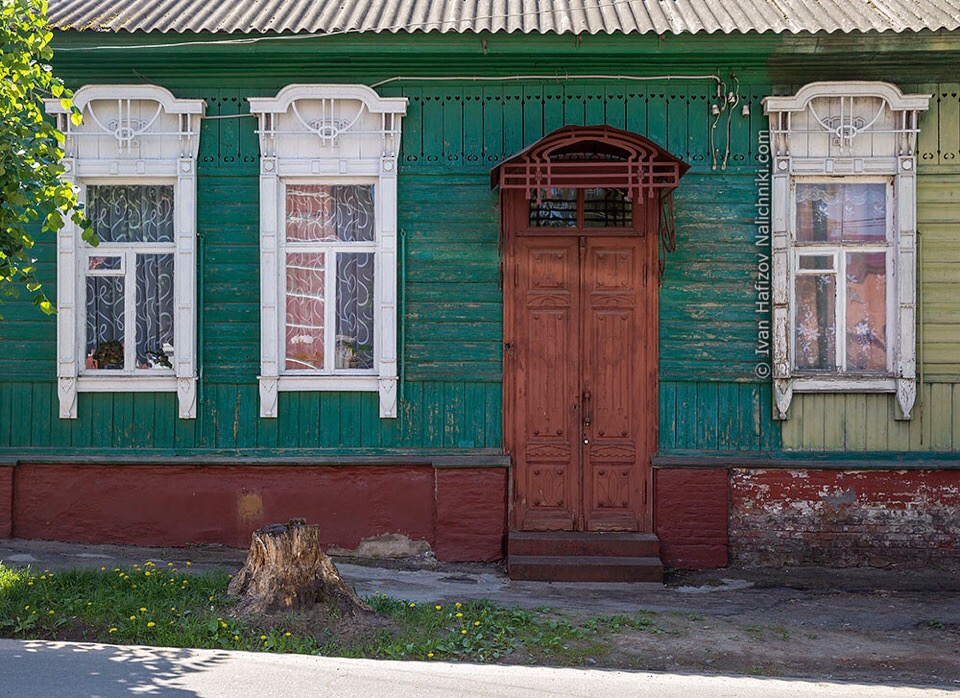
...I’ve been travelling around Penza Oblast — many interesting things. It’s too early to draw conclusions, but: in Kamenka the gables have semicircular windows (exactly those in the photographs), in Narovchat the houses are painted in two colours — not the nalichniki, but the houses themselves — a sort of coloured stripe, usually yellow, running across the middle (I’ll show that separately), in Serdobsk the carved eave boards have their points facing not only downward but upward too (which simply isn’t supposed to happen!), and everywhere — Penza included — there are masses of carved scroll brackets supporting the eaves: sometimes as many as five to a meter. Remarkable.
Serdobsk is the discovery of this trip: I somehow couldn’t find any accounts of its wooden architecture beforehand, despite it being an old city. The nalichniki here are massive, many have survived, and the locals are happy to point out streets and spots where interesting houses still stand. Highly recommended. And the cats here are exceptionally friendly.
The roads in the oblast have been excellent so far, and the hotels too. Though I still have a lot of ground to cover, so they’ll have plenty of opportunities to show their other side.
One interesting encounter today: a woman told me about two houses standing side by side, built in 1903 and 1908. One, she said, belonged to a priest — and above his porch the decorative carving resembled a priest’s ceremonial headdress. The second house he built for his daughter, and above her porch the carving was like a kokoshnik.
And that, she said, is how the priest put two houses on a single “posva”.
I asked her to repeat: on a single... what?
She clarified: posva — a plot of land, that is, a single piece of ground. I had never heard the word before.
The priest was later dispossessed, as it happens; the houses were given to a hospital, and two surgeons moved in, both distinguished — one a gynaecologist, whose wife was a dentist, and the other a general surgeon, whose wife was a teacher. “That”, she said, “is unfortunately all we know about the history of these houses.” Everything gets mixed up like this: the savior of souls was evicted; the saviors of bodies moved in.
A boy also took me around the streets of Serdobsk today. About eight years old. “All the houses here you can photograph,” he told me, “except this one” — pointing to an unremarkable-looking house completely clad in roof tiles — “a policeman lives there.” “Well, it’s the least interesting one,” I said. “But it’s the biggest,” my guide shot back. Hard to argue. Although on a street of houses with two or three windows each, that’s not hard to achieve.
Remarkably compact, the way people lived here.
As usual, I shot about fifteen hundred frames. I remember back in 2007, when USB 1 was still the standard, the photos — which weighed considerably less back then — would take a full two hours to upload each night. Now the transfer speeds are far higher, but the files are much larger; the detail is better and the noise less, so the upload and first pass of sorting still takes a couple of hours. Progress.