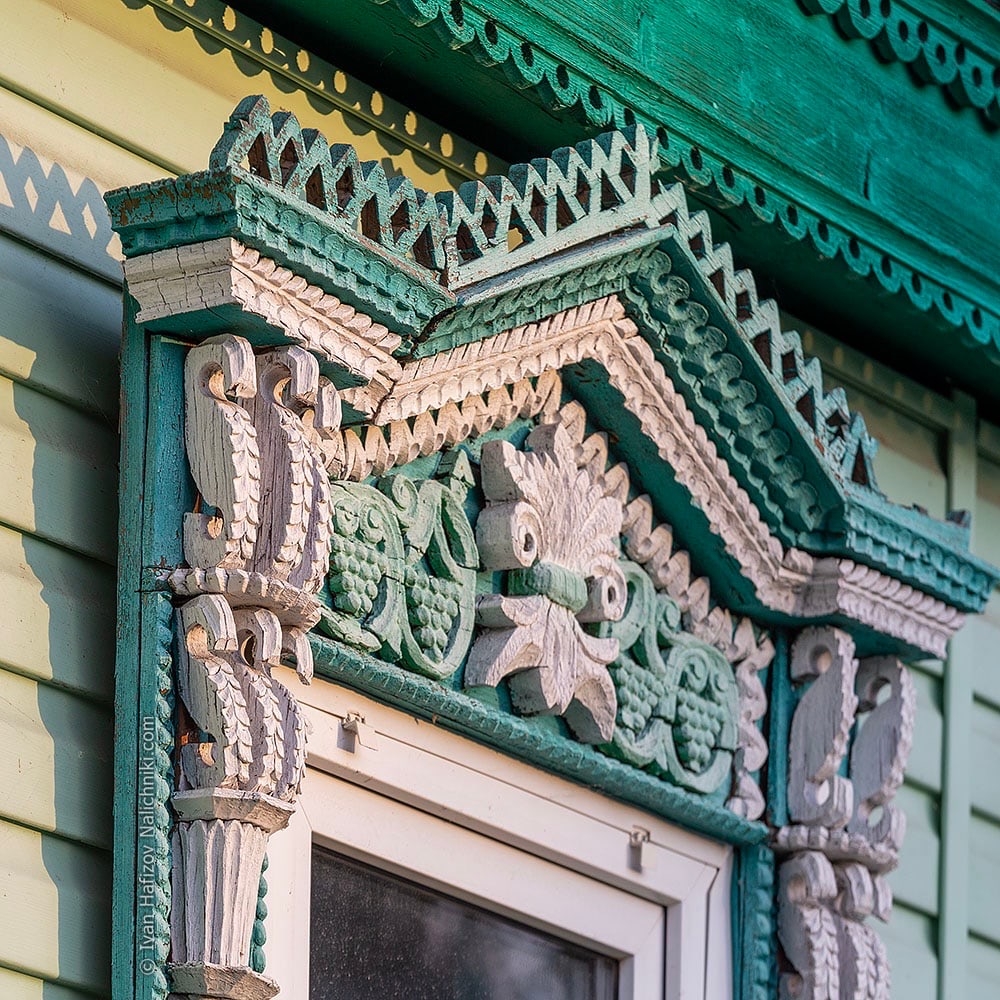
…— Have you been to Vagulino? — the grandmother — the first living soul I've encountered all day — is sitting on a bench that's been broken for a long time, her back to the nalichniki, which have lost their shutters over a century and a half but not one bit of their extraordinary carved beauty.
— Vagulino? — I echo (the name sounds familiar) — I think it's on my list. Isn't that where something terrible happened? Where nalichniki were stolen?
— They didn't take them right away — they wanted to, but they didn't get them out. Whether they copied them or not, I don't know.
Her voice is creaky but clear. If you looked away you'd never guess her age. And she says "they" with this old-fashioned emphasis…
— How did it happen? When was it, when they were cutting them off — there was a photographer there before them. He'd marked the place. Then these men came at night, they got in, and the woman was alone there. She got frightened. And she died. She scared herself to death.
— Right there and then? — I'm amazed.
— Well, not right then. A little later. They told her "Don't go outside," and they started sawing off the nalichniki. Cutting them. But she went into the yard, climbed out through a window. And she ran. Ran. And there she raised the alarm — folks came with a rifle. But she'd been so frightened she died.
— And the nalichniki — did they steal them after all?
— No, they didn't take them. Didn't take them. They ran off. But they came back, a week later, after she'd already died. And took them… One window was left, someone must have scared them off again. I don't know if they made copies or not — I haven't been.
— What a nightmare… — I can hardly believe what I'm hearing. — Do people come to photograph often here?
The nearest paved road is twenty kilometers away, and the city is about fifty. Hard to imagine this village being popular with tourists…
But the grandmother sets me straight:
— Many people come here, many, very many. And they've been digging around. Photographing everything. Very many. They'd get into everything, climb up into attics, poking around everywhere, like this — the old woman shows the characteristic sweep: a long stick, left and right across the ground.
— Metal detectors! — it hits me. — Looking for something old underground! Stick swinging like this, left and right?
— I don't know what they were looking for, — the old woman says, staring off to the side… They asked things, yes… About where the old houses used to be, long ago, when there were still houses there — she lifts her stick and points toward a field overgrown with young birches, and falls quiet.
I look at the distant hills, the forest as a stripe along the horizon, trying to find any trace of structures, to imagine the large villages that once stood here… and there's nothing… just field and more field… only a power line cutting diagonally across the whole panorama… I wonder if there's any view left in central Russia without one?
— They asked. — she repeats her last words. — Kept asking. And then two men came, and a woman. Said they'd raise the pension. Talked like that, talked and talked.
— What do you mean? — I don't quite follow — it seems she's telling a different story now. — What were they there for?
— Well, they fool us like that. There was a meeting of some kind. They said there'd be a pension raise, sign here and here… I don't know… And we pricked up our ears and listened. But a woman of ours was coming along in her Zhiguli — she works at the village council — and she says: what are you all listening for? They're about to pull one over on you. But these people kept going — the man read and read, all very smooth and polished, told us everything so nicely… And nothing. Nothing changed. Same as before. What had he been reading? What were we signing?…
— No young people here at all, are there?
— Nobody. There's nobody anywhere around here. No young people whatsoever. No men either.
— None at all? — I'm surprised.
— Not a single man. Here I am, eighty-two years old. That old woman over there — she's eighty-seven, going on eighty-eight. That's it. In Alexandrovka there's one — retired, a drunk. One man. In Pogoryolki too.
— So there are only two of you in this village — it finally sinks in — good God.
— That's how it is in all the villages now. The dacha people come out on weekends. And that's that.
— Surely it's not everywhere like that — I say — I've driven through villages in winter where all the houses were lived in…
— That's where the road goes past. Or where it's black-earth country… black soil, there it might be different. But here there's nobody.
— And 'black soil' — what does that mean? — I ask.
— Well, black soil… — she repeats pointedly. — Where the earth is black. Here we have a green zone. They put up a barrier over there — you can't drive past.
— What's there? They guard the forest? A nature reserve?
— We have a nature reserve here, yes. Our governor bought it all up. Everything here belongs to the governor. All the lakes we have — all our lakes — he bought them all up. Bottom half of everything here, his.
— The governor has a dacha here?
— No, no dacha. He just bought it all up. All the lakes.
— What for? — I ask.
— I don't know, — she laughs — he's rich, so he bought it. He flies here by helicopter every day. His wife died, so now there's another one. She was young, so he took another young one. And he himself looks like a little pig. So now he's here every day. Flying around.
Here the old woman looks at me directly, with the air of someone entrusting a great secret, and whispers loudly:
— Maybe they'll get rid of him. From Moscow.
— Is that likely? — I smile at her air of inside knowledge.
She smiles back:
— I don't know. Only he doesn't love our land. He only likes to buy things. But as for the rest — no.
Then she looks into the distance for a few seconds and adds, as if not to me at all, talking to herself:
— No, I think they probably won't. They'll outlive us all.