…"It's beautiful here, isn't it. You still haven't been to Peschanka, haven't seen the Bukhta."
"What's Peschanka?" I ask.
"That's the seashore — sand there, a sandy beach, so they called it Peschanka."
"Is the sand unusual? Or is it rocks everywhere else?"
The driver thinks it over.
"No, regular sand... Kind of... half-white, half..." He pauses again, then produces something complicated: "half-God-knows-what. But yeah, white. They take it for road surfacing."
"There are good places to rest around here. Tyoply Klyuch, that way — there are springs, three of them. Radon, some other kind. People make the trip."
I'd met our driver five minutes earlier at the Plastun airfield — if you can call a dirt runway and a wooden ticket office an airfield.
"Yura!" He reached out his hand, offering his services. "You're tourists, then, or?"
"Something like that," I said, not wanting to get into it.
"Hop in," he said, throwing open the door of a battered right-hand-drive Toyota. "I'll show you around!"
So off we went.
"Plenty of tourists come. People from the cities — Ussuriisk, Vladivostok, Khabarovsk, and even further, from the Amur. I just go north for fishing in summer. I've got a second car, a jeep. Bought it without papers, for getting around up there. No traffic cops here. You just go."
"What do you mean, without papers? No plates either?"
"No, I put on some fake ones. So the car doesn't stand out. Brought in a knock-down kit, ordered it from Japan, they shipped it. A full SUV, an eighty-fifth." He shows me a card.
"And what happens if the police stop one of those kits?"
"Five-thousand fine. And if you're running fake plates, they take your license for a year."
"Oh!"
"That's the document fraud charge. Fake plates — illegal. But now there are these groups, 'DPS-Control' and all that — the moment they spot a checkpoint leaving Dalnegorsk, word goes out instantly. People who know the score take taxis if they need to go somewhere. Or the more careful ones work around it — don't go all the way to the intersection (you know where they post up anyway), park short, walk out to the road, wait for someone going through. Ask the driver: if they're standing there, flash your brake lights three times so the taillights blink. Then he's in, and you're off. Though now it's easier with" — he points at his phone, meaning the driver chats — "Before there were local cops here. They cleared them all out."
"You could make a deal with the locals?"
"No — the locals were actually the worst shakedown artists. The minute they shut the local station, I bought my first knock-down kit."
"Can't you register it?"
"No, you need papers — the frame needs papers. You could document it in theory. They take it apart in Japan — body separate, frame separate, engine separate — and ship it as parts, taxed as parts. Here they put it back together: perfectly good vehicle. Bringing in a whole car, the duty would kill you. And it's twenty-three years old, nothing passes inspection anymore at that age..."
We drive in silence for a while. Dirt road; gravel ticking against the undercarriage, a tail of dust behind us.
Road signs are riddled with bullet holes — a few in some, a couple dozen in others.
I ask the driver about it. He laughs:
"Well, what do you expect — the countryside! Up north they're all shot through."
Then quiet for a moment:
"People around here are like that... shameless. The village kids bend the signs, rip them out. The generation that's growing up now — always on their phones, on their computers. Back when there were no phones, none of this happened..."
"And I wonder who gives them all those devices." I smile.
"They whine for them, what can you do!" He laughs with me. "Progress moves forward, everything moves... How can you not give them? And besides, there's that — 'everybody has one except me.' Nothing worse than that. I remember a kid on our street when I was in school who didn't even have a TV. Kids made his life miserable. So you don't want that for your own..."
Hard to argue.
"There's a waterfall here too..." Yura suddenly remembers his promise to be a guide. "Thirty-something meters. Chyornyi Shaman. There's a gorge called the Devil's Mouth that goes down to it... It's interesting to drive around out here. Sometimes people post in the group: 'Going to Chyornyi Shaman, putting together a group, three thousand apiece.' Then they stop at Svyataya Yelena, then Tyoply Klyuch..."
"What do people do out here? Locals, I mean. There's the nature reserve. Logging, I know. What else?"
Yura doesn't answer right away.
"That Terneysky reserve — biggest in Primorsky Krai. Looks beautiful, but the salary is twenty thousand rubles. Who's going to sit there for that? Either you do shift rotations, go up north, or... what? Nothing here. Loggers. That's it. Nothing."
"And services? Entertainment, businesses?"
Yura has his own idea of the service sector:
"No real auto shops, just garages. There's a hairdresser. No hospital. Fire station, school. A store, sure. Merchants!" He waves dismissively. "Before — I remember — there was nothing. You needed something: a three-hour drive. Now there's this one woman in the center with a shop. But she —" his voice changes, something clearly chafing — "she ships in Chinese junk from Ussuriisk. Finds it somewhere, someone stamps it for her... Merchants! She's renovating her whole building, new windows, everything done for her... Merchants! Tight people, those. I used to drive them to Ussuriisk for goods. They'd never pay a ruble over the price... My salary is thirty-one thousand."
"A taxi salary?" I'm surprised it's a fixed figure.
"No, that's my job. Day on, three off."
"And what do you do?"
"I'm not going to say." Yura shakes his head — clearly a long-standing policy. "A friend of mine got me in; you can't just walk into this place. Together, my wife and I — my job plus the taxi, and her work — we bring in fifty-six thousand. Fifty-seven. The two of us. A month. Plus every other year we can take a vacation."
"Every other year?"
"Once every two years, our employer covers train tickets anywhere in Russia. Military families get it every year; we're civilians, so every two years."
I'm surprised — I'd never heard of this arrangement. But the math still doesn't add up:
"So how do you actually manage? Prices here don't feel any cheaper — they're Moscow-level..."
"Prices are astronomical," Yura nods. "But we have a garden. We don't buy potatoes, carrots, onions; tomatoes and cucumbers from the greenhouse... Meat — well, someone brings one down, I put in an order, paid for it, done."
"'Brings one down'?"
"Hunters. You put in an order for a goat, say, and they call you: come pick it up. No problem at all on that front. And people poach, you know — nobody thinks it's all by the book. Manchurian deer, wild boar, roe deer, red deer... bears... If you just try to live here by the law, you'd starve to death. A hunting license — how much does that cost? Seven thousand for one boar. You bag it, you have to close the license. Nobody does that; they take them by the dozen. Who's going to pay seven thousand for a license for one boar? I'd rather spend seven thousand on store-bought meat and not even bother going out — and you might miss anyway! People live for the day out here... live large... But what can you do?" He lets go of the wheel and holds his hands out as if apologizing, though I haven't said a word. "Everyone knows there won't even be this much before long. Nature isn't infinite..."
Considering, I think, that we've been driving for an hour through empty forest, and that forest goes on for another three thousand kilometers west...
But Yura doesn't let me drift:
"They slaughter crab something terrible. Poaching there too."
"Why?" I don't follow.
"What do you mean?" he says.
"Why do they prefer to poach instead of doing it legally?"
"That's how they earn. That's their income. If they're caught, fines up to a million and a half. They just pay it and keep going. My relative — he says if he makes two hundred thousand on a trip, that's a bad day."
"In a day?" I think maybe I missed something.
"Yes! And sometimes up to a million."
"So why isn't everyone doing it? If it's that profitable?"
"Well, there are costs — it's not free. Motor, boat, traps, licenses — you do buy licenses; one license used to be five hundred and something for two crabs. They buy twenty just to have some cover. But they're catching hundreds."
"How much does one crab go for?"
"Gift-quality, eight hundred or so. Probably more now. Before, China was buying everything; now the border's closed, so it's all domestic."
He goes quiet for a few seconds, then delivers an unexpected conclusion:
"But even they don't live all that well. Nobody out here lives particularly well. Mostly people leave because there's no work, and no hospital — that's the main thing — no hospital, nothing. There was a fish plant, out in Svetlaya further along; they closed it. Our country, like always — nothing is worth doing here. So it closed. Now they're doing fish farming here. They raise chum salmon, release the fry. That just opened last year. Nothing here, a dead end. Look at the roads."
"The roads, yeah," I agree. "I'm amazed you can drive at this speed."
"When there's good asphalt you do a hundred and ten."
"Is this good asphalt?"
"Excellent! Up ahead, Dzhigit — where Lanrok went through — that's where the bad patch is."
We drive over a small pass. Dusty, two-metre slabs of broken asphalt alternate with stretches of exposed dirt three times as wide. No one coming from the other direction, so we drive the left lane — the right looks more like an obstacle course.
"Lanrok?"
"Lanrok. It started in the Philippines — that's where the name comes from. That's where all the typhoons originate."
"What happened at Dzhigit?"
"There's a bridge there. The water rose two meters above the bridge. I don't know how it held."
"Do we go over it?"
"Yeah. No asphalt left though — the current took it. Two hundred meters maybe, and that's it. It's probably lying in the river somewhere. And logging trucks run through here all the way to Plastun — offload in Plastun, load onto the big ship, and off to Japan."
"Just raw logs?"
"They do lumber and plywood too... I'm not sure if they're still shipping round timber. Before it was mostly round timber."
A couple of cars come the other way; we move back to our own, much rougher lane and slow down considerably.
"When did they last pave this road? Forty years ago?"
He nods but pushes back:
"Not Soviet times... around ninety-eight. And they didn't do it all in one stretch — took years, maybe seven. The road crews — that year — holes everywhere, and they're painting lane markings. I laughed: people are driving on the wrong side, and you're putting down markings. Asphalt doesn't make sense out here anyway — they haul it from Kavalerovo, a hundred and eighty kilometers. To Plastun. Another sixty to here. In the settlement they're pouring concrete now, cheaper than asphalt. Fifteen centimeters down. Concrete ends up cheaper than hauling asphalt this far. These logging trucks have destroyed the road —" Yura gestures ahead with a grimace — "what asphalt survives fifty tons rolling through it all day? None."
As if on cue, a truck appears from behind the hill, loaded to the gills and pulling two trailers. Black smoke from the vertical stacks and a slow crawl make it clear the grade is genuinely hard on it.
"That logging company — the owner is local?"
"Of course. He lives right here in the village, everyone knows him. Lord of all he surveys."
"So the roads are destroyed because of one man?"
"What's he supposed to do? He pays good taxes. But all the money flies straight to Moscow. If it stayed here, they could pave this road five layers deep. He makes his cut too... And of course they don't pay for the overloads..."
He sits up straighter, clearly remembering something, cheering up a little even.
"Let me tell you — so you understand how business gets done out here. Down the road there used to be a weigh station. You know what that is? On the road, a scale. A logging truck drives in, they weigh it. Well, there was no scale at first; then they built one. And they started fining every one of his trucks for overloading — he says the owner's name; I didn't catch it. The bigger the overload, the bigger the fine. Of course they all drive overloaded: why do two trips when you can haul fifty tons in one? First he resisted, tried to load by the book. But the business stopped working — too many costs: old trucks, fuel, everything else. What could he do? The drivers even tried going through the forest, but it's a nature reserve. In the end — you know what he did?"
"What?" I'm already impatient.
"He bought the weigh station!" He announces it with satisfaction.
"How?"
"It was state-owned. He just bought it."
"What's the point — so they couldn't fine his trucks?"
"No — they just came one day, ripped out every last bolt, and sold it for scrap. He demolished the whole thing and sent it to the metal recyclers. We'll drive past the spot later — you'll see."
I look out at the endless forest while Yura adds one last thing.
"If you just try to live here by the law, you'll starve to death. But our man — like water: he always finds a crack."
________________
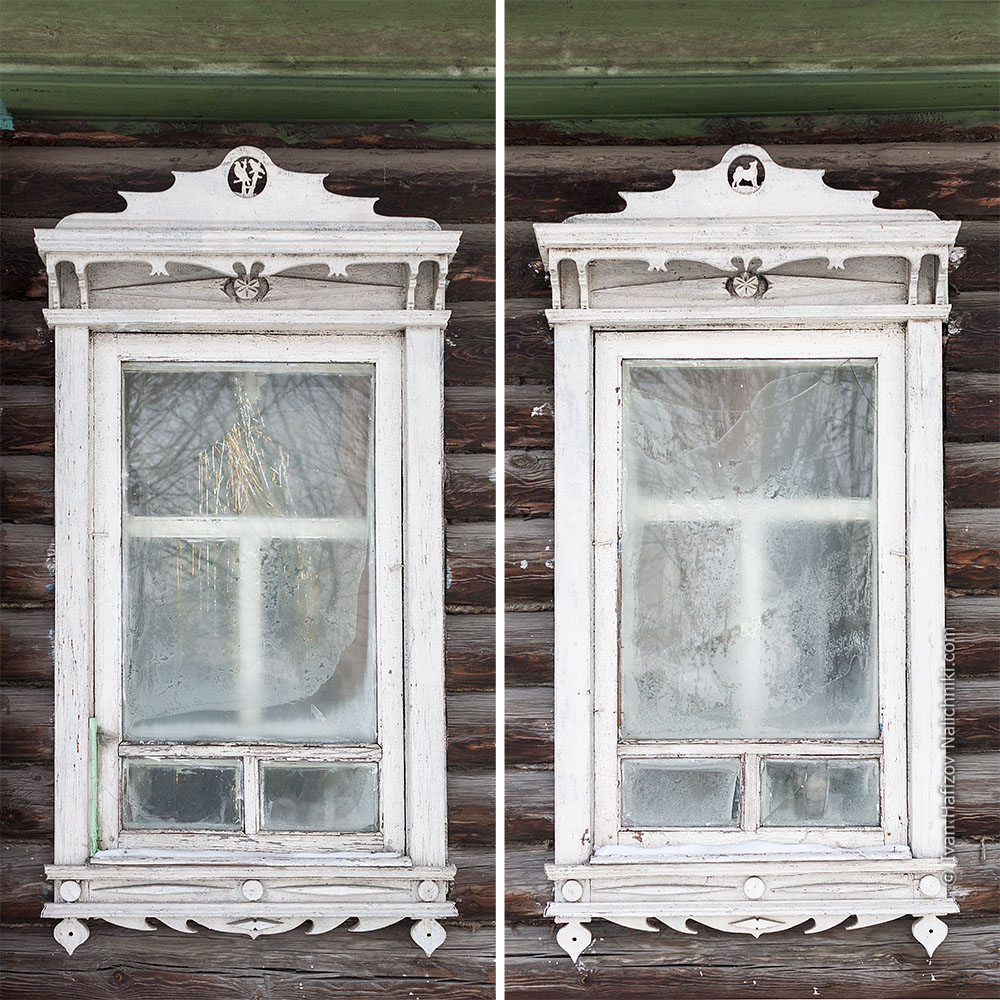
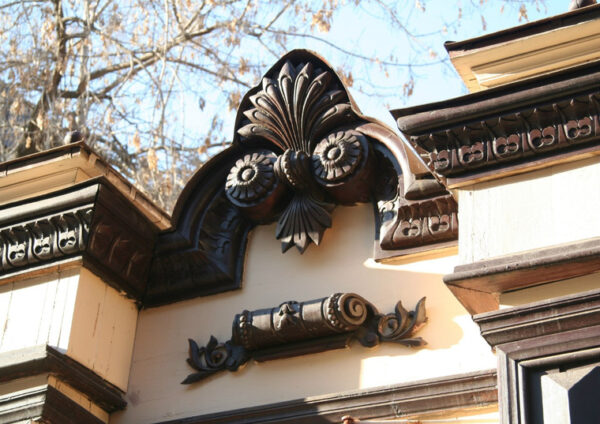
And in the photos — the wonderful nalichniki of Tyumen!
Most people don't associate Tyumen with wooden architecture, but there are several dozen absolutely stunning mansions preserved here, some with nalichniki of exactly this type.