

— What, really, you go around photographing nalichniki? — the woman makes no effort to hide her amazement.
— Yes, — I smile, — I've covered half the country already, and I've finally made it to your house. They say there was a wood-carver around here before the war — have you heard anything about that?
— How would I know? I'm a dacha person!
— Ah… — I draw out, wondering what to say to a revelation like that, but fortunately the woman continues:
— I've been here thirty years already. At first we just came for the summers, but now I actually live here.
A "dacha person" — she's clearly a city woman, you can hear it in her proper, polished speech. But thirty years of village life have clearly left their mark: instead of the standard Russian words, she substitutes the local village variants quite naturally:
— Yes, right there — all our carving is the same around here… — and she sweeps a broad gesture at the neighboring houses.
Then she suddenly turns to me and asks:
— Did you photograph the balcony?
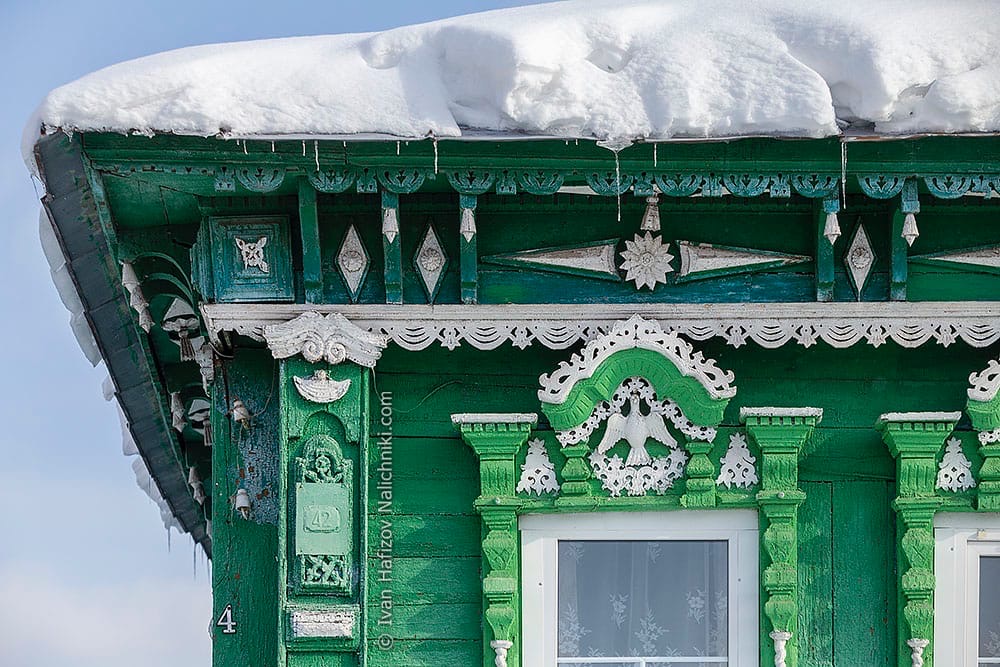
I look up at the house, topped by what is a fairly ordinary mezzanine for this area, nothing much like a balcony, but the woman corrects me:
— The neighbor's! Ours used to have nicer cornices, but as things started to fall apart, the cornices came off, then the little porch from there too… Ours was nicer. People used to come by and photograph it, I remember… Now we're just pulling it all apart: they put in new windows, but didn't do anything else…
The balcony in question — technically a decorative false balcony, built purely for fashion since there was never actually a door to step out through — is the only remaining carved element on the neighbor's siding-covered house. Maybe our dacha woman's balcony was nicer, but there's nothing left now to remind anyone of its former beauty.
— And will you really be taking down the nalichniki? — I return to the subject of what's being dismantled on her house.
— Well probably, if we keep working on the house, what else can we do? But not soon… And look, aren't those the same ones lying right over there? — she points to the house across the street, in front of which, in tall grass, stands a nalichnik — considerably simpler, however, than the ones decorating her house.
— You're joking? — I say. — Your nalichniki are a hundred times more interesting! And I think your carving is older too. What year was your house built?
— Twenty-six. The neighbors over there are the same vintage — there's a year carved on their little balcony — she waves somewhere along the street. — But now people make them simpler. Just: they do — she sharply traces a rectangle with her hands — and that's it!
We stand in front of her house, and — this feeling is rare — I suddenly understand that there's no need to ask questions or even say anything: for a while we'll both just stand there, each lost in our own thoughts. A pleasant feeling, the kind that's rare even with people you know — when being quiet together is a pleasure — and here it is, out of nowhere, with a complete stranger of a woman…
— What's your name? — I ask after a few seconds or minutes: time has no power here.
— Me? Aunty Valya… Come in, I'm having tea. It's just… it's gone a bit cold. I was out — she nods apparently toward the nearest town or market — selling blueberries.
— Oh! And what's blueberry going for these days? — I don't know why, but whenever a conversation allows it, I always ask the price when someone mentions buying or selling something…
— Different prices, — she answers thoughtfully, — different. Anywhere from three hundred down to two-fifty and two hundred: depends on who's selling. Strawberries too. But strawberries — I'm done with those, they're past their season… The rains have been steady…
— Strange summer, — I agree. The summer of twenty-seventeen was odd — somehow either too cold or too short…
— But we manage fine, we go out for berries in the summer. — Aunty Valya continues. — Last year there were so many porcini mushrooms. Oh, so many mushrooms there were. Oh, you can't imagine… You can't imagine! I'd bring back two hundred and fifty at a time, just like that, by accident… Going out for berries and coming back with a jacket full! Oh, the drying we did…
— A jacket full?.. — I want to be sure I heard right.
She sees my confusion and laughs:
— When you go out for berries you don't take a basket for mushrooms. So I'd tie the sleeves of my jacket and fill it up. But mushrooms I don't sell. My husband used to sell them, but not me.
— Why not you?
— Because I don't go out for mushrooms. My daughter goes… I can't manage it. I get lost in the forest. I could walk and walk…
— But you go for berries just fine! — now it's my turn to laugh.
But she answers with complete seriousness:
— Well! For berries I stay right by the path! I mark certain trees over there, pick around them and come back out. Move further along, then again. Otherwise I might just disappear for good. I'm a city person, from Kotelniki. So not that… The forest is foreign territory for me. But my daughter — I've been bringing her out here, to this house, every summer since first grade — she knows every spot. She'll get me settled somewhere and go off on her own: "Mom, why do you always sit in the same place?" And I say: "Well why do I need to walk all over? What difference does it make where I pick? First I pick the biggest ones, then from what's left, the biggest ones again, then from those the biggest ones I can find, then I go a little further, not very far, come back, and from those ones I also pick the biggest ones that are left… My husband was the same — he'd get me settled in a clearing and go off himself, and I'd just sit! Out of habit. It's fine. Works perfectly well.
At this moment, apparently remembering my interest in wooden architecture, she interrupts her mushroom-and-berry story:
— Oh, you might be interested — about two years ago some people came here, there, to that house! — she nods toward one of the houses further along the street. — They needed an old-looking house; they wanted to shoot a film. And they came to me too. Looked at everything, touched everything… but not from NTV, from some channel I didn't even know…
It was convenient for them somehow. They looked at everything, then just vanished… And they wanted to bring a cow here for it! Otherwise we just have one cow in the whole village, and she looks like she might — The woman sighs and continues more quietly now, almost as if musing aloud rather than talking to me — The village! No wells, no cows, not a single chicken… I'll go get milk in a minute, the farm delivery's coming soon…
Then she seems to genuinely forget about me, turns around, clearly getting ready to go inside, but I call out — though somehow, for some reason, already certain of her refusal:
— Could I photograph you, to remember you by?
In an instant she transforms, speeds up, flings the door open, and is already about to dart through it, but seeing that I haven't even raised the camera, she hesitates and doesn't lock it.
— Don't worry, — I say quickly, raising an empty hand — I won't if you don't want me to!
Aunty Valya nods, half-opens the door, but doesn't come back out and sends me off from the doorstep:
— Safe travels!
And a moment later:
— Or come in — I'll treat you to tea?


14 comments
Мне б, по уму, их начать записывать лет десять назад, но хоть сейчас дошло)
26 городов отсниму, и сажусь за вёрстку.
Если хотите, черкните личным сообщением свой электронный адрес: я напишу, когда всё будет готово к печати.
Книга будет, как и футболки сейчас, выпускаться по предзаказу, то есть сколько человек вложится в издание перед печатью — столько и напечатаю и разошлю заказавшим.