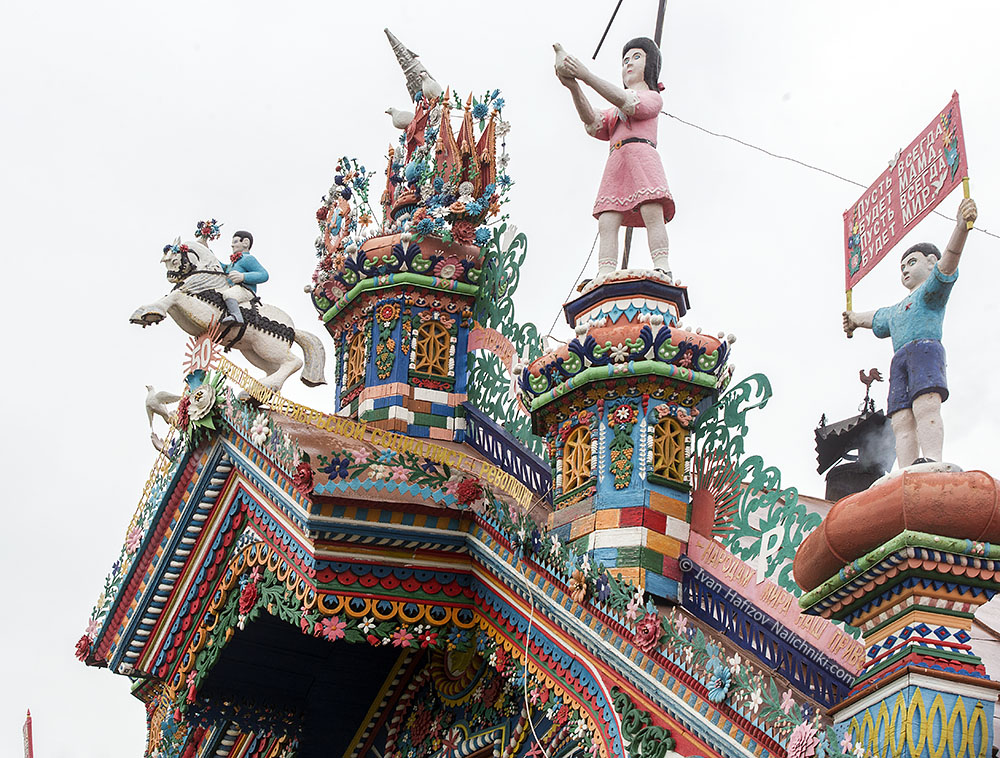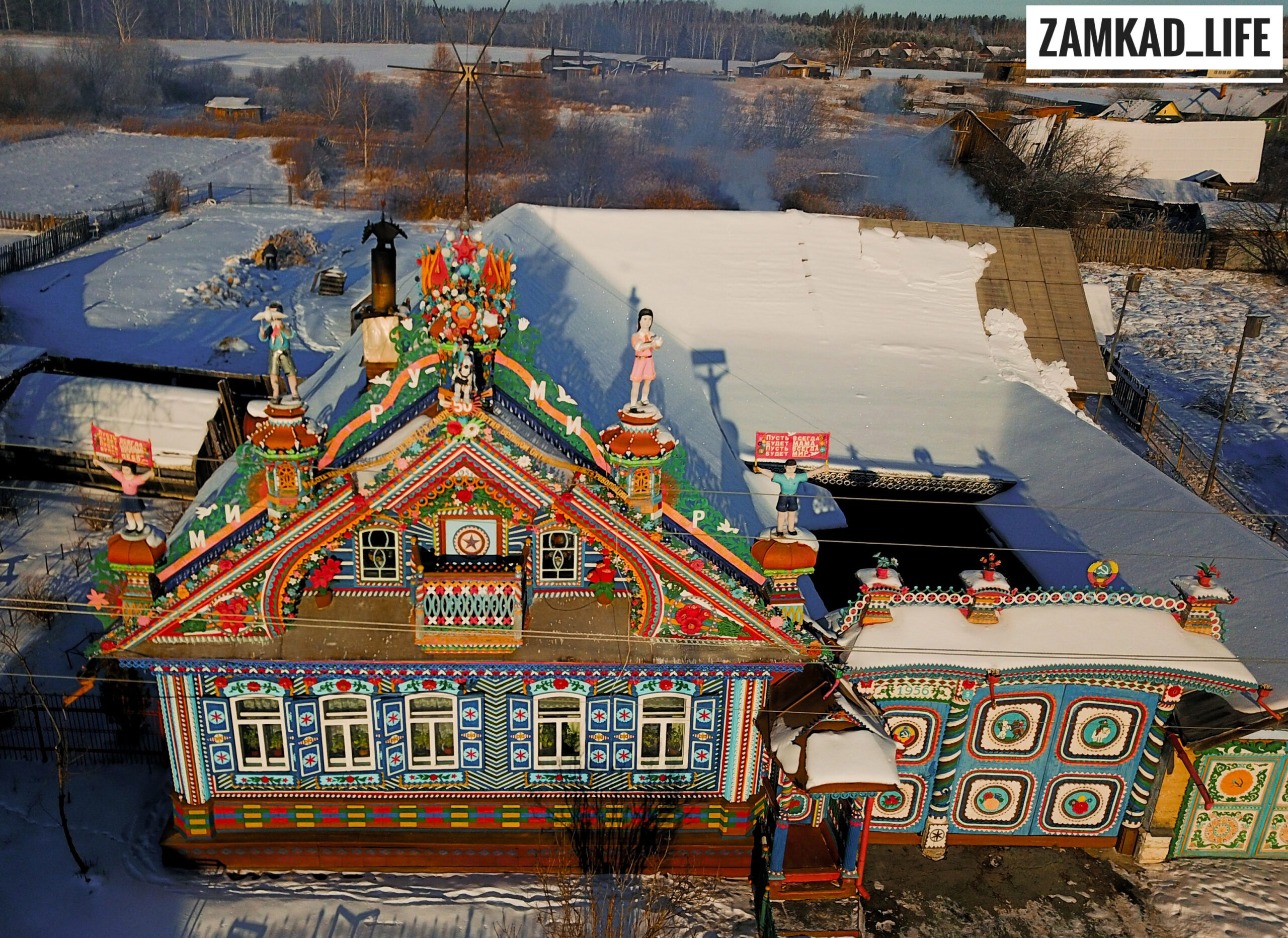


…In the autumn of 2017, together with Olya and Alexei — owners of the Miladoch workshop from Serbishino — and a journalist from the local paper, we drive to Kunara: a fairly large village, by the look of it, on the old Tagil road, a secondary route between Nevyansk and Yekaterinburg. Almost every house here has nalichniki — not quite like those in the neighboring towns, with their own character — but today we have an entirely different purpose: we've come to the house of Sergei Ivanovich Kirillov, which has no equal anywhere on earth.
This house, probably the only one in Russia with its own Wikipedia page, has no shortage of photos online, and I reasonably assume that Lidia Kharitonovna (the carver's wife) receives tourists a hundred times a day.
We knock.
We knock for quite a while — I'm beginning to think no one's home — but the gate finally opens, revealing a small, thin old woman in a black quilted jacket over a red flowered dress, and the inevitable white kerchief covering her gray hair. Against all expectation, she looks at our noisy group with surprise and bewilderment.
— Hello! Hello! — we call out over one another.
— Hello. — the old woman nods quietly.
— What a beautiful house you have!
— My husband built it, — she answers carefully. — My husband is gone now…
We're making all kinds of noise, admiring, interrupting each other:
— When did he pass? Such a beautiful house! Why did he think of it like this? What year did he start?
The old woman looks flustered, doesn't know what to answer first. She speaks slightly out of sync and very quietly; we, on the contrary, find ourselves nearly shouting — otherwise every question is met with a puzzled look and a "pardon?"
— It's been almost a year now that he's been gone. I'm alone now.
— What was your husband's name? — the journalist puts in a detail.
— Sergei Ivanovich. — she breathes softly.
— And how did he die? — Alexei asks, point-blank.
— Death came, that's all there is to it. — the mistress of this extraordinary house observes with quiet wisdom. — He was a blacksmith. — and adds, cryptically: — All kinds of weather there'd been…
We exchange glances… The enthusiasm gradually subsides; we try to slow down and listen.
— Could I photograph you? — I ask. She's standing right by the gate, and against the backdrop of the enormous carved archway, she seems even smaller than she is.
— Oh, what for? — she waves it off listlessly. — Do you really want to? — she asks, genuinely surprised, but doesn't object — so for the next few seconds we all click our shutters together, and only then step closer, continuing our questions.
Each of us has different things on our mind: the journalist is thinking about his article, the carved magnificence is pressing down on me, Alexei is focused on the woodwork, Olya… Olya was the first to notice:
— Is it hard for you, being alone? — Women always ask the questions I'd never have thought of.
— Hard, why? — Lidia Kharitonovna looks at her with unexpected directness. — I don't keep any livestock now, nothing. Before there was the cow — I had everything of my own. But no cow anymore… What's hard about it… Just that my husband's gone now…
— Well, what can you do, you just bear it… When mine dies, how will I live without him?
Hearing this, Alexei laughs softly, and I break into a smile: you don't often hear a confession like that…
— And how many years did he work on decorating the house, do you remember?
— His whole life, as long as he lived. He'd come running from the smithy to the workshop… Never hired anyone…
— And when did he start, what year?
— Well, when… right from the start… — the old woman answers again with remarkable economy.
At this point we notice that letters have been cut into the roof trim in openwork iron: "Work begun in 1954, completed in 1967 on the eve of the Great October Socialist Revolution" — and the question answers itself.
— Tell me, — I ask — might we come inside to photograph? They say you have an unusual stove…
But the old woman won't hear of it:
— There's nothing inside… A plain stove, a Russian stove… Nothing special in there… Everything's outside. There's also the carved courtyard, go in if you like.
I gladly step into the yard, and at that exact moment — as if on cue — a cat comes out too.
— What kind of wood did he use? — Alexei asks respectfully, trying to draw out the secret.
— Pine, all pine. Well, is that everything? — the old woman asks hopefully, already beginning to close the gate. But Olya suddenly remembers something she wanted to ask:
— Lidia Kharitonovna, is it true that Roizman said — he says last year they came and painted here… Did they paint here, or not?
— Who painted? — the old woman flares up.
— Roizman. Helped you paint the house?
— No… nobody came… let them not even say such things… — the hostess is surprised by the question — nobody even showed up… We do it all ourselves…
— When did you last paint the house? — I ask, surprised myself.
— It was… two years ago, or three… My husband and I always painted it ourselves…
— So it's not true that Roizman came here with volunteers to paint? Not true?!
— Of course not! — she assures us. — Wherever did you get that?
— Did he at least bring you paint?
— No, we always bought our own…
— And how much paint does it take? A lot to paint, isn't there? Who helps you paint?
— Nobody helped, we painted it ourselves…
We fall silent, perplexed. And Lidia Kharitonovna, watching us a moment longer, closes the gate — leaving us to enjoy her husband's extraordinary creation from the outside.
…
PS
"…Sergei Ivanovich's father, Ivan Evdokimovich, served in the cavalry and ended up near Stalingrad. A few letters survive. Simple lines: 'We have nothing to fight with. Here not just the earth — the water burns. Looks like I won't be coming back.' He went missing in action. Since there was no death certificate, no pension was paid for him. Sergei Ivanovich's mother died shortly after — worked herself to death on the collective farm. Four children were left with their grandmother Anna. They survived with great difficulty."
"…The worst fire came in April 1970. Twenty-two houses burned on the street; the fire came right up to Sergei Ivanovich's. Everyone rushed into the house to save things — he stood in the doorway, shouted at them, and wouldn't let a single thing be carried out. He ran to the well. There was a hand pump there that he had made himself. He got on the pump, and everyone ran back and forth with buckets, dousing the house. And he pumped and pumped. He pumped the well dry. And the house was saved. The whole street burned. Sergei Ivanovich said afterward: 'If the fire had reached the house, he would have gone inside and stayed there… That well was dug by grandfather Evdokim.'"
These are two passages from the book "The Little House in Kunara: Flowers and Doves of Blacksmith Kirillov," by Yevgeny Roizman and Yulia Kruteeva.
Sergei Ivanovich Kirillov died seventeen years ago, in 2001. In 2012 and 2013, Yevgeny Vadimovich Roizman, together with the blacksmith's daughter Lidia Sergeyevna and volunteers, restored the house in Kunara — every last square centimeter of it…
PS2
The unique aerial photographs of the house are by Sergei @zamkad_life.
PS3 The 2019 Nalichniki calendar raised 100% of its crowdfunding goal in under a day! Join in — people are saying it's the most beautiful calendar in the world! Link in profile.