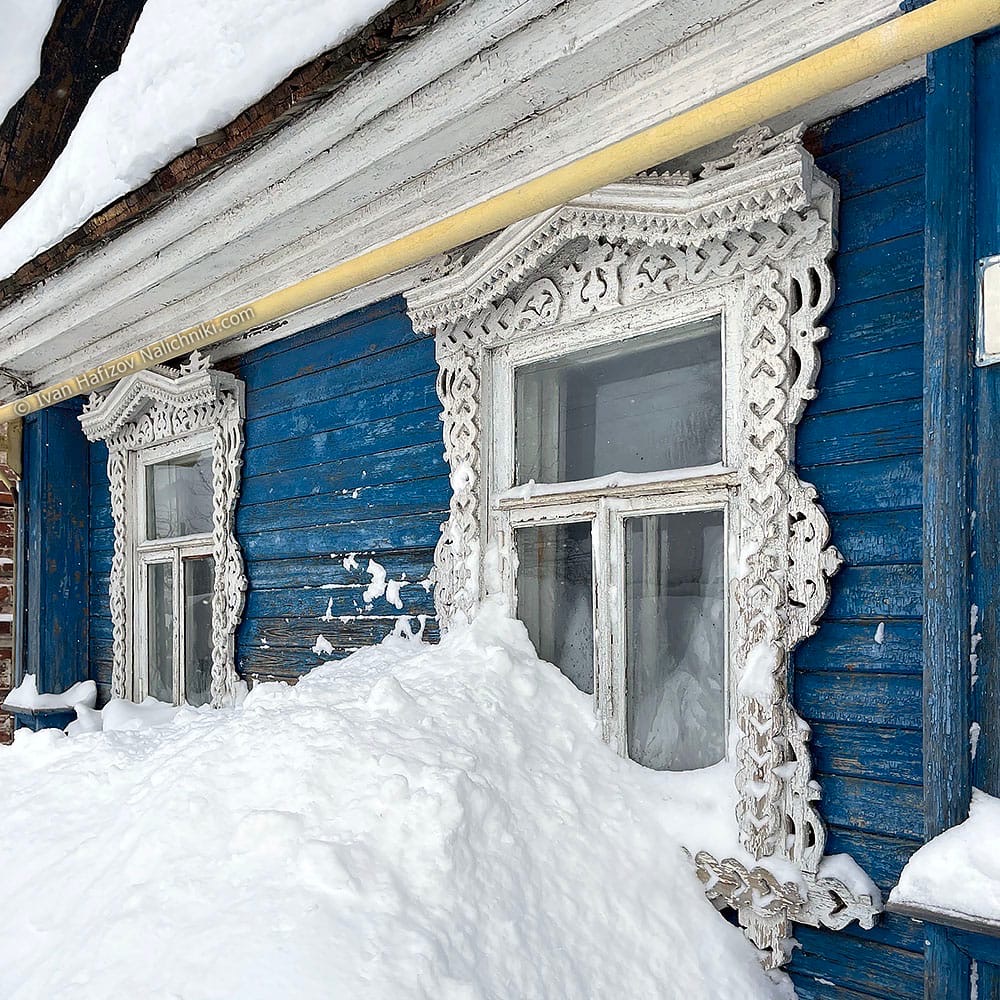
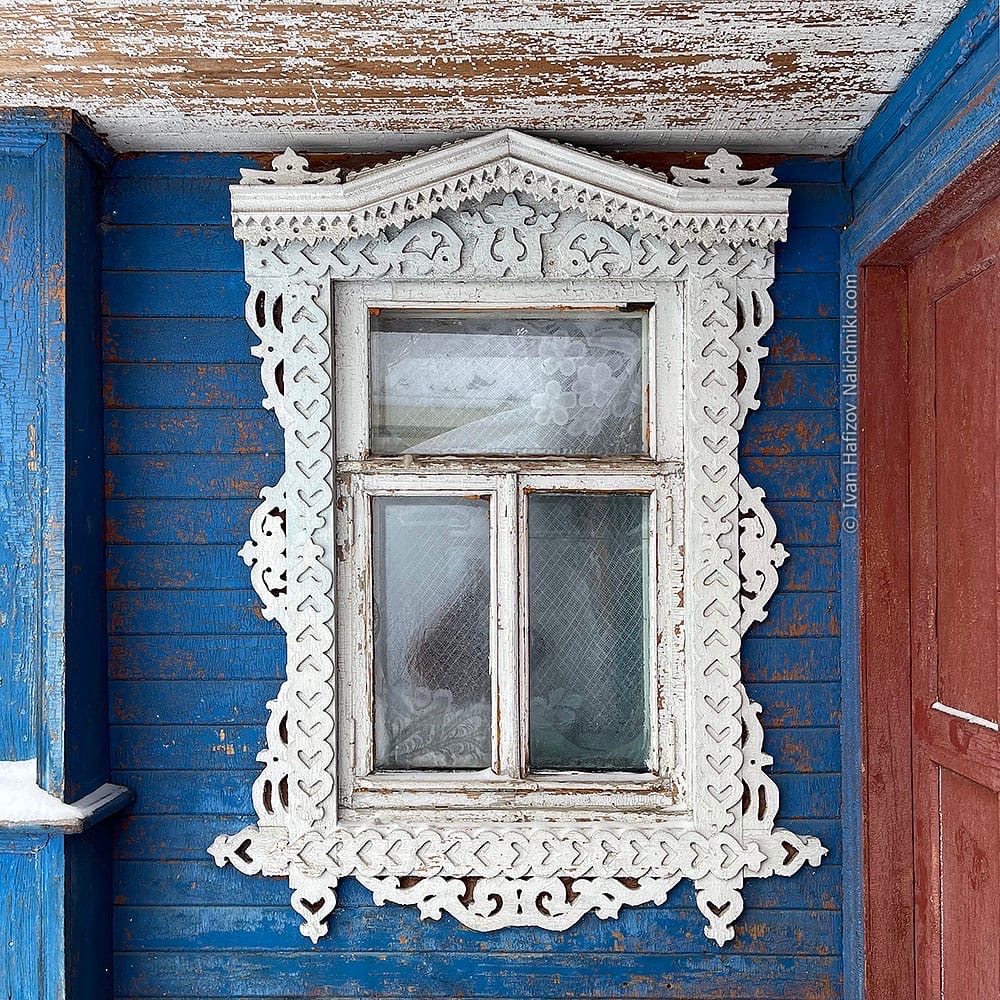
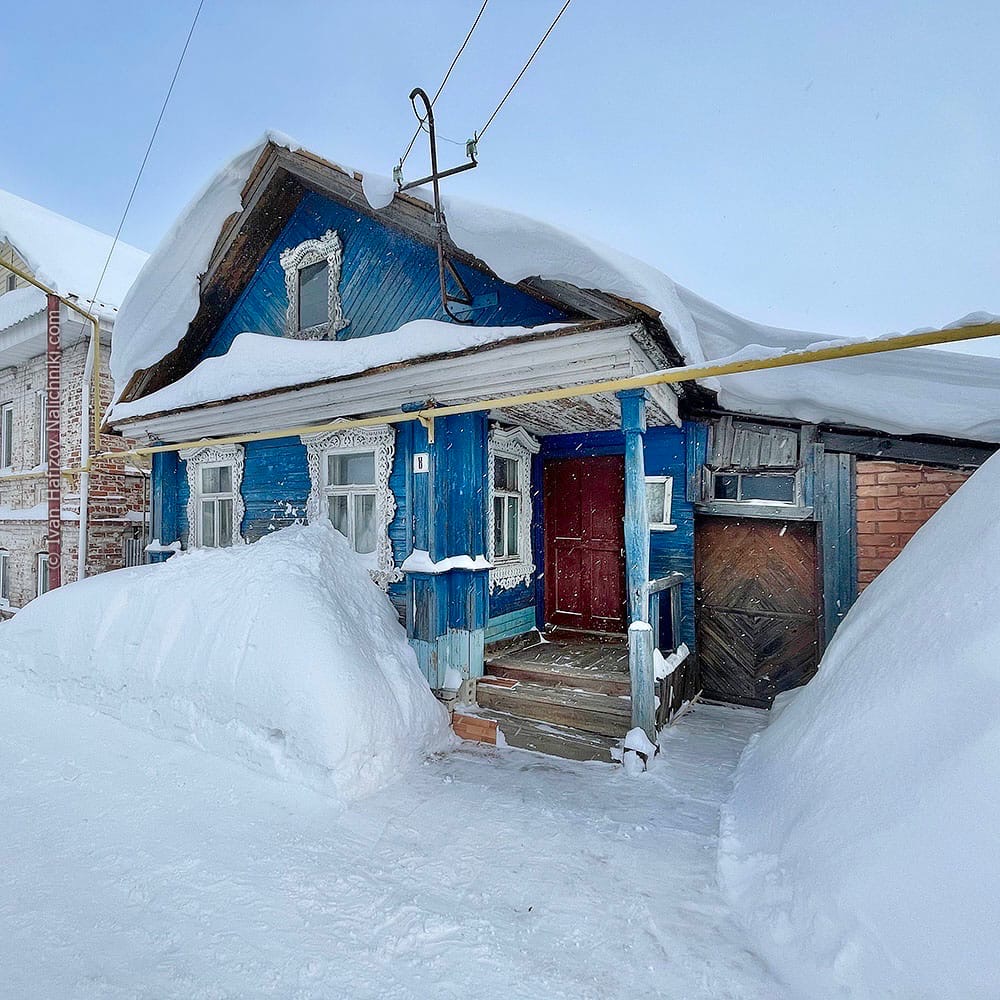
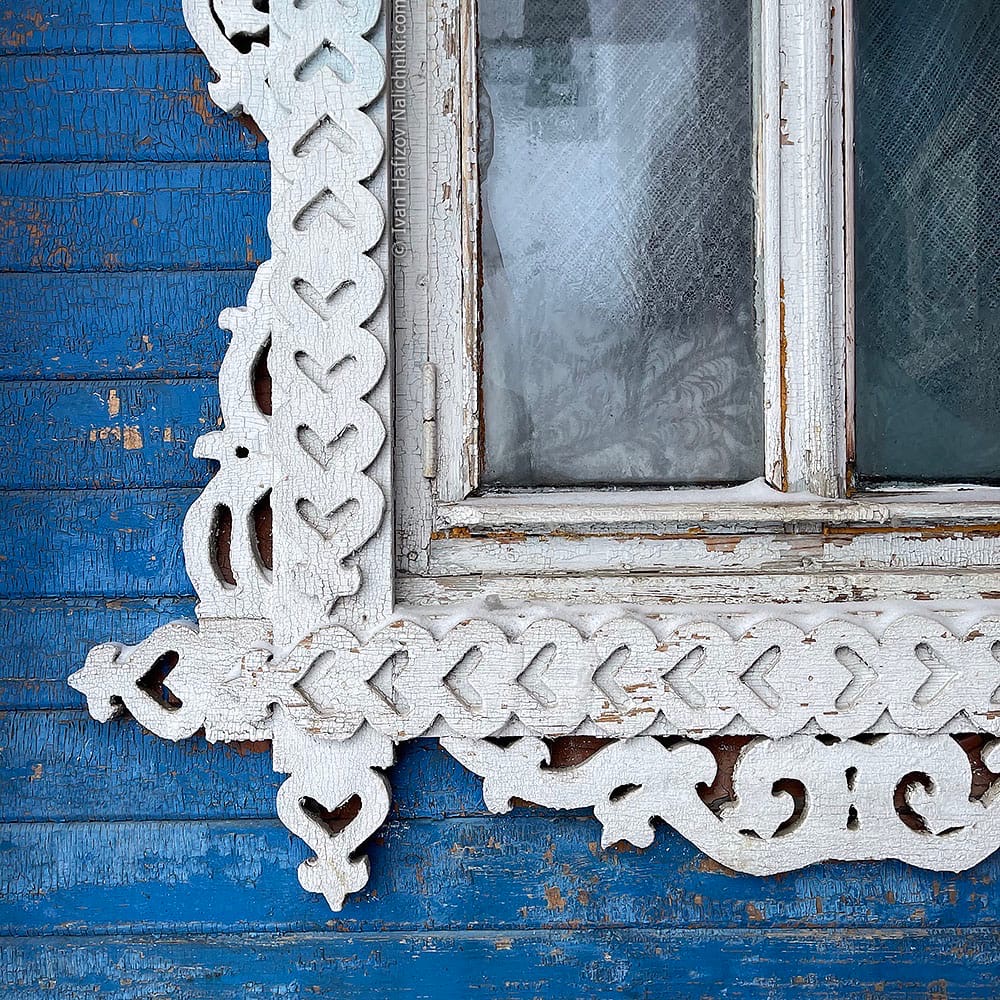
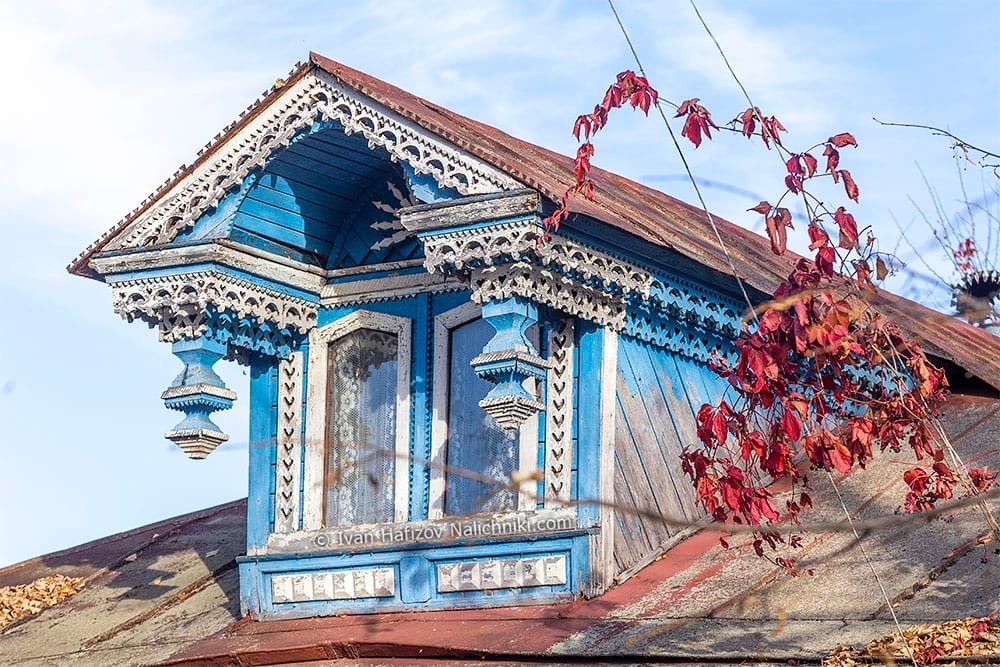
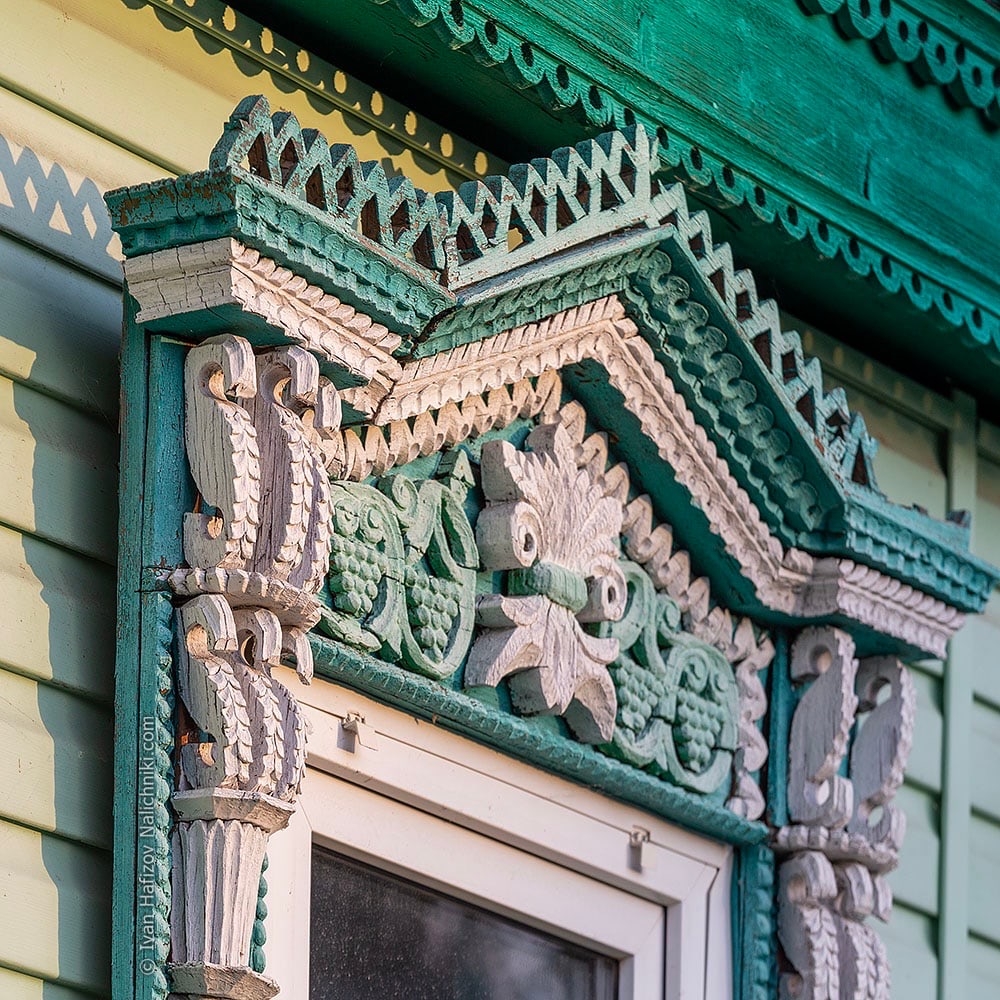
…— Oh, hello! Did we startle you with the whole crowd? You wouldn't happen to know what period these nalichniki are from — approximately? Are they postwar?
The homeowner watches our colorful mob with surprise and a little alarm: it's rare that in a city not especially known for tourism, twenty people should surround a house and start discussing the age of its nalichniki in a dozen different voices at once. Still, she answers:
— Forty-nine, fifty. Practically right after the war.
— Oh! And did you have them ordered and someone from the village carved them, do you know?
— These were ordered. This is… it's probably 1950, yes. Papa had enrolled in the academy. My older brother was born, and when he was about a year old he got meningitis, and then… almost a year after he recovered, Papa was diagnosed with open tuberculosis. And then.
— Tuberculosis? I thought that was something from long ago…
I move closer to ask more, noticing out of the corner of my eye that the group has quietly shifted to the next house, and now there are just the two of us talking. The homeowner notices too and visibly brightens.
— Are you tourists then? Where are you from?
— From all over, — I wave a hand. — Mostly Moscow.
She smiles, as if remembering something, but a moment later returns to the earlier subject:
— No, tuberculosis — that's TB. Open pulmonary tuberculosis.
— Is that viral? — I suddenly realize that apart from a couple of mansions formerly housing tuberculosis clinics (in Kratovo and Orekhovo-Zuevo) I know nothing about it at all. — How does it work, exactly?
— Most likely hereditary. Papa's mother also died of tuberculosis… Well, maybe not directly hereditary, but how else, if he was born to an infected mother? A predisposition, a predisposition… Anyway… Tolya got sick when he was not yet a year old, and recovered before he was two. There were eight or nine children in the ward, I think, and two of them survived: Tolya and one other boy. And the second boy was simply left deaf-mute. — She spreads her hands. — Infectious meningitis… Back then Papa went to see the Deputy Minister of Health and got medicine through him. They treated meningitis with streptocid. The academy gave him an official letter, and Papa went to Moscow — luckily it wasn't far from Tver. They gave him the medicine, and that medicine was enough for two children. Two children were saved with it.
— Streptocid? — I think I must have misheard. — That was the main treatment? I think of streptocid as a powder… Well, baking soda was revolting as a child, but streptocid or chamomile tea felt like luxuries — and you'd go and have these little folded paper packets made up at the pharmacy… Such a bitter thing…
— Well, that's now, that came later. Back then it was probably just becoming available. He could only get it in Moscow.
— And your parents were living in Tver at the time?
— Yes, they met at a dance during the war. Papa came to Tver for retraining. 1944, Mama twenty, Papa twenty-three. And then Papa went to the front. He was wounded. He was on crutches afterward… Papa was wounded in both legs and taken to a hospital in Kazan. And Mama made her way to Kazan, traveling from train to train. He had a star — an order — with chipped enamel, the enamel chipped off, and here's why: when Papa was wounded and they brought him to the hospital, he had spurs on his boots — the heel was torn off and one spur with it, but the other spur remained. So… He'd stepped on an infantry mine. And when they were rushing him to save him and dropped his tunic on the tiled floor — the concrete floor, of course — and chipped the enamel. And that's how the star remained with chipped enamel. And then when Papa was taken there, Mama — I'm sorry, I've forgotten again the name of that surgeon… Mama worked with the surgeon who had operated on Maresyev. He was one of the first of what you'd call our neurosurgeons. One of those rare surgeons, and he let Mama go so that Mama could make the trip. Somehow it all worked out and Mama went. She rode in freight cars. Made her way on connecting trains, in various troop trains. She arrived in Kazan, turned in the paperwork, and brought Papa back.
— This was still during the war?
— 1944. In May of 1944 they married. He'd arrived in winter, they courted for about three months and married. In May of 1944. And then Papa went to the front. He'd first been a motorman until '42, and then he came for a refresher course. He finished the course, was sent on for redeployment and from there to the front. Papa was a political officer in the artillery. And after that — this wound.
— So…
— Shoo! — the homeowner suddenly stamps so hard I jump.
A dog had crept up behind us and was apparently about to slip past us through the half-open door.
Something imperceptibly shifts, and we are once again just strangers on a cold non-tourist street.
— Well, go on, go on — catch up with your group. All the best!
— Thank you, — I barely manage to call back as the door is already closing.
— Yes, yes, yes…
And I run to catch up with mine.
PS The photos are from Gorodets, though unfortunately not that house — I didn't remember which one it was or where.