"Oh wow, what affectionate cats you have… Hello!"
I'd been planning to photograph two tabby cats, had crouched down, when suddenly the gate swung open and out came a lean, short man of about sixty, in a padded jacket, worn gray trousers, and boots that had once been black and were now flecked with paint. The cats shot toward him and started rubbing their ears against those very boots, and I scrambled to my feet, feeling guilty, as if I'd been caught doing something wrong.
The man, however, barely glancing at me, crouched down to pet the cats.
"Both toms," he explains, scratching one behind the ear so hard the cat squints. "Still kittens, really. You see, they showed up here in the spring. Their mother got killed by a truck right here. Hit her."
He sighs, but not sadly — the way you describe something inevitable: that's life, the fridge broke yesterday, and today of all days it's raining.
"So you two are brothers, it turns out?" I say, coming closer, angling to get some video of the cats on my phone. "What are your names?"
"They're both Vasyas," he suddenly announces, laughing.
"Two Vasyas?" I don't follow.
"That's right," he smiles, still stroking one. The second one inches cautiously toward me and, squinting, tilts the back of his neck up toward my hand. "A kitten shows up. I feed him. Next day — same again. Well, I do it again. Goes on like that for a week. I feed him — an animal's an animal, cheers you up. Plus it's the very start of winter, see? I let him inside, I've got little vents, he likes his freedom. And then one day the two of them show up together. That's when I finally figured out there were two of them — they'd just been coming in turns. Well, while there was only one, I'd been calling him Vasya. And then — two! Surprise! I said to them: where did you come from, what am I supposed to call you now? Well, I thought: let one of you be Vasya, and the other one Not-Vasya…" (Here I was about to laugh, but he doesn't give me the pause, keeps going.) "Except — how do you tell them apart? They're like two peas. So they're just both Vasyas. I shout 'Vasya!' — they both come. There you go!"
As if confirming this, both cats simultaneously raise their heads and look at him.
The man points at them, smiling.
"They understand."
And then, without changing his expression at all, but lowering his voice just slightly, he asks:
"What are you shooting, anyway?"
"Me? Nalichniki, actually!" I laugh at the sudden shift from warmth to wariness. "And cats! It's for the nalichniki museum. I go around, photograph, study old houses. You've still got some here in Samara…"
He suddenly cuts me off. "Pretty soon there won't be anything left here. Those…" — he raises his eyes toward the sky — "…in my view, they've decided to clear the city of wooden houses. Do you know what they call my house in their language?"
He doesn't wait for an answer.
"'Dilapidated housing!' It needs to be gotten rid of. And replaced with those…" — he trails off as if it's a swear word, gesturing at a twenty-story apartment complex already looming over the block. "'Dilapidated housing' — a house where my grandfather was born. A house that could stand another hundred years. They'd better replace their own brains. People who've never seen anything decent in their lives are calling this house dilapidated housing. Do you understand?!"
Naturally, I do.
"It's probably mid-nineteenth century, isn't it?"
"I think it's late nineteenth."
"With logs that thick?" I say, surprised. I'd thought they'd stopped building with timber like this by then.
"I won't lie to you. Do you know what this used to be called?"
I try to figure out what he means, can't — not that he's waiting for an answer:
"A pyatyostyonok — a five-walled log house. See that? Go touch the hinges, the bolts! Look at this!" — he gets worked up, steps back, slaps the window frame, points to the hinges — "all forged iron! Imagine! And nowadays they can't even make a decent axe."
Here he pauses, and I carefully bring up everything I've heard about axes from craftsmen at fairs:
"Well, I think Vacha still makes axes…"
He can't hold back, explodes:
"Shove it up your ass! That's not an axe, it's a…" — he practically chokes with indignation. "I trained as a mechanical engineer, I've worked with metals. You know when you dig up an axe that's been in the ground for half a century, maybe more — you tap it with your fingernail like this, and it rings. Do you understand what it means when it rings?"
I nod like a schoolboy who's been caught out. He keeps looming over me.
"Under the Tsar, there were good laws. For instance, there used to be something on this very spot. There was a fire. When I was digging around the yard, I found the foundations. First thing: no cement — and the foundation has stood there, you couldn't break it up with a crowbar today. There was some kind of banya here, I know because I kept finding copper coins from the eighteen-hundreds. You see —" he slows down, even starts gesturing more calmly — "if you eat something that's gone off, you get a gag reflex. Same with the earth: whatever it can't break down, it pushes back out. From any depth it pushes it out. Glass, for instance — can't digest it, so it ejects it. Things that don't rot, don't rust — if it can't absorb them, it ejects them. I found coins — one kopek, three kopeks, five kopeks, eighteen-hundreds.
"So back then — do you know what the laws were like? When something burned down here, the Tsar — they had intelligent people then, unlike those bastards today — they'd say: 'Here's a plot of land, build, and you pay no taxes for twenty years!'"
"After a fire?"
"After a fire," he nods. "And not just here. There was a vacant lot here. So I found in the yard — there's a foundation, what they call a strip foundation. And imagine: no concrete — they used egg yolk, I don't know what else, and no cement was needed. Have you seen the Chelyshev building? No cement — yet try pulling it down! And Chelyshev came to Samara with a bundle on his back. From a village. Penniless! And became the richest man in Samara!"
"What did he do?" — first time I've heard the name.
"Rental properties — come on!" He stares at me like I've just fallen off the moon.
"I'm not from here!" I say in my defense.
"Ah, you're not from here! I'll tell you — if you go along Sadovaya, you'll see the synagogue. I'm Jewish. You'll see it. It was the largest in Europe. Nowadays there are almost no Jews left. In the early nineties, some wealthy Americans came. They came to the synagogue and said…" — (it was in ruins by then. There'd been a bread factory inside, machines banging, vibrations… you can only imagine what had been done to it. They put churches into warehouses, put everything to use. Destroyed it all!) — "'We'll give the city a million dollars, disassemble it brick by brick, and take it away. Spend the money however you want.' They wouldn't let them. A million dollars! Could've bought medicine — anything you want! They wouldn't let them. The city is in ruins, it's been all these years! Wouldn't let them. And now they're finishing it off."
"And how did it all come about? I'll tell you: there was a concept called 'Siberian Jews.' The Tsar wanted to develop Siberia, needed a railroad. The technical side — Germans. The financial side — Jews. There were very few of them, they were called the 'Siberian Jews.' The Trans-Siberian Railway — where do you think all that came from? And all the technical infrastructure here… You see the trams running? Do you know who introduced the tram here? Well, first there was the horse-drawn streetcar — do you know who started that? Belgians! Long story short: the Belgians came, set up the horse-drawn line, then introduced the tram. All of it was Belgian-owned.
"And if you look at all of it overall… Well, there was Witte! Say what you like, Witte was prime minister! He was clever! He brought people in… You can't develop a country that size with your own population alone! How did they mine gold in Alaska? Did the Americans do it themselves? The whole world came running! Because the veins opened up! And the Russians were there milking it too — there were Russian settlements! Same with Russia — it was a Klondike! Everyone came — develop it, here it is, make something of it! And those bastards" — he raises his eyes skyward again, same as at the start — "oil, gas, forest, fish. Everything! They've already destroyed the space program, ruined it all, even lost this —" he gestures at his house, at the street.
He falls silent. So do I, weighed down especially by that last "even lost this." Our remarkable, long-suffering, seemingly enormous country has apparently proved powerless to preserve even this simple heritage — streets of wooden houses…
But this restless man keeps hammering away:
"Listen, Russia used to stand for something, didn't it? It stood on grain! Fed Europe! Hummed like a turtledove — all manner of goods…
"There's a house over there — white one, that way" — he waves his hand off to the side — "the man who lived there is gone now. Valera Kuroyedov. I was friends with him for many years. You turn the corner, there's a white house. That's where Valery Alexandrovich Kuroyedov lived. From a dekulakized family. In his time… we all joined the Pioneers, the Komsomol… And when I talked with him — they were from Ulyanovsk Province, peasants. So. He says: 'My grandfather sold salt pork.' I say: 'Oh?' And he says: 'By the wagonload.' I say: 'By the wagonload?'" — he slows down and repeats it syllable by syllable — "'do you understand? By-the-wag-on-load! Can you imagine the quantity? Wagonloads!! How did you raise that much? That's herds of pigs!!' And he said: 'Well, so they dekulakized us.'"
"And do you know how much fish there was here? My father was still serving here in '45–'46. Do you know how much fish? Forget Astrakhan! Even now there's plenty in Astrakhan because it feeds into the Caspian… Here, before those idiots built the hydroelectric dams, there was fish… You know a fish called zalum?" (I shake my head.) "You know herring? This is twice as fat as herring! Fish like that — fat, pot-bellied! They built the dams, they killed the fish! The thing is, fish follow their route. They just follow it. On the Far East they couldn't kill it: the salmon go to spawn, do what you like — the bears catch them… Idiots…
"Honestly, what are you young people doing here! How old are you?"
"Thirty-two!" I announce. (This is, in fact, a very old conversation. 2012, February.)
"Listen, if I were twenty-five today — even thirty-five — not a single day! Not a single day! There's nothing for you here, do you understand! Nothing! Get a good skill. I've been to Canada — it's just incredible there! Believe it or not, in Toronto — four million people — do you know how many Russians?" — he suddenly and for no apparent reason switches to the formal 'you' — "Three hundred and twenty thousand! One in ten! One in ten, I swear to God! Every Friday there's a stack of Russian newspapers and magazines this high! I saw it with my own eyes!"
"Wow!" I say, surprised again. "And when was this? Back in Soviet times…?"
"Just three years ago!"
"How about that!"
"A stack of Russian newspapers and magazines this high!" — He shows forty centimeters with his hands. "My brother lived there — rest his soul. They have incredible economists there. Smart people who sit and write economic analyses. About everything. And then time passes and we see it all come true right here! Here they're silent, there they print it openly. I'm just gobsmacked. Absolutely gobsmacked! Shoot me if you want, but I'm telling you — if I were thirty-five right now, not a single day here."
"And where do they want us thirty-year-olds?" I shrug.
"I'll tell you: a good skill. That's all. The Czechs are grabbing our kids with everything they've got. The Poles are grabbing them. They're wanted there. We don't need smart people here. Here we need oil, gas, and as many blockheads as possible — for the crowbar, the pickaxe, the shovel. That's all. Crowbar, pickaxe, shovel."
"Come on…" I try to push back. "You need those too…"
"Oh come off it!" He waves my argument away dismissively. "You going to build a skyscraper with a crowbar? Or cure cancer with a pickaxe? I'm walking in Canada, go into a shop in a good neighborhood, and here come people in turbans. I say to my sister: 'Who are those?' She says — doctors, programmers, engineers — Pakistanis and Indians. And do you know the competition to get in? Their best people leave. The population density there is terrifying.
"I have a friend whose son lives in Canada — a Samara guy. He's probably thirty now. They went to a doctor, and the doctor was Iranian. Tells them the whole story — came to Canada, passed the exam, impossible to live in Iran. Fascists, the women have no rights whatsoever. A woman is basically luggage. You understand what all that involves. He left, he's a doctor in Canada. The best people leave," he repeats. "From us too. And when you go abroad you have to pass an exam. And a lot of ours come and can't pass the exam. And doctors often find themselves… there's great demand there specifically for nurses. And our experienced doctor goes over and works as a nurse. But I know people from here, anesthesiologists, who went over, passed the exam, and they're in a completely different world. But they left at thirty.
"Me… who needs me? I'm sixty, I already have a place picked out where I'll lie down. But to my son I say: 'Kid, the main thing is to have a skill and the will. And don't be a coward.' What are they going to do — hand it all down from father to son? I have a friend, a Kazakh by nationality. Twenty-five years in the army. He's got a head on his shoulders — he's smart. His mother was Russian, his father Kazakh. I sat next to him at the same desk for ten years. He did brilliantly at university — physics, chemistry, mathematics, those were his subjects. But say, literature, or history — he was weak there. And he rose to colonel. I say: 'Misha, why didn't you stay on?' — he served in Siberia — 'You'd have made general!' And he says: 'Nah… The general's got his own son.' You understand? These people will pass the oil and gas down to their sons, the officials will pass their positions down. And what, I say, is waiting for you, son? So no…" — he turns back to look at the house, clearly recalling the beginning of our conversation, and ends slightly off-topic — "This was culture!"
Then he falls silent for a few seconds, waiting for a truck to rumble past behind me, steps back, opens the gate — into which the long-forgotten cats immediately leap — and adds:
"You know what I'll say? Last thing… Strange as it may seem, there was a man called Winston Churchill. And he said that democracy is a rotten system, of course, but nobody's come up with anything better. What we have — it won't lead anywhere good. So I'm telling you — you're a young man, choose a skill, and go — the world is open… As for us, it seems we'll never crawl out of this mess…"
________________________________________
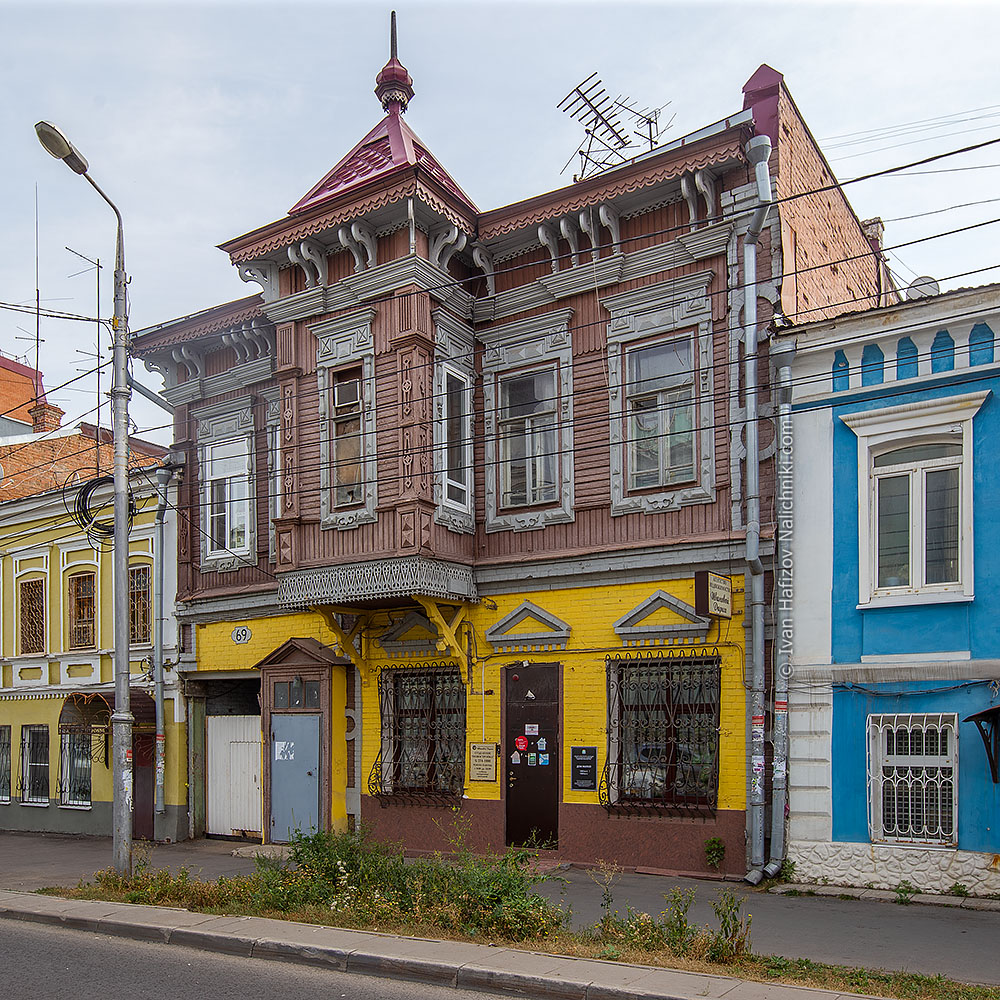
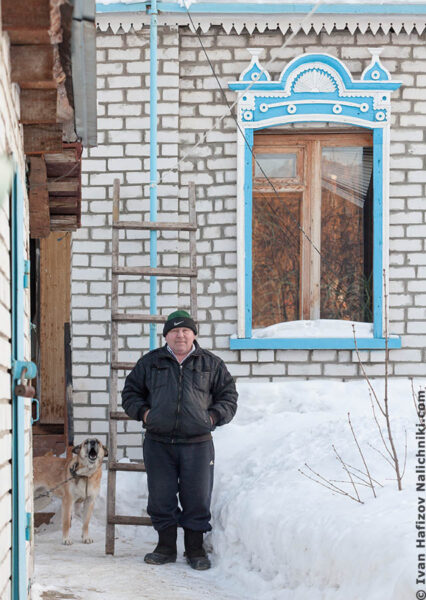
PS1. The nalichniki in the photos are from Samara — one of the most intricately carved local styles.
PS2. The NonNalichniki 2024 calendar can still be reserved on Planeta.ru (until midnight Sunday).