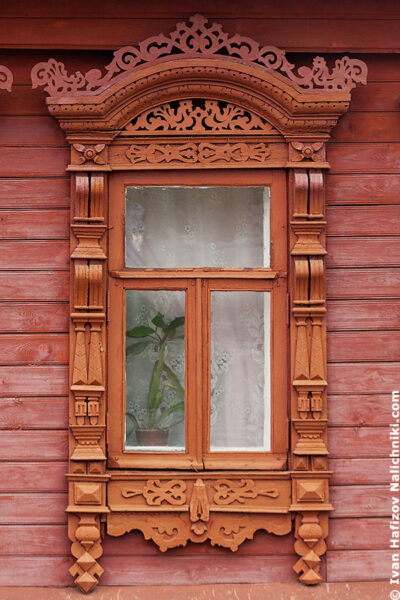
…— Nalichniki? So you're into old things? Good! I love that stuff too. Hey. Want me to find you a cast-iron iron?
— Nah, — I laugh, — what would I do with it? Hang it around my neck?
The man tosses the last logs off the cart hitched to his tractor, jumps nimbly down to me, peels off his stiff canvas gloves, extends a hand.
— Pavel!
I realize with surprise that he's not my age at all — I'd thought so while he was throwing the chunks of wood over the side. I'd now put him at sixty, easy.
Steam billows from his open quilted jacket. He radiates such vitality, such health, that I find myself smiling involuntarily.
— Ivan!
— You just passing through, or here for work?
I lift the camera dangling at my hip:
— That's why I came — for the nalichniki.
— I figured it was a hobby. Visiting someone?
He has a piercing way of looking at you, and I immediately recall the words of the guesthouse owner — which had seemed merely amusing at the time: "For the love of God don't tell a soul where you're staying, hear me, or the tax inspector will show up at my door!" — and I answer:
— Friends of friends of friends… — and immediately seize on a change of subject. — Wow, look at that — four magpies!
About ten meters away, four magpies really do land at once and begin their important strut along the road.
— Wild people! — laughs Pavel.
— Well, sure, — I'm a little embarrassed, — magpies usually fly solo… But listen — what I wanted to ask! Are those chains special, or can you use any kind?
Pavel looks at me strangely and it dawns on me I've never actually mentioned what I'm asking about. I mentally slap my forehead and clarify, pointing at the tractor's enormous wheels:
— The chains! On the wheels!
— Oh, those? They're from manure conveyors on farms. — Pavel smiles, watching me try to work it out.
— What do you mean? How do chains figure into it?
— Well, they used to clean out the manure… No farms now, of course. There were cows. A conveyor runs along and pushes the manure out. Scraper blades attach to it. It's called a manure scraper.
— A manure scraper?! — I think he's pulling my leg, especially since he tells it cheerfully, like a joke. But when I ask directly he just nods:
— Yep. Something else, right? Never seen one?
— No, — I admit, — never even heard of one. And the chains help? Everything seems pretty packed down here. — There's plenty of snow, but I haven't had to plow through any serious drifts yet.
— Only in real mud. In town you don't need them. They call me in, I do side jobs here. Someone calls about a semi — I say: "A semi? Nobody's pulling that thing!" A logging truck comes, yanks at it a couple times, and what's that going to do? Spins the wheels, packs it down harder — — Pavel winces and shakes his head, as though it weren't some distant logging driver who irritated him but me, right now — Don't spin it, I tell him. I rock it — back and forth, back and forth, once! — I got these fir branches, I'll pull him up the little slope, fifty tons on him, how you gonna do that yourself?! And I get there and some of them go "What'd you come for?" They mean on this thing, — Pavel slaps the tractor's wheel — "I got fifty tons on me!" What do you mean, what for — to pull you out! He laughs: Move along, old man! But we rock it twice and… I say to him, "Why not dig under it a little?" "What's that gonna do?" "What do you mean what? Dig — done! Like so, make him a little notch, and off you go!" Ha!
Having said his piece he cuts the air sharply, like chopping off the conversation.
— You smoke, Vanya?
I shake my head.
— Good man. Me, I've quit a hundred times, y'know…
He kneads a cigarette in his hands but doesn't light it, just turns it over, as if still deciding.
— …The North doesn't abide weaklings, Vanya… You can't be that way… Nature up there, she won't put up with weakness. Why would she! It's all very serious up there. What's a guy gonna do out there with those pointy city shoes on a semi? He steps out — what's he going to do? Me, I got a shovel and a crowbar — chik-chak, I dig under, rock it back, once — done, we're rolling! And they're sitting there in their semis in T-shirts! Young guys like that. They've gotten used to just… just turning a wheel. You from around here?
— Moscow region, — I answer out of habit. I used to say Moscow, but first it's not quite true, and second, people's friendly mood too often evaporated after that.
— I thought Kazan. The way you walk — when you were coming down the road I thought, maybe he's a Tatar.
I nearly choke with surprise.
— Well, I was born in Kazan! How did you —?!
— Ah. — he nods, satisfied, not the least bit surprised. — The gut feeling doesn't lie.
— And you, are you local? — I decide to ask him in turn.
— Nope. From Rostov. Ended up here by chance and got stuck. I was in Voronezh. Doing odd jobs. Fool that I am, I got pulled in… Like a fool who doesn't know any better at my age. I was sixty-five, Vanya. Went to Voronezh to make some money. We all got stiffed — all four of us.
— Odd jobs, meaning construction, repairs? — I'm not quite following.
He nods:
— Piecework, yeah. The client got his money and… — he spreads his hands with a heavy sigh. — What are you gonna do, kill the foreman? What are you gonna get from him?
— And you'd worked there a long time?
— Six months to the day. Ten hours a day. Wallpaper, and that damned paint, and tile… Apartments and houses.
— And what — didn't pay a ruble?
— Well, the first month he paid twenty thousand, and once he had everything he was gone and that was that. There are people like that, Vanya. Money ruins a man. When people were poor, life was simpler. No money, but everyone had a conscience.
I'm silent. What is there to say.
Pavel adds quietly:
— Money ruins a man. The more you have, the more you want, Vanya. Back in Rostov I was a driver. I worked for a company, drove all kinds of things. Management here and there, airport to train station, all of that. I drove, didn't ask questions — who, where, what. The pay was steady, and what do I care, I settled down: life is looking up. Then there's a crisis, and boom, right away: thank you, goodbye! And I was back to odd jobs. Then someone calls — he gives a name, but mumbles it, seemingly on purpose — calls from the company: "Can you help us out, one of our people flew to Moscow and forgot a suitcase, you've got a car. Good pay, the man's important, just needs to happen fast — come on, come over." And me there… I mean… Completely broke — like a gift from above. So I got ready and drove it.
— All the way to Moscow? — I'm surprised.
— All the way. — he nods. — So I… Look, Vanya — here we are, the two of us, talking for nothing, and that man up there — he raises a finger toward the sky — he got a promotion. He did! I arrive there, and this house, Vanya — you'd lose your mind! Security, all of that. I took a look at the whole setup. Drove home. And then this guy called me again. About a week later: "Come on, we've got a situation, someone left a suitcase at the station for some person." Then, I'd already set off, he calls: "He's already left for Moscow, could you help us out?" Well, by then I was already thinking — something's not right here. Something clicked. But I had to help, right! So you can imagine what I hauled for them over those three years I was running things for them. All kinds of things… Once there was a parcel to pick up from a train. Back then it was fashionable to send things with the conductor. So I do the whole business — slip the conductor three hundred rubles, pick it up, bring it over, hand it in, there you go. A square box in a bag. Ordinary-looking box. They open it right in front of me, and there are stacks of cash. I nearly lost my mind. If the conductor had seen what was in there! I don't know how much — several million probably — and he'd carried that parcel to Rostov for three hundred rubles.
He takes out the lighter at last and turns it in his hands, but still doesn't light it. Feeling my feet going numb, I shift my weight and ask:
— And what year was this?
— What? — he looks at me in surprise. — Ah. Which year? Two thousand seven. Eight. No. I started driving it in the ninth. Two thousand nine.
So listen. The third time I drove a suitcase to Moscow, I arrived. Called to say I was there. No answer. Same the next day. I waited, then someone called from Rostov — don't need anything, throw the suitcase out. No, not throw — sink it, he said, in the Moscow River. Tie some rocks and off a bridge. A real movie. And don't come back, people are going to be looking for me. Lay low, he said, and…
He looks up suddenly at his hands, then, a little slowly, pockets the lighter, takes out the pack, and stuffs the cigarette back in. He glances back at the tractor and looks at me, almost apologetically:
— I've been running my mouth with you.
— So how did it end? — I can't let him go without knowing.
— Well, how…
He pulls out his gloves again and tosses them up into the cab. — How… Drugs, Vanya. It was drugs in the suitcase. I open it and there are these silver packets — opaque ones. I… I just couldn't… I couldn't have known, Vanya. Just picture it, sitting there… I had a buddy, Sanya — God rest his soul — he died… was on that filth. How many times we… good man, he was… First he stopped being a man, then he just went. Quietly. And here I am, Vanya — picture it — Sanya's dead, and I'm out here driving that damn suitcase. I wasn't even thinking — they might be setting me up — what hit me was: I was delivering death to people with my own hands.
As if sensing its owner's mood, the tractor engine suddenly revs louder. Pavel flinches, turns, takes two steps up into the cab, moves something, and the engine settles back to a murmur.
— All right, Vanya. Whatever will be will be!
And he drives off.