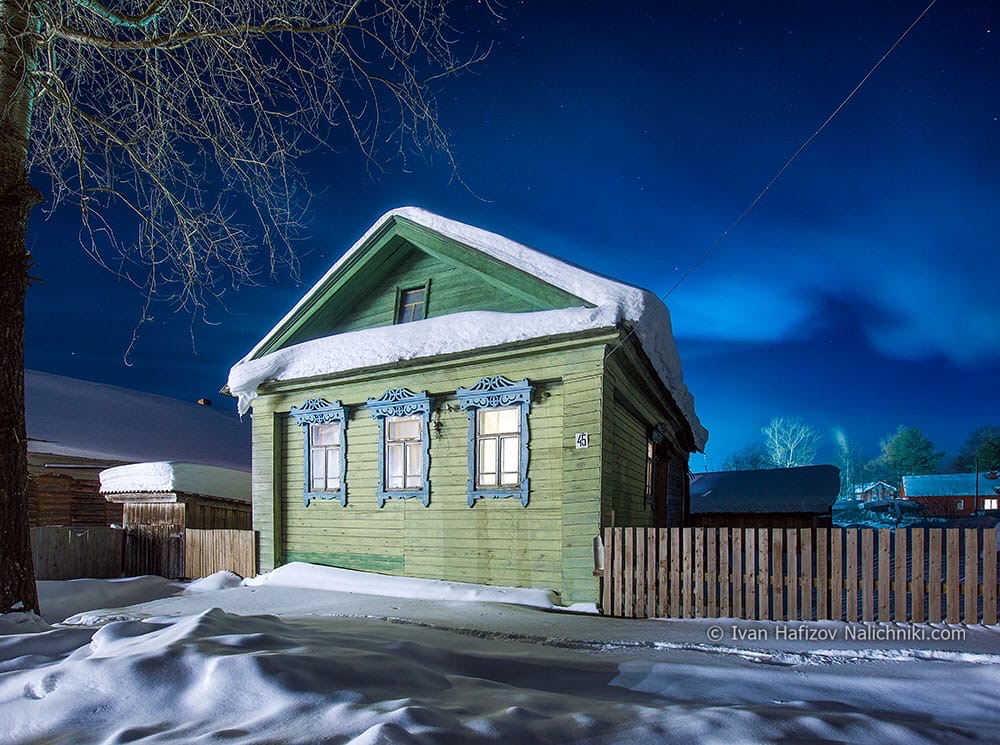
When describing carvings, we most often use the words "lace" and "lacework." "Lace" is borrowed from textile terminology, and "lacework" (ajour) comes from French — à jour, meaning "into the light."
Nalichniki are most often said to be "on the face" of the house. But in other provinces, nalichniki were called "oblips," "cutouts," "attachments," and "shanks." Which are decidedly not "on the face."))
"Wooden architecture" is a paradox and an oxymoron, since "architecture" traces back through Old Russian to the Old Slavic root zd — clay, brick. So "wooden architecture" is, essentially, "wooden construction made of brick."
You'll often find, even in scholarly papers, that the upper part of the nalichnik symbolizes this and the lower part symbolizes that. Some even claim that the owner of the house (or the artel foreman, a visiting carver, or a neighbor) encoded his profession / marital status / religion / number of children / attitude toward the party / ID number in the nalichnik. All of this may be true of one particular nalichnik, but in general, it's wrong: the only rule that 99.9% of nalichniki follow (and 0.1% hints that there are exceptions) is axial symmetry — the left side mirrors the right.
Nalichniki are an established symbol of antiquity — they adorn the covers of Russian folk tale collections. Yet nalichniki only appeared in the 17th century, during a surge of exchange with European architecture. They're not found in engravings, paintings, or the memoirs of contemporaries before the 17th century.
Nalichniki are a recognizable symbol of our culture, but they are not recognized as a national craft. We know our local crafts — Khokhloma, Yelets lace; we remember coopers, beekeepers, and spoon-carvers — but there are no "nalichniki makers" or "nalichniki carvers" as a recognized trade: only carpenters and joiners.
It seems that carved wooden nalichniki — and every word matters there: carved and wooden — exist only within the Russian world. I believed this myself for many years. But no: carved wooden ornaments framing windows exist all over the world — in Europe, Southeast Asia, and the United States. Their appearance is, of course, very different from region to region: everyone easily recognizes their own, and looking at the windows of other regions — or, even more so, of distant countries — will understand immediately that they're looking at something foreign.