…— And is zis your first time here, yes? — the older of the two men checks.
— Yes, I haven't managed to get here before.
— Go up to the cathedral hill, — the younger one points to the hill — up to the cathedral, and where the church is, up there you can photograph all of Plyos, it's absolutely unbelievable… You draw, or what? — he adds, nodding at the tripod that had been swinging from my backpack strap before we'd met, banging against my leg, and now standing peacefully against the fence.
— No, — I smile, sipping my coffee — I only photograph. And not so much landscapes — more old wooden houses.
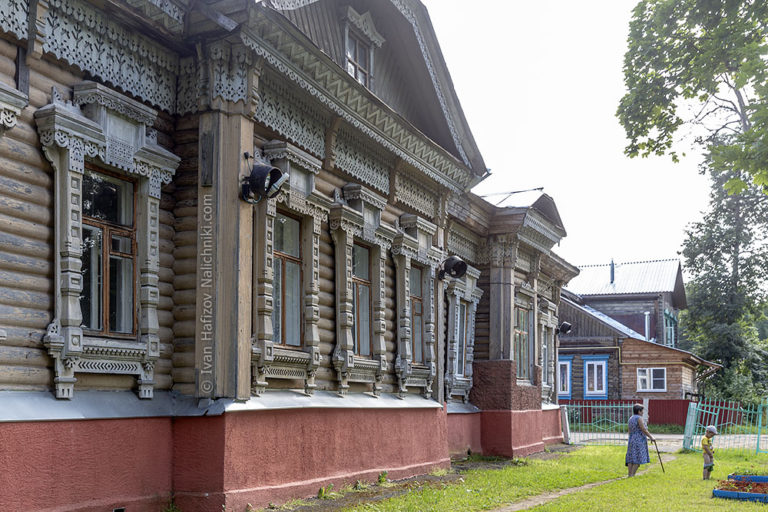
With these two men from the Caucasus — one perhaps sixty, the other roughly half that — we're drinking coffee in the center of Plyos. I'd photographed their nalichniki, they got interested, we started talking, and they invited me for coffee. Alik — the older one — is building a gazebo next to the house. The benches and table are already done, and the rest will come "gradually!" As it turns out, Artur, the younger one, had seen me that morning when I was still shooting on the embankment. He lives not far from there. And Alik says that right behind the church, just around the corner, stands a house built by the carver Nikolai Chistov. I already know about that vivid house, but I'd never managed to find the carver's name until now.
— And your nalichniki — did you commission them from him as well?
— No, — Alik laughs — he was probably a very small boy when these were carved. He maybe wasn't even born yet when they were made!
Alik speaks with a genuine, richly colored Armenian accent, and although from here on I'll write his words in "correct" Russian, keep the accent in your head. It tastes better that way. Artur, by contrast, barely has an accent left. You'd hardly recognize him as Armenian at all — he smiles a little more than most, his gestures are a bit more expressive. But you'd meet him and never guess: everything blurs together with time…
— This house… it must be a hundred and thirty, a hundred and forty years old. — Alik says. — And these nalichniki, the moment you try to take them off… you can't, you'd have to make new ones. The thing is, this is all handwork — not a single machine tool was used here.
— Our house is from 1840. — Artur adds. — The one you were photographing, on the embankment, where the cat is. It says "Smirnov House." The walls — the thickness is a meter! And what year is your house, Alik? — Artur asks. — What year… I don't know! Pre-revolutionary! My grandmother used to say, something like a hundred and thirty years it's been here, if not more. Because a priest lived here during the revolution. And in the old days who had the most land? Priests, or those — what do you call them — merchants… So we've got nearly fifteen hundred square meters of land…
— And now there are two owners of the house, yes? — I ask, referring to the "For Sale" sign displayed on the right half of the house, which is a little less well preserved.
— Ah, — Alik waves his hand — unfortunately our grandmother was deceived. The children were supposed to inherit.
— How's that?!
— They deceived her… Well, the way they do things now — deceiving an old grandmother, what's the trouble… So they came, took the documents, even her passport, filed everything… We weren't here, we'd gone to Armenia for the anniversary. These ones filed it all in their own name. Then when grandmother died, it turns out I'm not the owner. Well, we went to court for three years — and got nowhere…
— That's something… — I'm more and more astonished.
Alik doesn't continue, and what is there to add.
A boy of about eight comes out to the porch, asks if he'll be late for his sports section. Artur starts getting ready to leave; Alik and I stay to drink our coffee… It's nearly noon, I've covered almost all of Plyos, which means the minimum program is complete and I can relax a little… The April sun is warming things nearly to twenty degrees Celsius; all you need to do is turn your face to it.
— And you went for an anniversary…? — I remember what Alik had left unsaid.
— Of the earthquake, — he answers. I have two sisters there. One was in one house, and in the second one my aunt… You probably don't remember, how old are you?
But I do remember. I was eight, but those days stay with me more clearly than many others. I remember for some reason how I was getting ready for school — we had the afternoon session. I remember my mother shouting down to us from the second floor to get out fast, and how I pushed my sister off the chair — the one a bookcase full of books fell on a second later. And how I didn't think twice before jumping into the small but genuine, pungent leather army boots my father had given me a month before… And how they scolded me afterward for not having any proper shoes… And how my friend and I sat on the soccer field, bending our heads, while the field rolled in waves, so that people's ankles appeared and disappeared again… And how we cheerfully spent a whole week afterward living in tents with the whole neighborhood, and how proud and pleased I felt when some soldier in our tent camp let me chop wood for the first time… And how we rode drowsily through the city, forbidden to look out the window, but I saw the collapsed wing of our school anyway… And how we flew out through Yerevan that night, and on the tarmac stood enormous, blinking, colorful aircraft of airlines then completely unknown to me but branded into my memory — Lufthansa and KLM…
— We lived in Leninakan, — I say simply. — I was in second grade.
— We were in Leninakan too, — Alik understands at once.
Artur, having sent his son off to get ready, comes back to us and recalls some details:
— And we flew out of Baku on the sixth of December, the day before, there was the massacre going on there, all of that…
Those details I didn't know at the time, so I try to piece it together:
— That was when… Karabakh was already starting?
— No, — Alik corrects me — that was Sumgait… That was when Gorbachev was in power… — So, — Artur continues — they brought us to this Talin… — and adds, seeing my puzzlement — there's a Talin in Armenia. And they were taking us to Artak, to the village. To the Artak district. We arrived when everything was already in ruins…
"Alik," I think to myself, "is older than both of us… He probably has it harder — he remembers so much more."
As if answering my thoughts, Alik pours himself more coffee:
— My cousin used to work at the tenth school — the one down from the station… you probably remember? No, you probably don't… She was a French teacher — it was a French school — and her daughter… she was ten years old, or so… They were left there… We lost so many then…
— Well, a natural disaster — that you can understand, but how many people were just killed outright by the gangs? — Artur adds, growing heated.
Alik, by contrast, is perfectly calm. He thoughtfully spoons in two sugars, stirs unhurriedly, tastes it, sets down the cup:
— And Gorbachev, when he was told about it, said that they were two hours late to save the Armenian families. And those thugs knew exactly who lived where… Nobody got out alive, they killed everyone — children, old people, everyone… It was a horror then…
…
We sit in the center of Plyos, drinking coffee. From a radio receiver — I only now notice it — Erasure plays "I love to hate you," and somewhere very close flows the great river, beside which, a hundred-some years ago, on this very spot, an unknown priest drank his coffee — a priest who lived two hundred meters from Levitan, closer to the church and to the house of Nikolai Chistov, who was separated from him by no less than half a century…