…The next morning I drive out to Talashkino again.
Twenty-five multicolored tourist buses in the familiar parking lot shatter any hope of quiet: groups of bright-coated tourists all talking over each other about what they've just heard, guides with numbered paddles trying to organize the chaos, unfamiliar languages sounding here and there — nothing at all like the night before…
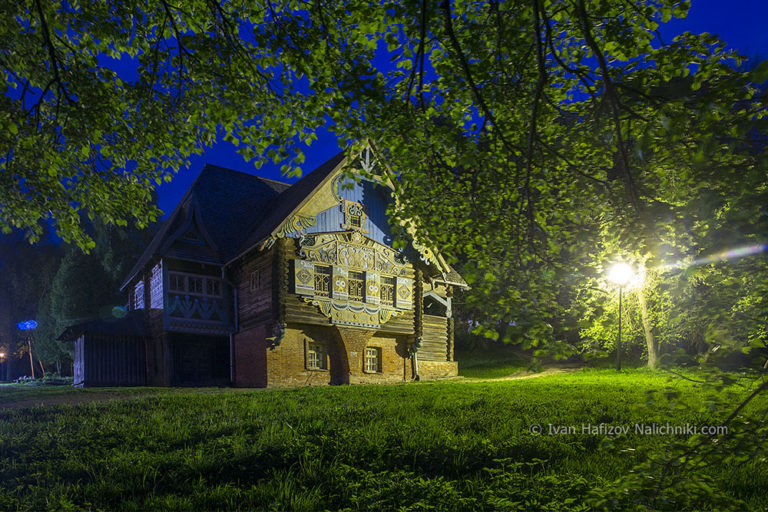
The familiar gate stands wide open. To the left, the spreading tree I'd shot from the night before… To the right, the Teremok — the little fairy-tale cottage. The same, and yet completely different…
The internet is a wonderful thing. Inspired by the sight of the Teremok, I had spent the night finding an article by Maria Zabolotskaya, "Princess Tenisheva's Dream," read it aloud, recorded it on a dictaphone — it wasn't long — and now, as I walk and photograph, I listen and listen and listen… And I imagine…
"Masha Pyatkovskaya, born out of wedlock, who never knew her father, sent off to boarding school at five or seven, who associated her happiest childhood moments with her nanny's fairy tales and… with the paintings covering the parlor walls… 'When the house had gone quiet, I would slip in noiselessly on tiptoe, leaving my shoes outside the door. There were my friends, the paintings…' From childhood she loved history and the natural sciences, and her singing teacher kept telling her about her fine voice…
At sixteen, a young lawyer proposes and she accepts… A family, a daughter, a husband who turns out to be a weak man and, on top of it, a gambler… Dreams of something greater… She goes to audition for a soloist of the Mariinsky Theatre, and he advises her to go study in Paris, to Marchesi's opera studio. Once decided, she stops listening to her family's entreaties — and this decisiveness seems to me to become her defining trait."
"It is hard to describe what I felt when I found myself free. Yes, free… Breathless with a rush of uncontrollable feeling, I fell in love with the universe, fell in love with life, seized hold of it…" Marchesi took a particular interest in her. Yet she did not live in Paris on music alone: she took lessons in the visual arts, began studying art history, spent hours in books and museums… And another passion made itself known — a pull toward everything ancient, everything carrying the pure origins of human genius…
But for now — Maria Klavdiyevna returns to Russia, where poverty awaits her, an ambiguous position in society, pressure from her former husband, and no prospects whatsoever…
…
I move to a new vantage point, closer to the Teremok, under the shade of the apple trees. I have to wait quite a long time here for the flow of tourists to thin — they seem to have been waiting for me to start shooting. But there's no rush, and I sink back into the past listening to my own voice…
…
"…In a difficult moment Maria is found by her best childhood friend — Yekaterina Svyatopolk-Chetvertinskaya. She supports her, inspires her. Maria comes to join her at Talashkino — then Svyatopolk-Chetvertinskaya's estate, eighteen kilometers from Smolensk — to open a school for peasant children together. 'We went from cottage to cottage, persuading the peasants to send their children to be educated, explaining that they would be taught not only literacy but also farming…' Becoming absorbed in organizing the school, Maria begins to study pedagogy seriously, observing the state of education in Russia. Of the institution where her daughter was studying she writes: 'The education they receive there is highly questionable — they are pushed from class to class, brought through to graduation, but their knowledge amounts to nothing, with rare exception. In this enormous herd of living beings, everything is leveled — the good and the bad. Individuality is stamped out by the uniform, the walk, the manner — to the point that they even have identical handwriting, and what lives beneath that crust — all the same.'"
At this time she meets Vyacheslav Nikolayevich Tenishev — a prince and entrepreneur involved in railway development, building St. Petersburg's first automobile factory… In 1900, Sergei Witte — the finance minister of the day — appoints Tenishev as Russia's commissioner to the World Exhibition in Paris, in which Maria Klavdiyevna will take an active part… Among his other qualities, he has an excellent understanding of music, plays the cello, and is always learning…
They move near Bryansk, where Maria becomes the guardian of the only school in the area. Watching with astonishment the remarkable changes in the children — who had only recently been idling around the yards — "Before me stood future people, consciously engaged in their work, who had taken on serious tasks with enthusiasm and dedication" — Maria Tenisheva opens several more schools in nearby villages and simultaneously fights for a ban on child labor at the factory and establishes a charity to help orphans and widows…
Later, when Vyacheslav Nikolayevich leaves the management of the Bryansk factories, the family moves to St. Petersburg, where Maria immediately organizes a musical salon frequented by Tchaikovsky, Scriabin, Arsenyev, and many other celebrated composers and performers. She also opens a studio to prepare students for the Academy of Arts. Repin himself takes on the teaching, and before long the place is enormously popular — among the studio's students, the then-young Ivan Bilibin, Efim Chesnyakov, Mstislav Dobuzhinsky, Zinaida Serebryakova…
At the same time she becomes one of the founders of the journal "Mir Iskusstva" (World of Art), opens a drawing school in Smolensk, mounts an exhibition of her picture collection — which she later donates to the Russian Museum… At the same time, adding to her (eventually the largest in Russia) collection of Old Russian applied art objects, she organizes expeditions to various corners of the country… In 1905 she donates the entire collection to the Smolensk branch of the Moscow Archaeological Society, having first built a separate building for it there… "With the years, more and more, Russian antiquities began to arrest my attention, and a whole world — until then unknown to me — opened wider and wider before me, and this world drew me in more and more strongly. I suddenly felt that all of it was close, mine, native. Loving Russian nature with a passion, I had always at heart been a purely Russian person. Everything that touched my country moved and stirred me deeply."
Talashkino would be the shining proof of those words."…
Moving unhurriedly, photographing details, I circle the building and wait for the frame to clear of tourists. Behind the Teremok I discover a tall hill, bare at the base but grass-covered, and climbing it you find yourself level with the roof. I wedge the tripod legs between the artists sitting, standing, and lying with their easels, and once more turn all my attention to listening — the story has finally come to the Talashkino estate itself…
…
"…The Tenishevs purchase it in 1893. By this time Maria Klavdiyevna is already known in capital circles as a talented singer, a great lover of art, a patroness of young artists… As in St. Petersburg, she quickly creates at the Talashkino house a welcoming, creative atmosphere that draws many celebrated artists, musicians, and scholars. Contemporaries call Talashkino a little Russian Florence, where people dream of Russia's rebirth. And not only dream.
Not waiting for action at the government level, Maria Tenisheva sets herself an almost unimaginable task: to transform the peasant's way of life, to teach him a new relationship to the land. To this end she invites from St. Petersburg the famous Professor of Botany Robert Regel (Russia's only Doctor of Horticulture at the time), buys the Flyonovo farmstead near Talashkino, where she decides to create a new-model agricultural school with a model teaching farm. There too, at Flyonovo, a model apiary is established, a museum of beekeeping, and a weather station… In September 1895 a new peasant school opens, next to which a fairy-tale cottage is built, decorated with carving and painting — it houses the library and the teachers' room.
The sketch for the cottage is drawn by the artist and architect Sergei Malyutin… known to us for his illustrations to Pushkin's Ruslan and Ludmila and The Tale of Tsar Saltan… and familiar to all admirers of Russian Art Nouveau through the Pertsova apartment building on the embankment that I love, near the Cathedral of Christ the Saviour… The best books, textbooks, art albums, and journals are brought here from the capital and from abroad. Those who visited the Flyonovo school were struck by the cleanliness and comfort in which the peasant children lived and studied…
One of the jewels of the Flyonovo school was also a children's balalaika orchestra, famous throughout the Smolensk region. The reason: a celebrated musician, a balalaika player, soloist of Andreyev's Great Russian Orchestra — Lidin — who, inspired by the Princess's endeavors, moved to live and work at Talashkino…
But another old dream would not let her go — artistic workshops at Talashkino. Long an observer of art's development in Europe and Russia, an active participant in the capital's artistic life, having earned the reputation of a patron of everything new, bold, and gifted — Maria Klavdiyevna herself turned more and more often to the question of Russian national art.
The time came for her to realize her long-held vision — to revive the Russian style, not by imitating antiquity, but by drawing inspiration from the epic, fairy-tale past embodied in Old Russian art: "…Every epoch, every generation, can bring something new, can say its own word — but not by copying the past, rather by being inspired by it."
The Talashkino artistic workshops were headed by the same Sergei Malyutin, and one after another, ceramic, embroidery, dyeing, furniture, artistic ironwork, and woodcarving workshops were opened. A first museum, "Russian Antiquity," appeared here too.
"Talashkino was completely transformed. Everywhere you went, life was in full swing. In the workshop there was planing, woodcarving, carved furniture being ornamented with stones, fabrics, metals… …In another workshop young women sat at embroidery frames, singing songs in full voice. Past the workshop came peasant women with bundles under their arms: they had brought finished work or were picking up new assignments. You walked and your heart rejoiced."
The workshop's products quickly became famous: a shop called "Rodnik" ("The Spring") opened for them in Moscow. And shortly after, following an exhibition of Russian applied art abroad, Talashkino's work was the talk of all Europe. Maria Tenisheva would later say: "My Talashkino workshops are a test of Russian art. Were this art to reach perfection, it would become universal…"
In 1903 Nicholas Roerich arrived at Talashkino, later to become a true friend to Maria Klavdiyevna; Mikhail Vrubel was a frequent visitor, as was Konstantin Korovin… Everything created here astonished and delighted not only celebrated artists but many other contemporaries…"…
I come back down the hill, closer to the Teremok, touch the rough walls, regret that I can't quite reach the wood shingles on the roof… The tourists have unexpectedly cleared entirely, the artists sitting on the hill have been left far behind, and I find myself suddenly alone with the log wall rising above me and the painted window. There is something real about this place. Fairy-tale, dreamlike — but very real…
I take a few shots of the carved porch, cast one last glance at this remarkable building, and, listening to the final chapter of Princess Maria Tenisheva's story, head into the depths of the park to find the church she never got to finish…
"A storm swept through — sudden, terrible, elemental… What had been built cracked and fell apart; a cruel, blind force destroyed all the loving labor… The school's fledglings were scattered, the craftsmen dispersed…"
The last ten years of Tenisheva's life were spent in emigration, on a small estate at Vaucresson that her friends called "Little Talashkino." There, already gravely ill, in a small studio on Avenue Duquesne, she continued working on enamels, earning her living through her own labor. Her enamels were highly prized and found their way into many museums and private collections…
Years later, having lived through the bitterness of disillusionment and loss, Tenisheva wrote: "I told myself that temples, museums, monuments are not built for one's contemporaries, who for the most part do not understand them. They are built for future generations, for their development and benefit. One must set aside personal enmity, grievances, any personal point of view at all — all of that will be swept away with the deaths of my enemies and my own. What will remain is what was created to serve and benefit the young, the generations to come, and the homeland. After all, I always loved it, loved children, and worked for them as best I knew how…"
PS. Talashkino is waiting for you today. Go without a second thought.
PS2. There are three days left to order the nalichnik calendar from across the country.
The link: https://planeta.ru/campaigns/nalichniki2019