

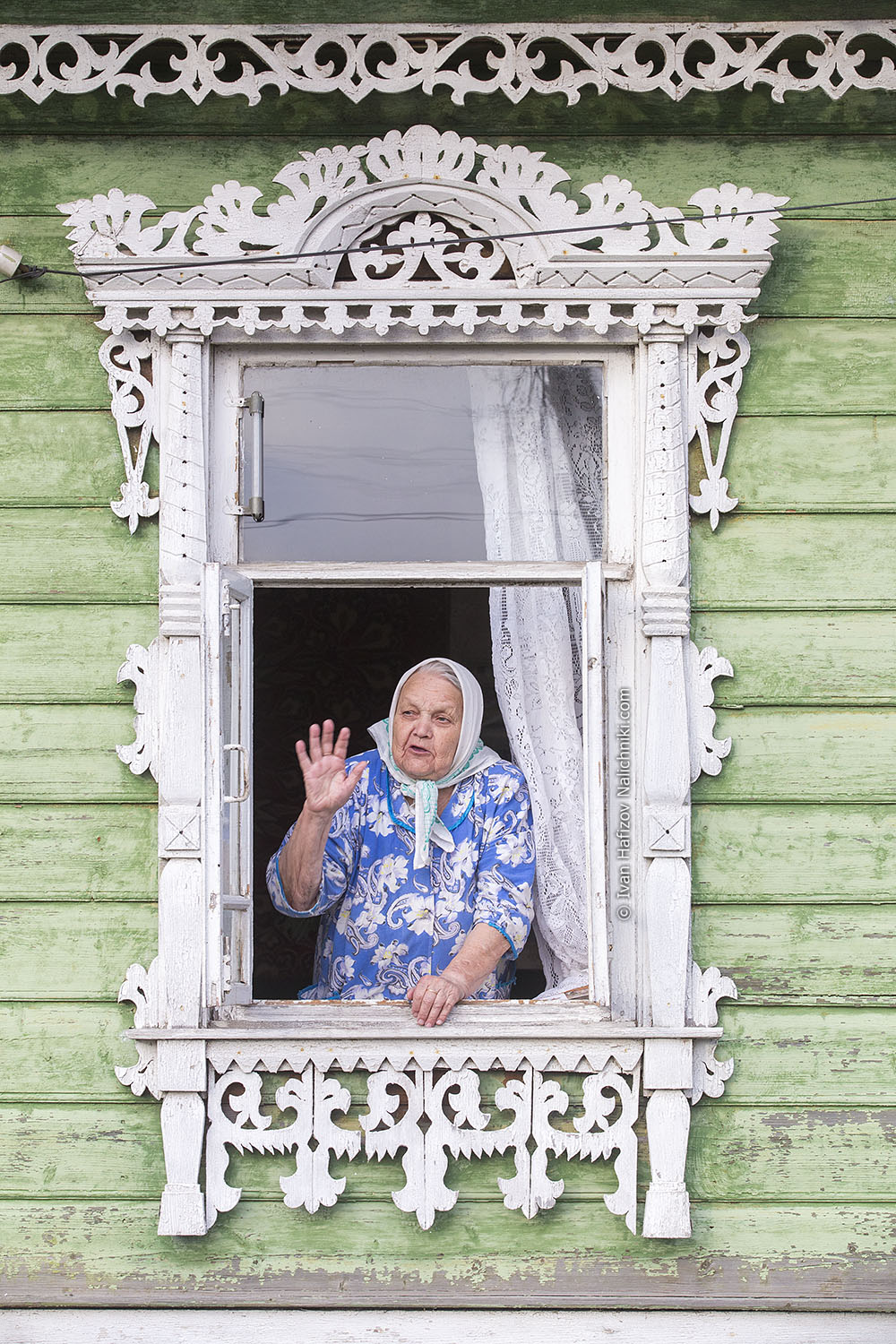
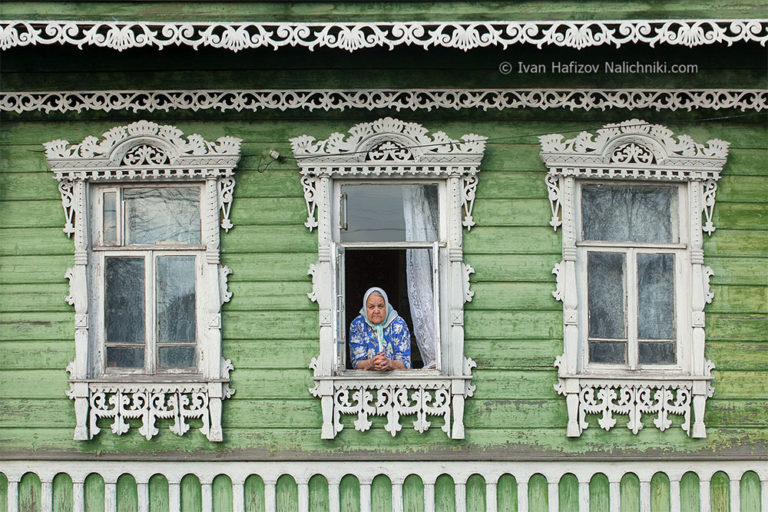
…— The neighbors that lived here, the neighbors, they up and left, I don't know where to, seems like they didn't sell the house, I don't know. Seemed like it was fall, I go knock — look at that, the leaves haven't been raked, the whole path buried. I peek through the window and — up and gone: vanished. When and why, nobody knows… I keep an eye on the house, so I came out, thought, what's this person looking at. So you're here for these wooden things?
— Yes, I photograph nalichniki, I'm building a collection for a museum.
The old woman had appeared a minute ago from the house behind, clearly dropping whatever she'd been doing: she's in a blue apron, with a gray, well-worn towel with blue stripes over her shoulder. A gray braid down her back completes the picture, with a blue ribbon woven into the end. And her eyes are gray-blue, clear, translucent. Remarkable eyes.
— Well I've heard about it, yes, people collecting irons now, old things, they came to me too and asked, I gave them a trunk, then I found it at the dump: I guess they didn't need it after all. Well, what can you do, I took it back… Heavy trunk, good trunk. Barely dragged it home. Barely.
— Took it back? — I say, surprised.
— Well, why let it go to waste? Good trunk, a hundred years old if it's a day. Or maybe two hundred, who knows. Still a good trunk, it'll stand another while.
— And it's a nice trunk? Painted?
— What do you mean nice! — she laughs — an ordinary trunk. Just heavy.
She takes the towel down, deliberately, unhurriedly, wipes her hands in a particular way.
— And the nalichniki — do you know if one of the owners carved them?
— No, not them. Before them. Before them. They bought the house not that long ago. They're brother and sister, from Moscow. Andryusha lived here, got married, had four little ones. And the sister would come visit from — I don't remember where. But somewhere near us. She had a whole brood of them, and when they'd come, things would really get going here… Oh, I'd get after them… — remembering it, she smiles so warmly that I can't help smiling too. — Running everywhere, the little one banged her knee, tears and screaming, oh…
Suddenly she turns serious and in a confidential half-whisper tells me:
— They most likely went to their mother, all of them. I think so. You could find them through her.
— I'm more interested in the nalichniki, — I answer, keeping up the mysterious tone with a smile.
— Ah, right, right. But if you want to find them — she goes on, though it'll do me no good — the mother lived in Moscow. Old woman. Her husband died long ago, was some kind of big shot back in the day. Died before Yeltsin, at least he didn't live to see that mess. Well. Andryusha used to tell me. I'd say to him: "Why don't you bring your mother here, she's alone there!" Look, I've got nobody left, where am I supposed to go — drop dead right here. But you've got a house, you should bring her. And he'd say: "Go on, try and bring her! She's got five rooms and a clinic there. And an elevator. And she never leaves the theaters. What would she do here?" Gas — we've had it for years now, they dug up the whole road putting it in, then just left it. We had mud up to our knees here. It's nothing now, I suppose… Well so… But she complains, he says, that we never come to see her. But what am I supposed to do with my family, he says, what's there for them? They need fresh air, they're used to it.
Suddenly a muddy UAZ pulls up next to us; a broad red face in camouflage leans out the window and asks if she's seen Seryoga today. With a barely perceptible shift in her face, she becomes completely plain and ordinary in an instant, and answers that she saw him through the window this morning but doesn't know where he went. The driver stomps the pedal, the UAZ jerks off, parks a few houses down, the driver slams the door loudly and disappears through a gate.
— Crazy rascal, — she remarks, shaking her head, and then, transformed again, her eyes lit up once more, she picks up the story:
— Well so… The mother's there alone, and he and his sister are here, and they don't go. And apparently he was trying to talk her into selling that Moscow apartment and moving to them. She wouldn't hear of it. But then suddenly she agreed. Andryusha was walking around here cock-of-the-walk, reporting to me: "I talked her into it!" I said — what? He explains. The Moscow apartment was big. Seems he'd done the math — how much, what it's worth — figured out: you could buy half this town with that money. And he bought her — here she makes a dramatic pause and looks at me solemnly — a castle in Poland! Four stories and a park with a fountain! Except there's a rule there, apparently, that one day a week you have to open the castle to anyone who wants in, give tours or something… And she had some Polish roots. She kept saying: let's fix it up, let's bring the pond and park back, and she took up learning Polish — at seventy! Andryusha's family would go spend the whole summer with her, he'd tell me fairy tales about life over there afterward. And she — here the old woman leans toward me again, conspiratorially, and announces it like a great secret, with a triumphant smile — she found herself a gardener, and then went and got married there. Catholic ceremony — so it's as if the first marriage had never been.
Then she looks back at the house and the street and says with a sigh:
— So you take my word for it: they moved there for good.
And then, as if suddenly remembering me, as if completing the circle, quietly, her whole manner somehow fading, she adds:
— So I keep an eye on the house, in case anything… I came out: what's this person looking, maybe he knows something…



9 comments
Конечно настоящая, я других пока и не видал)