…I really need to get going, but Seryoga tops up the tea and — what keeps me far more than the tea — keeps telling story after story.
"And in my platoon there was this little snitch, this… from the special department… sketchy kid from Leningrad, he'd been involved since childhood… born cop, basically. He was a Komsomol member, a volunteer, a local party activist… his dad was apparently some kind of KGB man, and the kid had been in that world since childhood — there was this thing in the Soviet Union called 'young police auxiliary.' And all that whole business."
"Wait," I say, "what year did you serve?"
"From '90. Ninety through ninety-two. Right when the Union was falling apart… I saw the coup on Palace Square. So… Then I found out he'd also been reporting to this… special officer. We had a soldier who'd gone AWOL, I was company clerk at the time. Anyway… What year are you, by the way?"
I laugh:
"From 1990, if you can imagine, I have almost no memories at all. What I do remember is my cousin coming in suddenly in tears. We say: 'What happened?!' She says: 'Tsoi died!' And I go: 'Who's that?' — Well, I was ten, it completely passed me by."
"Fair enough. But you listened later?"
"Of course! Ha, did I listen!" I laugh. "So much that when I didn't put him on for a week for some reason, my parents said it was like a relative had gone away."
"Right. Anyway! You just reminded me. About this Pasha. We had a separate company, and I came to HQ for something… and out of the special officer's office he comes, and I say: 'Pasha, what are you doing here?' And he goes all shifty: 'Oh, I'm just, I'm just, er…' Sketchy character, basically.
"Anyway, that's the backstory. My final batch — that's July 4th — and this Pasha is in it. We end up in the same company, even the same platoon. And he tells me this story about how he used to help the police and the volunteer patrols. They were assigned to all the concerts. Because it was something new, uncharted territory at the time. Grebenshchikov's first official concert was in '86."
Seryoga thinks.
"Or was it '87? In '86, I think, at the SKK. They gave two concerts — it was just mind-blowing. Packed out! Anyway… And so he was on duty at Tsoi's very last concert in Petersburg. At the SKK. Which I didn't get into, but he was in this volunteer patrol. And there was this story that… well, the concert, thousands of people, a hundred thousand, and of course after the concert everyone waited until the crowd dispersed, and only then did they take Tsoi away. And Tsoi, he was sitting there so that the fans, all of that… so there wouldn't be a scene. They waited, basically, for all the drunk, stoned die-hards of Kino to make their way home, and then, like, he'd get in the car and go. So… And since it was the SKK and they had nothing there for concerts… well, the Soviet Union was still going, everything was rough and ready: the dressing rooms — they were all just hockey changing rooms, basically. So there they all sat in one room: Kino drinking and all these… this riffraff, these young volunteer-patrol kids… And one of these volunteers took a poster off the wall and went up for an autograph. Well, all this riffraff had already stripped the place of posters — like, 'Holy hell, Tsoi's right here!' — and then also shuffled up to Tsoi for autographs. And he didn't refuse: nothing else to do, everyone's sitting there smoking, waiting… And so they all got autographs, but this one, Pasha, had nothing. And Tsoi says: 'And you?' Like, 'Don't you want an autograph too?' And he says: 'I don't have anything.' And Tsoi pulls out a pack of KIM cigarettes, signs it, and — here, take it. So…"
"Wow! A signed pack of cigarettes from Tsoi's own hands! How symbolic!" I say. "And KIM — does that stand for 'Communist Youth International'?"
"They were some kind of light ones, menthol… Something Tsoi-Kim in the name… I don't remember. Anyway. So this Pasha arrives in the Soviet army, and there's this completely unhinged sergeant… Oh! We had a separate company, and in that separate company there were Kino fanatics of the highest order. The main one was the platoon commander, a sergeant from Murmansk. Or Severodvinsk… but he was just… completely… In short! At night they had a band, electric guitars, they'd sometimes get it going, he'd jut his jaw out like Tsoi… completely obsessed. And this is 1990, you have to understand. Fresh new training unit, some kind of hunger, some kind of cold, some kind of hell, basically. And then this Pasha goes: 'Comrade Sergeant, sir, how about arranging me this… overnight pass… And I'll give you a pack of cigarettes with Tsoi's autograph.' And our platoon commander… I don't know what they did to him exactly, but somehow they wrangled Pasha free of it… the company commander had disappeared somewhere… he was a proper little fuhrer, lord help us… they promised something, worked it out somehow, and let him go, and he brought back the pack… And two weeks later!…"
Seryoga pauses, and I understand that the ending is close.
"It's a scene straight from a painting. So: the Soviet Union. Soviet army — a hundred and twenty men, one enormous barracks, bunk beds, and at the far end a TV mounted on the wall up near the ceiling. At nine o'clock, one hundred and twenty men, as one, sit down on their stools — 'four to a row' — and watch the Vremya news programme. And stitch their collar liners for the next day's inspection. And then on Vremya — I mean, for someone my age, it was just mind-blowing — the main Soviet broadcast announces: 'Singer and composer Viktor Robertovich Tsoi has died.'
Everyone in shock, because news for Vremya… this was a total reality shift: they'd announced a rock musician on Vremya! Pasha's sitting right next to me, I turn around and say: 'Pasha, imagine how badly you've blown it: that pack's going to be worth a fortune soon. All that for one night out!'"
Seryoga goes quiet, and I, on the contrary:
"Wait — so what happened to the pack? Did whoever got it manage to hold onto it?"
"Of course!" Seryoga beams like the sun itself. "He sent it to his mother in a parcel straight away, to be on the safe side! So it survived."
He goes quiet, and I try to imagine what that boy must have felt. It doesn't quite work. He wasn't even a fan, so he shouldn't feel sorry, and he got what he wanted… but there must have been some sting to it all the same…
Seryoga brings me back to the present:
"Oh wait — have you heard the story about Tsoi and the fridge?"
I have no idea what he's talking about, and shake my head. Sounds like the title of an episode of a Czech cartoon about Little Mole.
"No?! Come on!"
He leans forward excitedly:
"There was this whole story! A year ago, maybe two… Some people, as it happens, on Rubinstein Street sold a communal apartment. Cleared everyone out. And the people moving out shifted a fridge that had stood in one spot for forty years. And behind the fridge they found!" — he holds the cinematic pause — "Tsoi's address book and passport!"
"You're kidding!!!"
"They all showed up… Kasparyan came, said: 'Well, actually, that passport was stolen from Tsoi somewhere in Gelendzhik. And this person, from Petersburg, probably stole it there and it just sat with him…' But the more likely story is that there was a concert in this apartment, Tsoi put it down somewhere, everyone got drunk and stoned, and the passport fell behind the fridge and just lay there. And besides the passport with the residency stamp, there was actually also his phone book — with Grebenshchikov's number, Joanna Stingray's address, and all of that…"
"And where did it all end up? Some museum?"
"Sold at auction. For something like… five million, I think? What different fates objects have…"
______________________
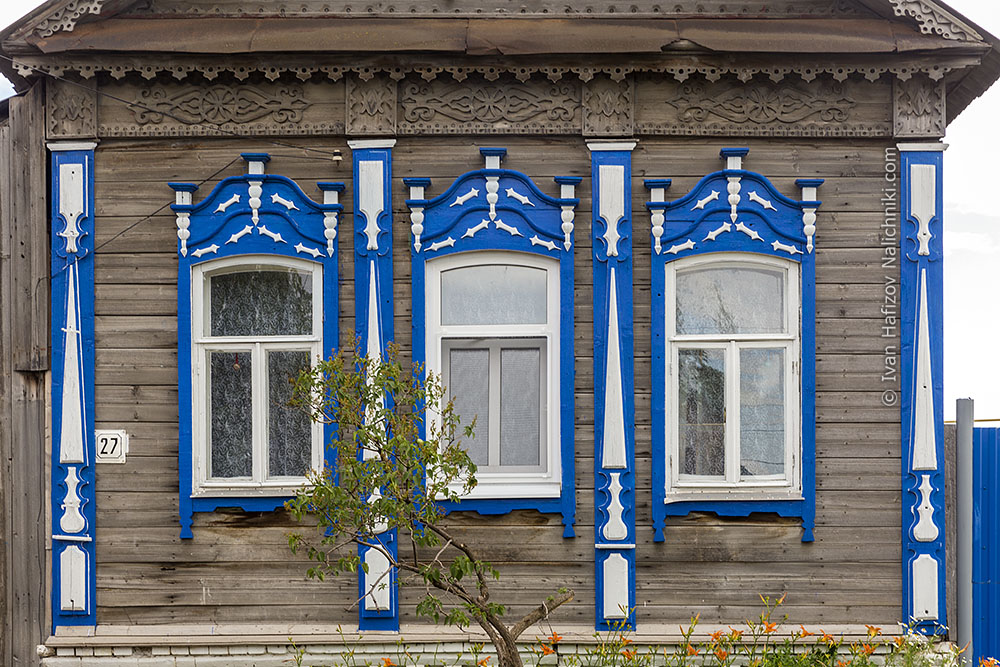
PS And in the photos — the diamond-shaped (and not only) windows that surprised me, from the village of Maydan in Mari El.
I haven't been many places, admittedly, but I've never seen anything like them)