


…— You won't get it that way, you need to go inside!
I give a start and turn around. The voice belongs to a woman who is watching with interest as I jump up and down by the fence, trying to photograph what appear to be beautiful nalichniki on a house I'd spotted from a distance. A hundred meters back, the street rises uphill, and through the foliage I'd caught a glimpse of a merchant house. But shooting from there is too far, and the fence is clearly over two meters: even jumping with the camera stretched at arm's length, I'm only capturing the very top of it.
The woman has a small bag over her shoulder — clearly coming from work: it's a weekday, nearly six in the evening. "Probably a teacher," I think. "Or a librarian." For some reason I want to think librarian, though by her age she may well be retired.
— But is it even occupied? — I ask in surprise. And catching myself, add: — Good evening!
— Of course it is. Come on. — and without waiting for my reaction, she walks toward a pair of large iron gates on the right. — One of my former pupils lives here. I take it you're interested in wooden architecture? I saw you from the street, going up to every house.
I barely manage to nod before she's already knocking loudly on the painted-and-repainted, three-meter-high gray gates — gates that would suit a military installation, needing only the red stars.
We listen to the barking from behind the wall for several minutes; then a bolt slides back with a clang, and behind it a pair of male eyes peers out at us with attention. Briefly up and down at me, carefully and questioningly at my companion. She breaks the silence first:
— I beg your pardon for the late call — we'd like to take a look at the house and photograph it…
— What for? — the eyes ask rather bluntly.
— For the nalichniki museum. — I put in.
— The man is studying the carved woodwork of the area. — the woman adds.
— I study carving from all over Russia. — I insert again.
A barely perceptible pause; then the man says, very leisurely:
— I don't do publicity.
— What's publicity got to do with— — the woman begins, but I cut her off:
— I never publish addresses. Usually just the town.
— We won't publish anything! — the woman declares with conviction, and I'm involuntarily won over by how quickly she absorbs and runs with new information.
— Here, look, — I hold a card with nalichniki photographs up to the window slot — here's the website address. Please, take it. The man, however, is in no hurry to take the card:
— I simply don't do any kind of advertising. Self-promotion either.
And before I've had time to conclude that we're probably getting nowhere, he steps back from the slot and adds:
— Well — all right, go around to the front and photograph it.
The bolt covers the eye slot, the latch scrapes back, and the heavy gates open to reveal a broad, solidly built man, beginning to go gray, in a blue tracksuit and slippers. And behind him: a house of breathtaking beauty.
Houses, to be precise — because behind the gates hide two enormous estate houses, each more beautiful than the last.
— The dog won't bite? — my companion asks.
— She's by the garage over there. Won't bother you.
We step a few paces inside and look around. The houses turn out to be twins: five windows each across the facade, nine along the side, and a large veranda besides. I can't suppress a gasp of astonishment and start asking questions.
— What are these houses, do you know? And the nalichniki — they're enormous! Completely unlike anything around here!
— Please forgive my appearance — says my escort, suddenly switching to the familiar "you" and speaking in a bright voice.
— Oh, never mind, — the owner smiles. — Mine's about the same. — And turning to me, with undisguised pleasure, he begins to explain:
— The factory manager lived here. (He gives the name.) The factory owner's nephew. They called it "company housing."
Raising the camera in a questioning gesture, I check again just to be safe:
— I'll take photographs? You really don't mind?
— Go ahead, photograph away.
I shoot the nalichniki from every angle I can manage: they really are superb, and well preserved besides. After several minutes I sense the wave of goodwill beginning to shift toward impatience, and I turn around.
— So — everything done? All right? — the owner asks.
— And that one? Would you allow me? — I nod toward the second house: from where we're standing, the nalichniki aren't visible and I think they may be different (and so they are).
— The nalichniki on that one aren't as good… — he says thoughtfully, but gives a nod — go on, photograph the front.
The nalichniki on the second house are indeed in poor shape: of the five on the facade, really only one could be called intact, and that's generous. But the carving — what carving! An iconostasis! Even in this condition the nalichniki are astonishing in their sheer monumentality! Taking advantage of having wandered some distance from the owner, I quietly take several full shots of both houses: "I'll risk it," I think. "He won't actually kill me. And who knows what might happen to these houses — at least the photographs will exist." I come back to them and praise the houses sincerely; I can see it pleases him.
— Year of construction: 1883, — he stands a little straighter. — Nothing here has changed since then.
— Really, even the lower logs haven't rotted? — I'm surprised.
— Well, I did do repairs… — he says, a little hurt. — Had to lift the whole house about half a meter.
— You did all this yourself?! — my astonishment knows no limits.
— Yes. They were abandoned when I found them. Windows were knocked out. Over there they've got plastic now — (the far house indeed has white plastic frames; the nearer one — which I take as a conscious preservation decision — still has its solid wooden frames, with metal security bars fitted between them).
— Will the others get plastic too?
— Yes. They'll look exactly the same. No difference at all.
— But the nalichniki — all this beauty will stay, won't it? — his acquaintance joins the conversation.
— Of course, of course — the estate owner nods proudly.
— But over there at my place, — the woman nods somewhere beyond the fence — one house after another, and it all gets stripped off! Vandals, real vandals, I think. They haven't the faintest idea what they have!
Taking advantage of the owner's distraction, I click the shutter a few more times and photograph both houses whole. But I'm caught immediately.
— Hey, friend, now you're not just doing nalichniki — you're photographing the whole house! I told you, I don't need any publicity. — the man makes no effort to hide his irritation.
I give an awkward smile and ask:
— I'll delete it without a problem. But I do it for the historical record. And truly, I never give addresses.
— Well, see that you don't… — the owner of the house begins, thoughtfully.
— I have, by the way, — I interrupt, pressing my advantage while he hesitates — a surprise for you! Right now!
I duck under his arm holding the gate panel, run to the car — luckily it's parked close — grab two nalichniki calendars from the trunk (it's handy that I printed an extra supply) and run back. I present a calendar ceremonially to the owner of the house. My escort, encountered so fortunately at exactly the right moment, receives the second.
— Thank you very much, — I say, — for preserving all of this. I have the deepest respect for the work you've done here. And thank you so much…
— Oh, there's plenty more to do yet. — the owner gives a modest smile in parting and closes the creaking military gates behind us.
The woman presses the calendar to her chest and walks along with me to the next house. We chat about this and that, discussing the nalichniki on that house too. But when we've gone perhaps two hundred meters from the estate gates, she seems to deflate somehow — as if suddenly exhausted — sighs heavily, and, speaking now as if forcing herself, adds a few small details to the owner's account:
— All these airs he gives himself… He saw you weren't local. But the truth is! The truth is, it was a pioneer camp! It was never abandoned a single day! He got it while it was still warm. For next to nothing… His father was, of all things, a shepherd. And what became of the original owners… Lord… I don't even want to say anything bad… That's our local mafia for you… Plastic windows… Ah, of all things to have done to something like this… Ruined it all, just for himself and himself and himself…
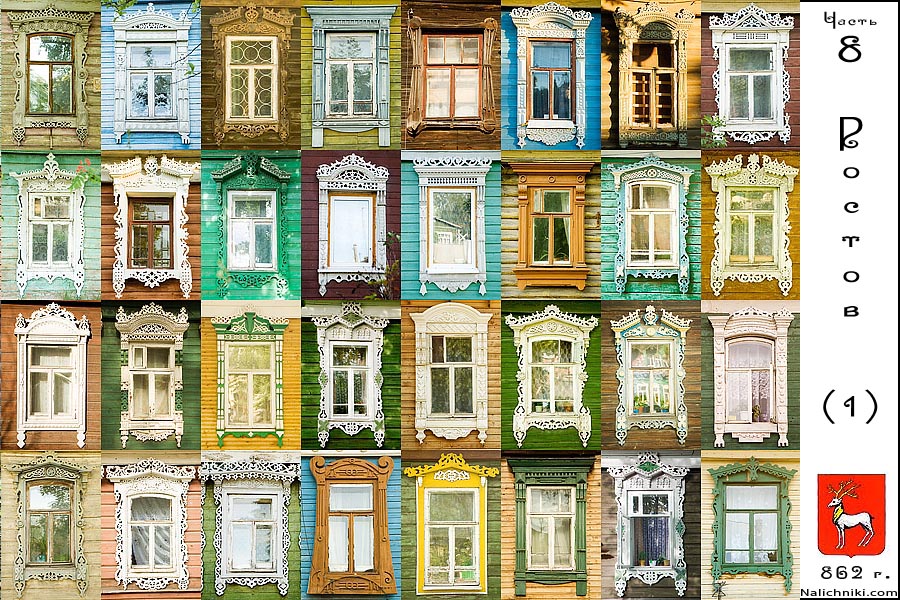
P.S. The photographs, as you may already have guessed, show a completely different house. It has nothing to do with the story. This is Vologda — the Tikhanovsky house, built in 1895.


3 comments
Дом 100% узнаваем, видела и снимала этот его буквально пару недель назад и точно помню, что там местное отделение РАН сидит, и никогда этот дом не пустовал... Дурят нашего брата)))