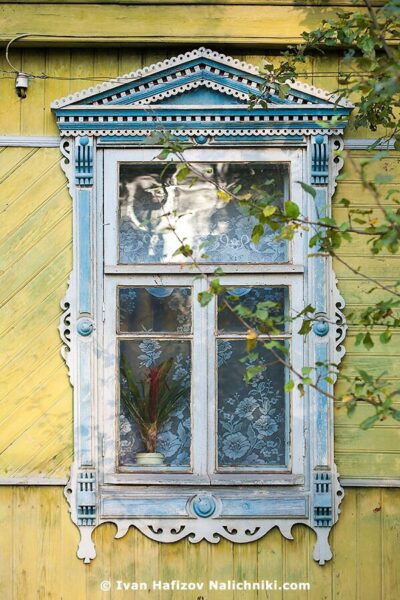
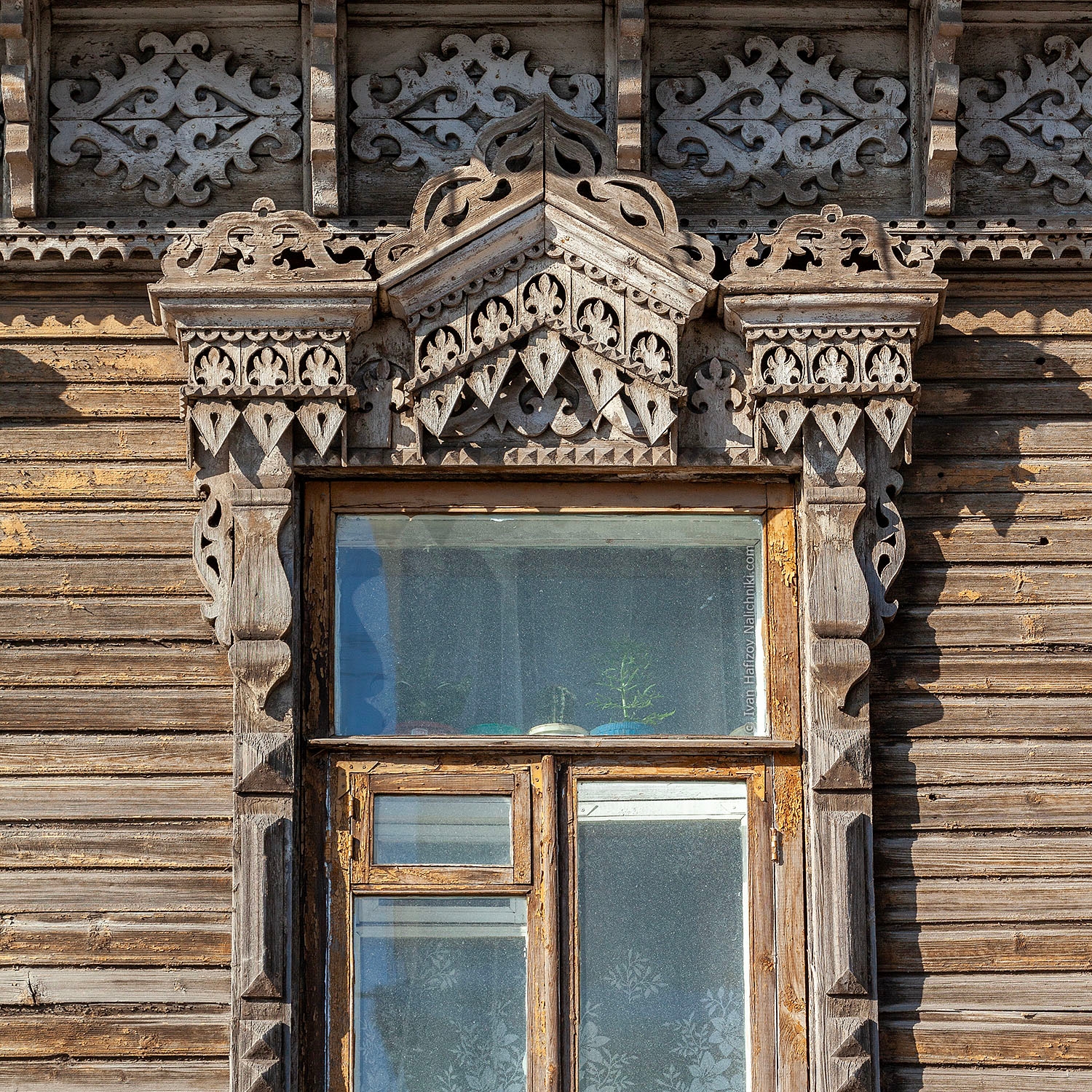
Yukhov is one of the smallest cities I've visited, and probably the smallest where I've photographed nalichniki. Its area is three square kilometers, and the population less than seven thousand. Today Yukhov couldn't even qualify for city status: in Russia you can only become a city if a settlement has more than 12,000 inhabitants. But Yukhov became a city back in 1777, when that status was granted quite differently. What drew me to Yukhov was not its size, nor the fact that in the last hundred years the city has been completely destroyed twice. What drew me was that right here, 211 kilometers from Moscow, occurred what all of us know from school textbooks as the "Great Stand on the Ugra River"! Those who studied history diligently in school — not yet knowing why, but sensing it would come in handy — remember the fact of this Stand. To recall the details, though, I did have to dig through the books.

In fact there were two stands on the Ugra River. The first occurred in 1408 and had nothing to do with Yukhov, having happened a couple of years before its founding. The second was in 1480 — squarely on the city's 72nd anniversary.

As you may recall, the military-political dictatorship later known as the Mongol-Tatar Yoke was established by 1241, when the Mongol invasion of Rus occurred.

I'll skip the unimportant 230 years for this story and jump straight to 1472, when Khan Akhmat of the Great Horde led his army against Rus. On that occasion his forces met resistance near Tarusa — they were prevented from crossing the Oka, and generally given a rough time.

Yet despite this, until 1476 Rus still paid tribute to the Horde. And after Ivan III ceased to pay, the Tatars under Akhmat again raised a great army and set off again to collect.

Akhmat's army reached the upper Oka, sacking Mtsensk, Odoev, Peremyshl, Stary Vorotynsk, Novy Vorotynsk, Stary Zalidov, Novy Zalidov, Opakov, Meshchovsk, Serensk, and Kozelsk along the way. And by October 8th the army stood near where the Rosvyanka flows into the Ugra — close to Yukhov.

Khan Akhmat demanded explanations and tribute; Ivan III sent boyars with gifts in reply, buying time. Cold was setting in, and Akhmat's mounted army, having consumed all the fodder in the area, was struggling to feed itself. On top of that, an epidemic — presumably dysentery — was taking hold in the Tatar ranks.

Everything was at stake for Khan Akhmat — a successful campaign would strengthen his position in the Horde and the position of the Great Horde itself. Failure would likely mean rivals would move against him. So he mobilized practically the entire Horde for this campaign.

Learning of this, Ivan III dispatched a diversionary squad down the Volga toward the Great Horde's capital, left undefended by its army.

Whether this squad reached its target and completed its mission is unfortunately unknown. What is known is that Khan Akhmat heard of it in early November 1480.

And then, in those first few days of November, the several coincidences occurred that would come to be called "the Great Stand on the Ugra River."

For several days the Mongol-Tatar and Russian armies stood facing each other on opposite banks of the river. And during those days Khan Akhmat and Ivan III were each solving completely different problems.

Ivan III was seeking a favorable position for battle in case the Horde forces successfully crossed the river. On October 28th the decision was taken to fall back to Borovsk. The withdrawal took several days. It's not known exactly, but logical to assume that by November 4th no Russian forces remained on the Ugra bank.

Seeing the Russian forces retreating without battle — and knowing too that a commando group under Vasily Nozdrevaty was approaching his capital — Khan Akhmat decided not to pursue the Russian army but to withdraw toward his own capital.

By November 11th the Horde army had completely abandoned the Ugra bank. If we assume they needed about five days for this (as the Russians did), they began withdrawing on November 6th — a couple of days after the Russian troops.

Naturally, the Russian people — and quite possibly the inhabitants of nearby Yukhov — knew nothing of the commando operation in the enemy's rear. So the "victory" was attributed to the miraculous intercession of the Mother of God, who had saved the Russian land from ruin. From that time the Ugra River has been called "the Belt of the Mother of God."

Khan Akhmat, incidentally, returned to save his capital but failed to save himself — he soon fell at the hands of another khan. Evidently he hadn't justified the confidence placed in him.

The Great Horde could no longer claim tribute from Rus after that. And so the Stand on the Ugra River brought an end to the Mongol-Tatar Yoke.

The city of Yukhov most likely lived through these events as a village or settlement. It became a city only three hundred years later, as already mentioned.

And some 144 years after that, in the hungry year of 1921, a fire swept through Yukhov. Kaluga Oblast is renowned for its forests, not its stone, so nothing at all remained. But Yukhov was rebuilt from scratch.

Then twenty more years later, treacherously and without warning, 1941 arrived. On October 5th the city fell to the fascists. Four thousand people were taken prisoner, more than three hundred defenders of the city perished. One can only imagine what the loss of four thousand people means to such a small city.

Five months after the fall, on March 5, 1942, the city was liberated. The retreating fascist forces burned it to the ground again.

But this song won't be strangled, won't be killed. Yukhov was rebuilt again, on the same spot.

Wooden, as before.

Perhaps even better than it was.

Though who knows what kind of houses would have been preserved, what kind of carving there would be, had this land not burned so often...

I'm looking at the map now, trying to decide where to direct the expedition vehicle in October. Reading travel diaries and reviews. And with sadness I'm coming to understand that the Kaluga, Bryansk, Orel, Belgorod, Lipetsk, Smolensk regions are most likely only faded remnants of what was here a hundred years ago.

But sometimes, looking at such beauty, you can't help thinking — how many years does it take to restore woodcarving traditions in a city? After all, someone remained, someone remembers...

But unfortunately, it's nalichniki like these that one more often encounters. Probably inevitable. Though not a cheerful thought.

Having already sent the post, I realized I said absolutely nothing about the nalichniki themselves. That they're young — you've already gathered. Besides, it's evident they were carved by people from very different cities — from both Kaluga and other regions.

By some nalichniki — for instance, number 11 — one can quite recognize Maloyaroslavets. But most can't be identified yet.

The "ears" of this nalichnik, for instance, suggest it's local — from Kaluga Oblast. Kaluga itself had similar ones. And the next one is neutral again.