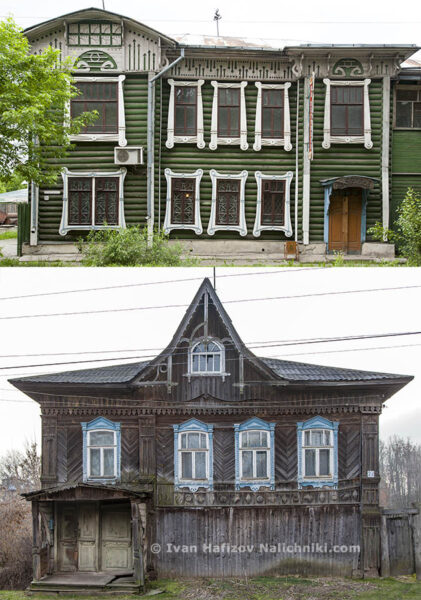
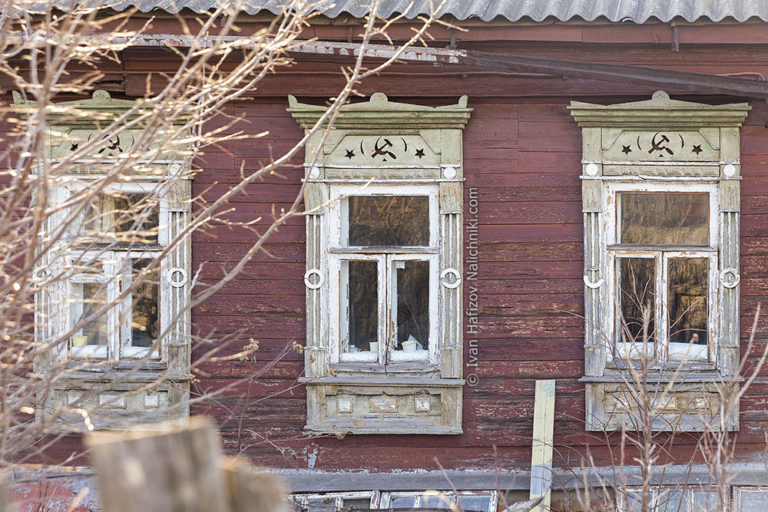
I tried to put it all together.
First: I'm not aware of any dragons depicted in wood before 1900. All known examples are from the twentieth century.
Second: it's worth distinguishing between the mass-produced dragons — which appear on many nalichniki and form their own distinct type — and unique one-off designs, like the "house with dragons" in Tomsk or Omsk (each of those is an artist's project with its own very particular story).
Third: dragons are found quite widely across Russia, but only in a handful of specific places. You can count them on your fingers: Taldom and its surroundings, Yelets (apparently without surroundings), Rostov Veliky (with surroundings stretching all the way to Nerekhta), a few in the Urals, more have been sent from Tatarstan. That's roughly it.
Fourth: unlike so many other carved motifs, dragons — as far as I can tell — were not copied from decorative stonework or plasterwork on urban buildings. (At least I couldn't find anything comparable in stone architecture.)
And fifth: right now there's a Black Friday discount on the "Dragons" set. It's not the first time they've gone on sale, but it's the first time six extra crown-piece options come with every set — different dragons, all taken from actual nalichniki in the Taldom district.
The link is here: https://nalichniki.company.site/Черно-пятничные-Драконы-p605890772 — Black Friday (oddly enough) runs through the end of Sunday.
PS The photos are from Rostov the Great — notice how easily the dragons can be read as roosters, and vice versa.