
 The reason for this post was the questions that I am often asked in connection with the "Guide to Russian Nalichniki". Thank you so much for them, because the questions give you a feel for the subtle points of the project that I have not yet been able to convey to you.
Some of them are quite obvious (I don't even know why I didn't immediately describe everything in detail), while some came as a complete surprise to me. In any case, I hope that with these answers, the project of creating a book about nalichniki will become more transparent and understandable.
1. About 8.5 million.
The most common question is "Why so many, because you can print a book cheaper."
The answer is simple — you can print it, and it's really four times cheaper. I didn't tell you well that not all the money goes to print the book. The actual budget of the project is as follows (in thousands of rubles):
3660 — expeditions to 399 cities of Russia for two years;
2500 — printing 5,000 copies of the book;
889.2 — 13% income tax;
772.9 — commission of the crowdfunding platform and payment aggregator;
500 — delivery of 5,000 copies of the book;
180 — providing bonuses and preparation ;
That is, only 2.5 million rubles are allocated for printing in the printing house, and very few printing houses can compete with this price. And publishing houses are disappearing altogether.
2. About the book's printing options.
When I started calculating the project, I didn't understand the parameters of the book's publication at all, so the abundance of questions related to them surprised me. It is clear, of course, that many of the questions were caused by the fact that I was unable to convey the answer to the first question.
Here are the preliminary parameters of the book:
70x100/8;
45 printed sheets;
paper — 170 grams;
hard cloth cover, dust jacket;
5,000 copies.
Why are these parameters preliminary?: The layout of the book, as I have already said, will be handled by the Shchuka design bureau, and as a result, the book may be completely different. I don't think the result will be radically different: it's unlikely that the guys will make 4 paperback volumes instead of one weighty book. But that the end result will be different is absolutely certain.
3. About 399 cities.
The next point that often raises questions is the need to photograph the nalichniki in exactly five hundred cities (that is, in 399, since they were already shot in 101).
Here I have to tell you in more detail.
All cities are divided into two groups. Those that are located close to each other and those that are located to the side and you will need to fly there by plane to the same city. The European part and the Urals mainly belong to the first group. The Far East is certainly the second.
The average distance between cities, for example, in the Vladimir region, is 90 km, so even if you "subtract" the entire Vladimir region from the project, the savings are about the same as if you subtract, say, Khabarovsk.
And there are about twenty of them.
Of course, you can save a lot by ignoring them altogether. That is, to "subtract" these 20 cities from the project and get very significant savings: about a million rubles.
And I was seriously considering this possibility. I haven't drawn this map yet.
 Green indicates regions where 95% of cities are located, and red indicates regions with only 20 cities.
It is quite clear here that if you "subtract" only 20 cities from the project, then you will no longer have to talk about any "Guide to Russian Nalichniki", because its whole idea will become meaningless.
4. Why take pictures yourself?
This question is very important, because it has been asked to one degree or another for five years.
And really — why not throw a cry and collect all the photos from all over the country in a month? After all, it is much better to solve the problem in such a "managerial" (or, as they say now, "crowdsourcing") way without going anywhere: people are everywhere, except for babies who don't have cameras now.
So I thought, why not? After all, the project Shushara.ru — he has been doing the same thing for a long time, and since May 2005 they have collected a good collection of 1,638 images of nalichniki!
Therefore, on August 1, 2012, I sent out a call for everyone to send their nalichniki. There were only two rules at that time (the book was still in the distant future, so I didn't think at all about copyrights, publication permissions, the size of the photos, and even more so about their quality, completeness, and authenticity verification):
— the nalichniki had to be photographed from the street side;
— each set should cover at least 32 nalichniki..
I remember that I was very happy with the invented way to assemble the nalichniki. However, it turned out to be not as effective as it was thought.
In two years, thirty people have registered on the site, but only three actually sent their nalichniki:
Olga Shirokova — Borovsk and Vereya;
Alexey Kiselyov — Gorokhovets;
Natalia Mishkina — Michurinsk.
It is worth paying tribute to the authors, who gratuitously spent several hours (and in the case of Michurinsk, in my opinion, even days), shot unique material, collected it, processed it, sent it, and even described their impressions...
But in two years, four cities... Hmm...
Since then, I probably no longer believe in the idea, "it's only necessary to throw a cry and everyone will drop their business, take stepladders and go, ignoring the barking at dogs and the questions of the owners, to photograph nalichniki all over the country" :)
And besides, new questions would immediately arise.: How do I include these photos in the book? Who will write a text about this city? What kind of patchwork will the book look like (and can it really appear) if everyone who photographed the nalichniki in those cities writes the accompanying text?
There are no answers.
In addition, since 2013, I have been shooting all wooden houses in stereo (3D), and I hope that someday a technology will appear that will allow me to reissue a book with three-dimensional pictures.
After all, Prokudin-Gorsky took color photographs at the beginning of the 20th century and did not expect to see them printed at all :)
5. Why did you choose crowdfunding, because you need a grant!
Completing the top five questions is the question of why crowdfunding was chosen, and not other forms of financing.
And, as always, there are several reasons for this.
Of course, first I tried to get a grant from the Russian Geographical Society. The grant was not given, the reasons were not explained: it is not accepted there. The history of the Russian Geographical Society is murky, but it is in the past.
Then I tried with the Vladimir Potanin Foundation. However, alas: The "Virtual museum of nalichniki" does not go through several parameters at once. For the foundation, it's not even a museum at all.
I wrote to several other foundations, but there was no reply or greeting. For comparison, out of eleven letters to the regional administrations, 9 were answered, and two (Kirov and Vologda) — by mail. Of course, the answers are disappointing — no one can allocate money / transport / people to help, but at least they looked at the project. There was no return from the funds at all.
At this stage, it became clear that it was possible to continue to seek funding from foundations. And even find him someday. But it's not clear where to put 17 cubic meters of books later. Give it away? To sell? Where should I store them? And how do you know if this book is really needed, or if this way of preserving and promoting nalichniki is a fool's errand?
And here it became clear that the best way would be public financing!
This is the only way to really find out from you — is this book needed? Because if you need it, then 5,000 people who are interested in it, I'm sure there will be.
And if it is not destined to be printed, then well ... then there is no need to waste time: we turn on our heads and do not waste two years of our lives on an unnecessary book, which will then gather dust in warehouses for 15 years.
So the answer is simple.: This is the best way to finance such a project!
There is very little information left that I wanted to share here.
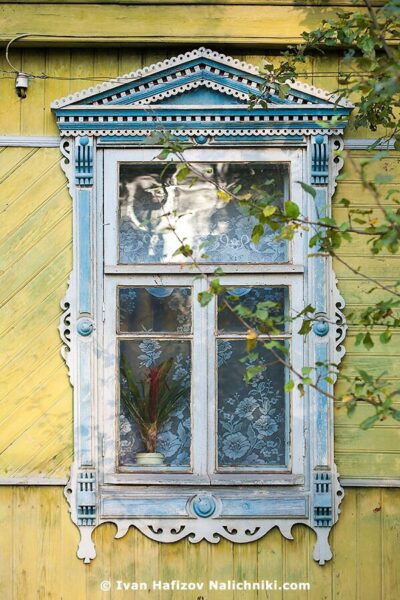
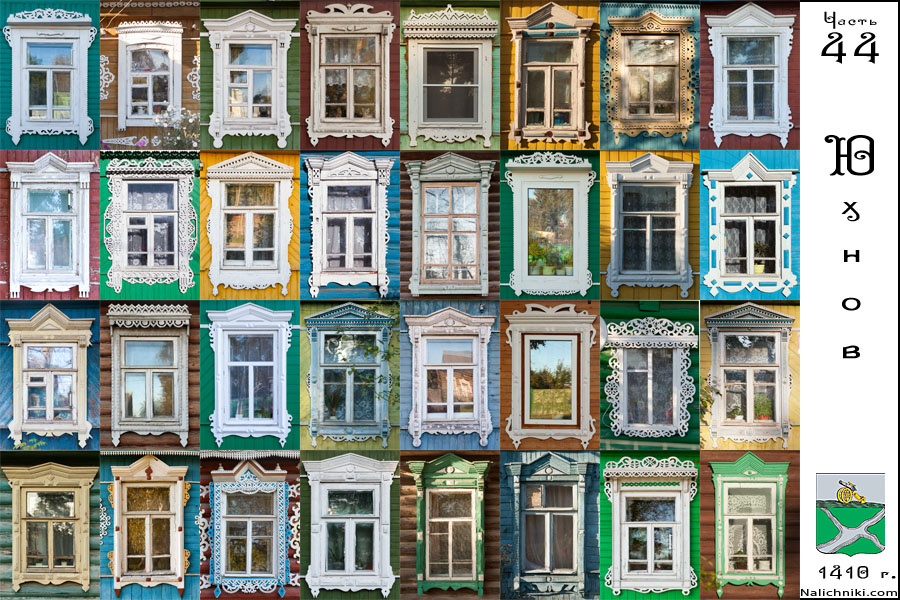
PS1 In the title of this long post is one of the most beautiful houses in the Kaluga region. A house on the embankment of the small town of Yukhnov.
For me, it is a symbol of the wooden architecture, which we know nothing about. And which we can find out about if we want to.
PS2. There was no place in the text for a direct link to a portal where you can support the project. It's here: http://planeta.ru/campaigns/4804



14 comments
Бабушка меня почти не слышала, поэтому ответить на расспросы не могла. А хозяин дома умер, об этом рассказали соседи.
Это Юхнов Калужской области)
И я вот немного занимаясь деревом, никак не могу понять КАК делали наличники? Понятно, что вручную, но КАК? Я не понимаю...
Заказал книгу, ОЧЕНЬ жду её выхода. Есть предположение, что и резьба была не просто рисунками, а могла рассказать о владельце дома, как погоны у военных.