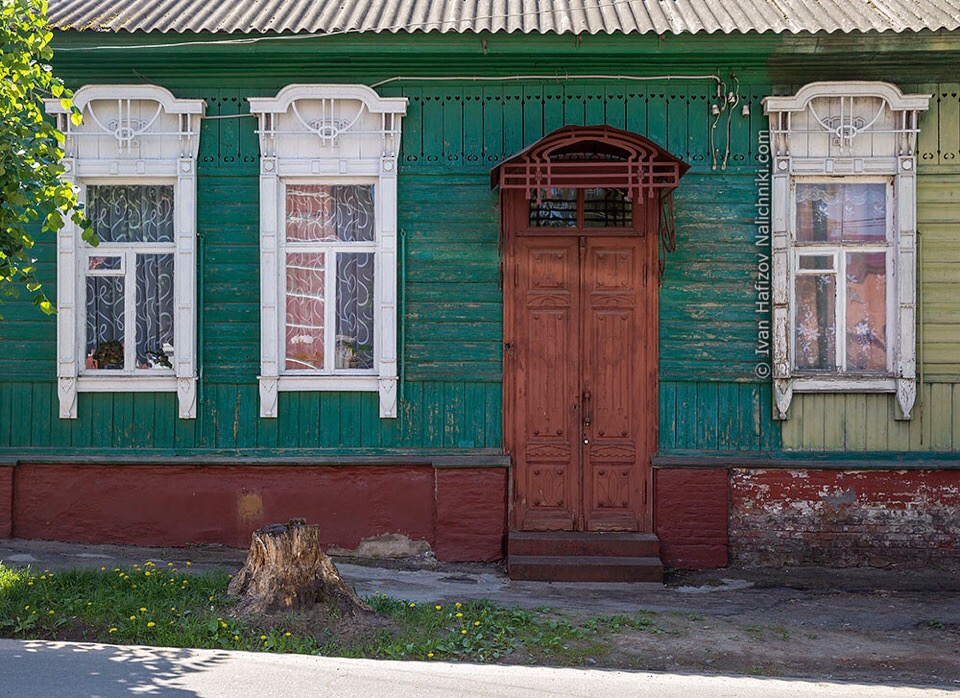
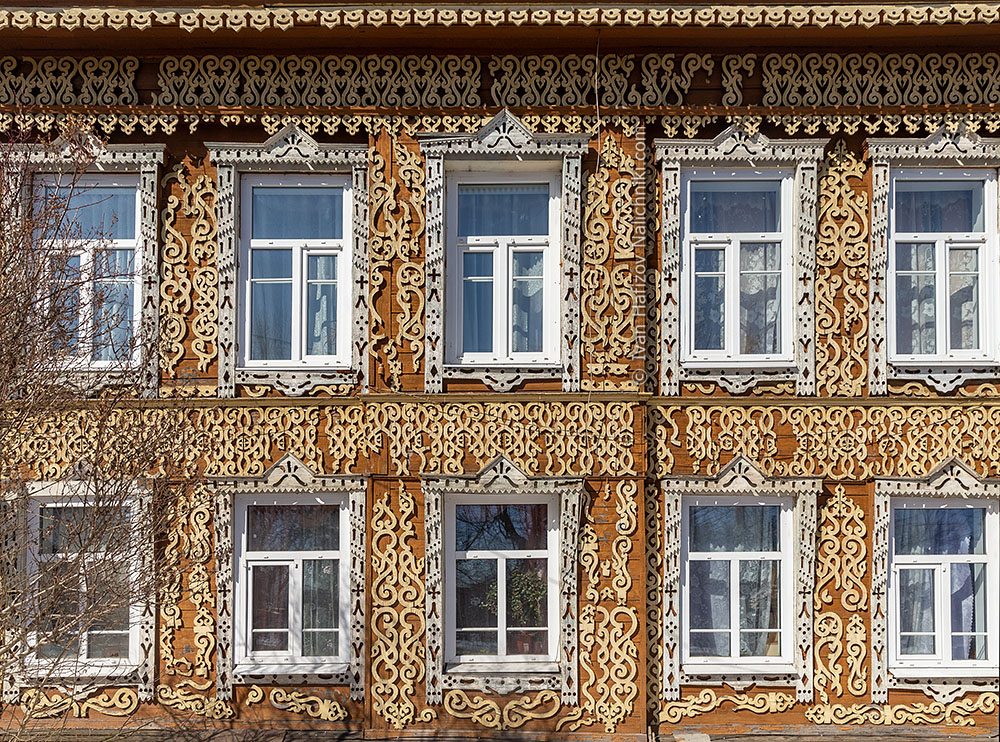
…— We had one of those badges up there at the top, you know — do you know what I mean?
— A fire insurance badge? — I try to make out a trace (usually after removing one of those metal plaques, an unfaded oval or circle of paint remains on the wall), but I can't find anything.
The woman — not elderly, though well along in years — had stopped to ask about the photography. Without the keen nosiness typical of small towns and villages, without the confrontational edge you sometimes encounter in bigger cities. Simple curiosity. I told her about the nalichnik museum, and she remembered the badge.
— Yes, an old one, embossed… Someone's hands were itching for it, they took it down in the night! It was the Yakor Insurance Society. I looked it up — it was when Alexander I ratified the creation of Russia's first insurance society! Seventeen hundred and something, yes… And this was the very house that was insured, you see! I would always — she turns her head back, showing how she would check as she left the house — come out and look: is it still there? Still there. So they did it — took it right off at night! And I figured out who afterward: because two young men had been going around, knocking on doors, asking about anything old, they were buying antlers, old iron, asking about icons everywhere… They probably spotted the plaque and took it.
— Yes, — I agree — that type has a sharp eye for what things are worth…
— So even our own woodcarvers told me "give that to us." I said no: let it be nailed up, let it stay there, let people see the antiquity!
— What a shame! — I say ruefully, remembering — Someone once told me that with those "collectors of antiques" you should always say straight off that it's a copy, and the original is inside the house. And really, you might as well actually replace it with one…
— Well, making a copy costs money too… and it was already old, corroded, you could tell by looking it was old… But what… how much could they have gotten for that plaque? The one in the museum there was newer but still old. On the museum. They took ours at almost the same time.
— They took it from the museum too?! — I'd never heard of such brazenness.
— Took it from our local history museum. And they published about it afterward, and I also confirmed that mine was taken at the same time…
— Was this a long time ago? — I ask, imagining it might be from the turbulent nineties.
— No, recently! In winter I think it was. In 2017!
— And how old is the house, do you know?
— I looked it up at the Bureau of Technical Inventory. It's been on record with the BTI since 1917. As soon as Soviet authority started taking inventory, they registered everything and they registered it too. But I think it might be from around 1910, 1914… Or it might have already been fifty years old by then… But it's solid! Stone foundation, what more can I say! — she proudly spreads her hands, her whole manner suggesting that says everything. — And down in the basement, you know, it's all laid with rough fieldstone. You know… the basement-crawlspace. The vaults in there are high — all fieldstone… The Russian stove (we did take that down of course, because we wanted more room for the dining area), the Russian stove had a fieldstone foundation. It's still there now. And my husband… we hired workers, wanted to take it apart and throw out the stone. But the floorboards — she shows the thickness with her hands, about thirty centimeters — like this! I don't put anything over them at all! A hundred years old, even by BTI records! I haven't put down anything, no linoleum, nothing… Just the boards on the floor, painted. My husband has passed, but he wanted it all to be preserved. And my grandson loves it too. "Leave it, Grandma," he says, "let it stay!" Everyone else has put in plastic windows, but I don't want to. I have these handles on the windows and doors, you know, little golden ones, copper! And the ceiling is two meters eighty-five, maybe two-ninety… ceilings like that, it's a merchant's house! A merchant's. And that's why I don't want to… — the woman waves her hands to show how strongly she doesn't want to change anything she's inherited… — Inside, by the way, it's not even wood or anything — I have plaster, all the ceilings have ornamental molding…
— Ornamental molding, even?! — I look at the house more closely. Nothing about it from the outside would suggest such a thing!
— Molding, yes, — the owner confirms. — There's also beautiful molding in the merchant Kharitonov's house. That only came out later, nobody knew. People just lived there, there were two apartments. When they divided the apartments, they split it: people lived in the first half and in the second. In the second half lived the director of our local history museum, and his wife was from the Razumovsky counts. We have Count Razumovsky here in Khvalynsk — her father was a judge. And his building, their house, is — if you go further down the street: one block from here, and then on the next block. On this side, a four-story building, greenish now it seems, their big house. Brick, very solid. There's some kind of memorial plaque there, I believe. And after the revolution when they were resettled, the daughter stayed on, and they were Freemasons or something, because at our cemetery… she was a teacher, my mother was also a teacher, so they were friends. So. And their cross — Galina Nikolayevna's cross at the cemetery — has that Masonic tree with the lopped branches! And when… the Muscovites who live in that house now… when they started taking apart the earthen foundation bank to do repairs (mine is brick, but theirs is on posts, they had to redo it from scratch) — they found a bill there, or a mortgage, whatever it's called, and there were some debts listed, it was all faded and pale… Well, she gave that paper to the museum and that's how they found out that… we had a merchant here named Kharitonov who had his dairy shops here and everything else, a trader… So it was only then that they found out it had been that merchant Kharitonov's house.
— Were there many merchants here, do you know?
— Oh, our merchants traded all the time. Shops, stalls — meat, dairy… Everything on this side was rebuilt, it was all wooden, we lived here as children… I lived in Siberia for thirty-five years and came back here.
— Oh, where in Siberia? — I ask, surprised.
— Kemerovo.
— Really! I photographed nalichniki there once!
— Well, — she ignores my remark. — And this… So we came here and bought this house. My soul drew me back here. It's paradise here. The climate… not just somewhat better — it's absolute paradise! I grew up here, but after school I was assigned here by the state and then left, and I spent thirty-five years there. And came back here. Not one day, not one single day have I regretted coming back from Siberia, even though I did live there thirty-five years, after all…
Questions race through my head: I want to ask her whether the town has changed a great deal, how difficult a decision that was to make, how you just leave everything behind… And other things besides… But conversation, as always, leads to details I'd never have thought to ask about.
— Here — the woman sweeps her arm across the whole street — many houses here had them, in that house where Valya lives, there were these, you know… Porches! Sometimes iron-roofed here, but carved ones. And all of them had these little bells… Double doors, and the bells went like this: a wooden knob and a rope. You come into the porch, and there are benches on both sides, for the… for the gentry… for the owners… You pull it like that, and a little bell rings inside…
— Pull the rope and the door will open! — I laugh, quoting Little Red Riding Hood.
— Yes, yes! That's how we lived!
— Oh, how wonderful, I never saw anything like that anywhere…
— But now they're gone, all those porches were torn down, only a few with cast-iron carving are left… You know, in our center, where there was a ravine and these ancient trees, and when they cut them down to — you know — beautify the square by this church, we were all devastated: we had a city garden there, a park, we all went there to dance as children, and there were these ancient trees and they cut them all down and made a square… And next to the church, there's a factory, before, in Soviet times, it was a canning factory (we have orchards all around, apples, we're apple country!) Well, there's a wrought-iron arch there! You must photograph it! There's a little lane, the factory made it, and the arch… old, from those times. And if you go further, there's another old house there, brick, the merchant Nemoykin's… oh, the history here is so rich, if I tell you all of it, you won't get anything photographed before dark! Alright, off you go, you have so much ahead of you!