Twenty-five colorful tourist buses on the familiar parking lot shatter any hope of quiet: groups of bright tourists all talking at once about what they've just heard, guides holding numbered paddles trying to organize the chaos, unfamiliar languages sounding here and there — nothing like last night…
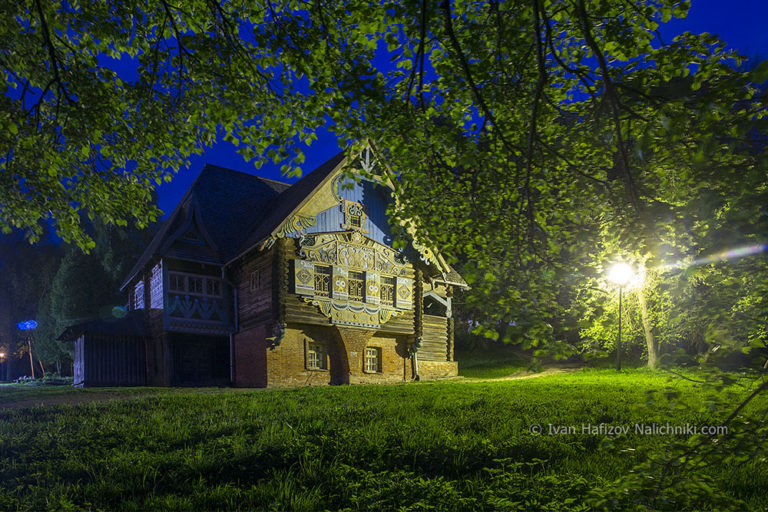
The familiar gate stands wide open; to the left, the spreading tree I shot from last night… To the right, the teremok… The same one — and yet completely different…
The internet is a wonderful thing.
Inspired by the sight of the teremok, I'd found overnight an article by Maria Zabolotskaya: "The Princess's Dream." I read it aloud, recorded it on my phone's voice recorder — it's short enough — and now, as I walk and shoot, I listen, and listen, and listen… And imagine…
…
"Masha Pyatkovskaya — born out of wedlock, never knowing her father, sent to a gymnasium at five or seven, linking her happiest childhood memories to her nanny's fairy tales and… to the paintings that covered the walls of the drawing room… 'When the house grew quiet, I would steal in on tiptoe, leaving my shoes at the door. In there were my friends, the paintings…' She had loved history and the natural sciences from childhood, and her singing teacher kept insisting she had a good voice…
At sixteen a young lawyer proposed and she accepted… A family, a daughter; the husband turned out to be weak-willed, a gambler besides… Dreams of something greater… She auditioned for a soloist at the Mariinsky Theatre, who advised her to go study in Paris, at the Marchesi opera studio. Once she'd made up her mind, she stopped listening to her relatives' pleas — and later this decisiveness became, it seems to me, the defining trait of her character.
'It is hard to describe what I felt on finding myself free. Yes — free… Choking on a flood of unstoppable feeling, I fell in love with the universe, fell in love with life, seized hold of it…' Marchesi took a special interest in her. But she did not live by music alone in Paris: she took classes in the visual arts, began studying art history, spent hours with books and in museums… Another passion emerged too — a pull toward everything ancient, everything that carries the pure origins of human genius…
But for now — Maria Klavdievna returns to Russia, where poverty, social ambiguity, pressure from her ex-husband, and the absence of any prospect awaited her…"
…
I move to a new vantage point, closer to the Teremok, under the shade of apple trees. Here I have to wait a fair while for the flow of tourists to subside — they seem to have been waiting for me to start shooting. But there's no hurry, and I drift back into the past under my own recorded voice…
…
"… In a difficult moment Maria is tracked down by her best childhood friend — Yekaterina Svyatopolk-Chetvertinskaya. She supports her, inspires her. To her estate Talashkino — eighteen kilometers from Smolensk, then Svyatopolk-Chetvertinskaya's property — Maria comes so they can open a school for peasant children together. 'We went from cottage to cottage, persuading the men to send their children to learn, explaining that they would be taught not only reading and writing but agriculture as well…' Engrossed in setting up the school, Maria begins seriously studying pedagogy, observing how education is organized across Russia. Of the institute where her daughter is enrolled she writes: 'The education they take away from there is highly doubtful; they are dragged from class to class, brought through to graduation, but their knowledge is zero — with minor exceptions. In that vast herd of living beings everything is leveled, good and bad alike. Individuality is suppressed by uniform, by gait, by manner to such a degree that they even have identical handwriting — and what lives beneath that crust, no one cares.'
Around this time she meets Vyacheslav Nikolayevich Tenishev — a prince and businessman developing railways, building Saint Petersburg's first automobile plant… In 1900 Sergei Witte — then Minister of Finance — appointed Tenishev Russia's commissioner for the Paris World's Fair, in which Maria Klavdievna would take an active part… He had, besides everything else, a fine ear for music, played the cello, was constantly learning…
They move near Bryansk, where Maria becomes patron of the only school there. Watching with astonishment the wondrous changes in children who had lately been loitering about back alleys — 'Before me stood future human beings, consciously approaching work, eagerly and earnestly tackling serious matters' — Maria Tenisheva opens several more schools in the surrounding villages, and simultaneously fights to ban child labor at the factory and establishes a charitable society to aid orphans and widows…
Later, when Vyacheslav Nikolayevich leaves the Bryansk factories' board, the family moves to Saint Petersburg, where Maria immediately organizes a music salon visited by Tchaikovsky, Scriabin, Arsenyev, and many other noted composers and performers. At the same time she opens a studio to prepare students for the Academy of Arts; Repin himself agrees to teach, and soon the place becomes enormously popular — among its students, then young, are Ivan Bilibin, Yefim Chestyakov, Mstislav Dobuzhinsky, Zinaida Serebryakova…
Around this time she becomes one of the founders of the journal "Mir Iskusstva" (The World of Art), opens a drawing school in Smolensk, mounts an exhibition of her picture collection — which she later donates to the Russian Museum…
Around this time too, adding to her collection (which would become the largest of its kind), she organizes expeditions to various corners of Russia… In 1905 she transfers that entire collection to a branch of the Moscow Archaeological Society in Smolensk, having first built a special building for it… 'With each year the Russian antiquities arrested my attention more and more, more and more widely an entire world — until then unknown to me — opened before me, and this world drew me to it ever more powerfully. I suddenly felt that all of this was close, my own, native. Loving the Russian landscape passionately, I had always been, in my soul, a purely Russian person. Everything that touched my country moved and stirred me deeply.'
Talashkino became a vivid confirmation of those words."
…
Unhurriedly shooting details, I circle the house and wait for the tourists to leave the frame. Behind the Teremok there's a tall hill — grassy only at the bottom — and climbing it you end up level with the building's roof. I set the tripod legs between the painters sitting, standing, and lying with their easels, and once again become all ears: the narrative has finally reached the Talashkino estate itself…
…
"… The Tenishevs acquire it in 1893. By this time Maria Klavdievna is known in capital circles as a gifted singer, a great lover of art, a patron of young painters… As in Petersburg, she quickly creates in the Talashkino house a welcoming, creative atmosphere that draws many celebrated artists, musicians, and scholars. Contemporaries call Talashkino a small Russian Florence, where people dream of Russia's renewal.
And not only dream.
Without waiting for steps at the governmental level, Maria Tenisheva sets herself a seemingly impossible task: to change the peasant's way of life, to teach him a new relationship with the land. To that end she invites from Petersburg the celebrated botany professor Robert Regel — the only holder of a Russian doctorate in horticulture at the time — purchases the farmstead Flyonovo near Talashkino, and decides to create there an agricultural school of a new type with a model teaching farm. There too, at Flyonovo, a model apiary is established, a beekeeping museum, and a meteorological station… In September 1895 a new peasant school opens; beside it is built a fairy-tale cottage, adorned with carving and painting — inside: a library and teacher's room.
The cottage's sketch is drawn by the artist and architect Sergei Malyutin… known to us from his illustrations for Pushkin's "Ruslan and Lyudmila," "The Tale of Tsar Saltan"… Known to everyone who loves Russian modern style from the Pertsova apartment house I love so much, on the embankment near the Cathedral of Christ the Saviour… From the capital and from trips abroad, the best books, textbooks, art albums, and magazines are brought here. Visitors to the Flyonovo school are astonished by the cleanliness and comfort in which the peasant children live and study…
One of the jewels of the Flyonovo school was a children's balalaika orchestra, famous throughout the Smolensk region. Its cause: the noted musician Lidin — a balalaika virtuoso and soloist of Andreyev's "Great Russian Orchestra" — who, inspired by the princess's enterprise, moved to live and work in Talashkino…
But another long-held dream will not let her go — craft workshops in Talashkino. Having long observed the development of art in Europe and in Russia, having actively participated in the capital's artistic life, having won the name of patron and champion of all that was new, bold, and talented, Maria Klavdievna herself was turning more and more toward the fate of Russian national art.
The time had come to realize a long-held plan: to revive the Russian style — not by imitating antiquity, but by drawing inspiration from the epic, fairy-tale past embodied in old Russian art: '…Every epoch, every generation, can contribute something new, can say its own word — but not by copying the old, only by drawing inspiration from it.'
The Talashkino craft workshops were headed by that same Sergei Malyutin, and one by one there opened a ceramics workshop, an embroidery workshop, a dye works, a furniture atelier, an artistic forging and woodcarving shop. The first museum — "Russian Antiquity" — appeared here too.
'Talashkino was completely transformed. Wherever you went, life was in full swing. In the workshop: planing, carving wood, ornamenting carved furniture with stones, fabrics, metals… In another workshop girls sat at their embroidery frames singing loudly. Peasant women passed the workshop with bags under their arms: bringing in finished work or collecting new. You walked along — and your heart rejoiced.'
The workshops' products quickly became famous: a shop "Rodnik" opened in Moscow. And a little later, after an exhibition of Russian applied arts abroad, all of Europe was talking about the Talashkino pieces. Later Maria Tenisheva would say: 'My Talashkino workshops are a test of Russian art. If this art were to reach perfection, it would become universal…'
In 1903 Nikolai Roerich arrives in Talashkino — he would become a true friend to Maria Klavdievna; Mikhail Vrubel and Konstantin Korovin are frequent visitors… Everything created here astonishes and delights not only celebrated artists but many other contemporaries…"
…
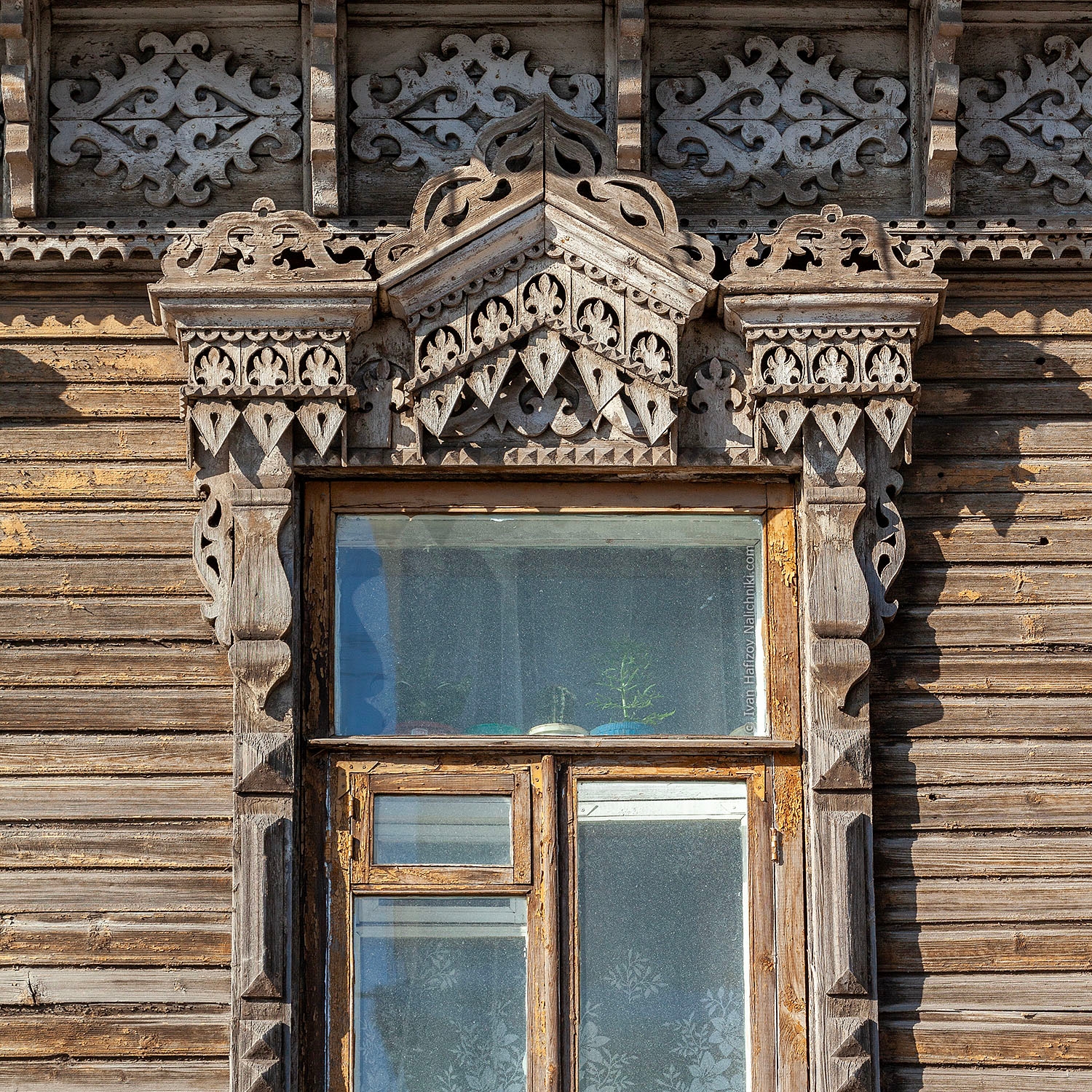
I descend again from the hill, closer to the Teremok, touch the rough walls, wish I could reach the shingles on the roof… The tourists have unexpectedly all gone; the painters on the hill are far behind me; and I find myself suddenly alone with the log wall rising above me and the painted window. There's something real about this place. Fairy-tale, dreamlike — but very real…
I take a few frames of the carved porch steps, throw one last glance at this extraordinary house, and — still listening to the story of Princess Maria Tenisheva — walk off into the depths of the park in search of the church she never managed to finish…
…
"The storm came crashing down — unexpected, terrible, elemental… What had been built cracked and fell; a cruel, blind force destroyed all the loving labor… The school's fledglings were scattered, the craftsmen driven off…"
Tenisheva spent the last ten years of her life in emigration, in a small estate called Vocreson, which friends named "Little Talashkino." There, already gravely ill, in a tiny studio on Avenue Duquesne, she continued working on enamels, earning her own living. Her enamels were highly valued and made their way into many museums and private collections…
Years later, having lived through the bitterness of disappointment and loss, Tenisheva wrote: "I said to myself that temples, museums, monuments are built not for contemporaries, who for the most part do not understand them. They are built for future generations — for their development and benefit. One must set aside personal enmity, grievances, every personal point of view — all of that will be swept away with the death of my enemies and my own. What remains is what was created for the good and service of the young, of future generations, and of the homeland. I always loved it, loved children, and worked for them as best I could…"
PS Talashkino is still waiting for you today. Go without hesitation.