

…You stroll through yet another street of yet another town, asking about the old carved houses. The answers, as always, are short and dry: nothing's left, they tell you. You should go to the villages, they say. To Vologda, to Suzdal. Anywhere but here. You nod along, as if in agreement, and turn onto the next street, ask again, and hear the same response.
You chide yourself for your persistence. Believe people when they tell you things. There's nothing left here. Even Google Images confirms it. Stop wasting time. Move on… But then, just as you're about to give up, something shifts on the horizon — a shadow, a shape, blurred but unmistakably there, and your heart leaps in quiet defiance. A gift from fate, perhaps? A hidden treasure, unnoticed by the locals, taken for granted by everyone but you? Maybe — if it isn't just a burned-out log house wrapped in a banner with an airbrushed fairy-tale manor (because, of course, the administration building is right across the street). Maybe — if it turns out to be real — this will be the very thing that makes the whole search worthwhile.
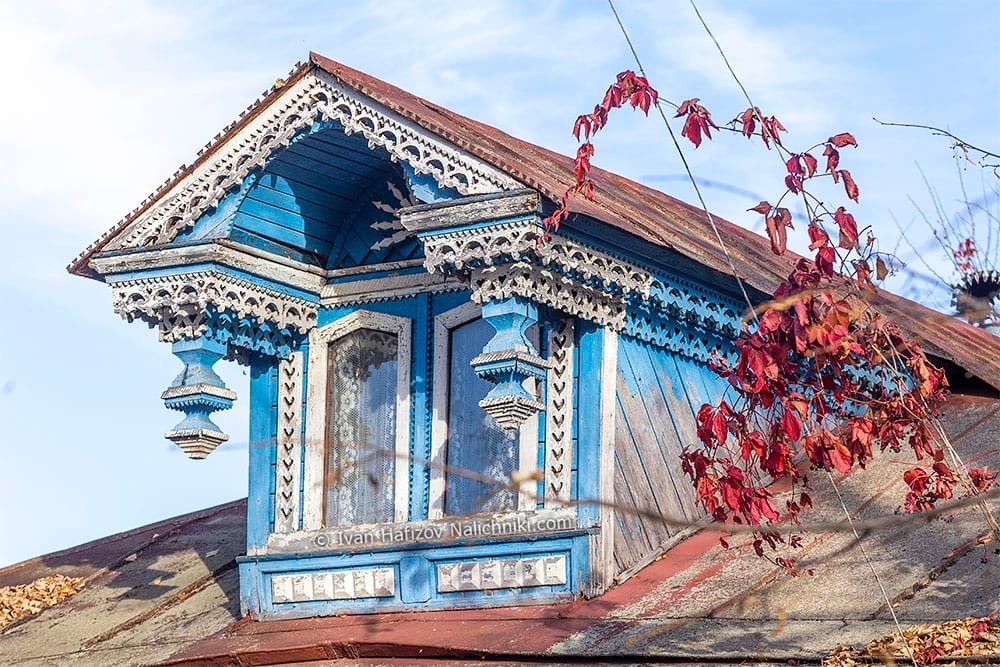
You come closer, but you don't look straight at it. You play it cool. You photograph the neighboring house instead — the one that can't hold a candle to the first. You capture the dull little thing in detail: first the whole façade, twice, then the Nalichniki, the eaves, the decorative carvings, the gate — if there is one. All the while, from the corner of your eye, you take in the real prize, holding yourself back even from the pleasure of anticipation. You savor this moment of suspense.
And then, as if offended by your feigned indifference, the owners of the house — the real house — step outside. And suddenly, instead of explaining why you want to photograph it, you find yourself defending the fact that you haven't taken a single shot. Words tumble out before you can stop them — of course you meant to, of course you were just about to! You ask them all about it: who built it, when, how, why. What drove them, how did they manage, what did they do for a living?
They invite you in for tea. You decline — you have a hundred kilometers left to drive, and it's getting dark. A hundred reasons to say no. And yet, five minutes later, there you are, sitting at their table, sipping tea with blini or spooning up borscht by the glow of the ever-present television. Because how could you refuse?
And then, hours later, you step away, different from the person who arrived. But more than anything, you step away grateful — to chance, to fate, to whatever it was that led you to this quiet little street.


20 comments
Я прям первая в очереди на неё!)))
Правда странно, что больше ни одна страна так не поступила, ну да это вполне укладывается в мои представления о немецкой педантичности :)