— …What in the world are you doing!
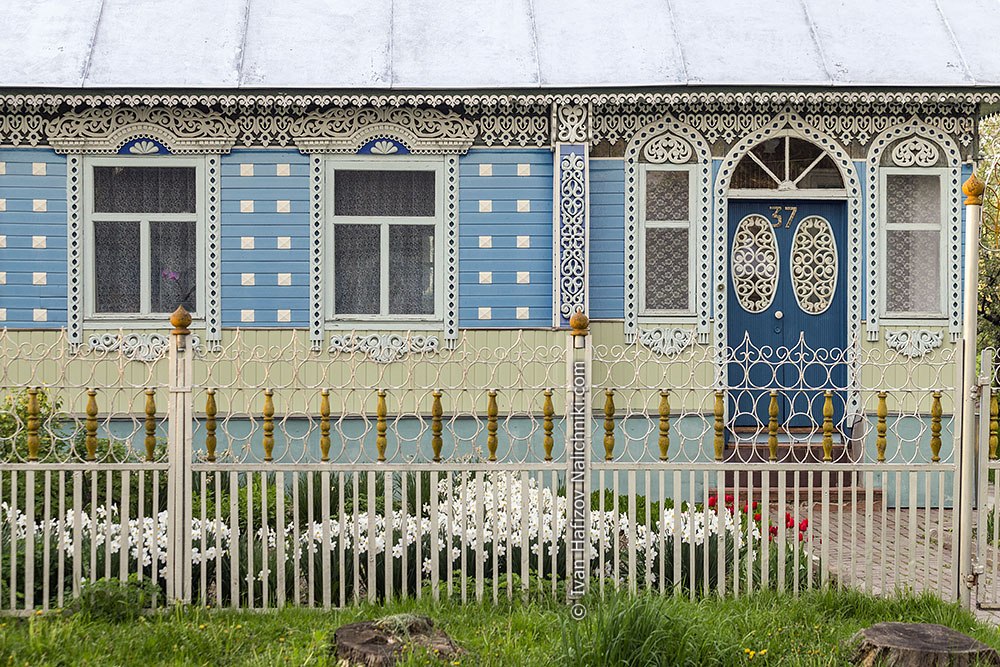
— Oh, hello! — I jump: absorbed in photographing the carving details of one of the most elaborately decorated houses in Yelnya, I had completely missed the moment when its owner appeared.
— I just want to shake your hand! My name is Ivan.
— Mikhail Alexeyevich. — He shakes my hand, but looks suspicious.
— Where are you from?
— I'm from the Moscow suburbs. I study wooden architecture — the people across the tracks told me that here you have…
— You want to buy something?
— No, I just study… — I smile.
— Ah, — he draws it out. — You want to copy it?
— Nope, — I smile even wider.
— I'm just a photographer. Was this your work? — I clarify.
— Mine, — he laughs. — Who else's?
Mikhail Alexeyevich looks about seventy, sprightly. He's standing on the other side of the fence but seems to be in a hurry somewhere, so I start with the most important thing — the resemblance of his house to the work of Tomsk craftsmen: the carving looks like it was copied from house number 46 on Bolshaya Tatarskaya Street. But the master explains it differently:
— The patterns of wooden architecture, — he begins in the tone of someone opening a public lecture — repeat themselves not only in Tomsk but in every region — in Ivanovo, in Kaluga. There's no other way it can work. There is geometric carving, and there is the plant world, and the plant world is the same everywhere.
— Where did you draw your patterns from?
— Where… I had newspaper clippings… And then… each design, it only fits… — The master points at a low house across the street — there's a window over there too, but you can't put this design on it. My window is wider — only this particular one will fit. And from there it's the artist's own imagination, as they say.
— How did you even come to this?
— Well, I just decided to and that was it!
— When was that?
— The thing is, when a person has worked with wood since childhood, he has many theories rattling around in his head. And I've been at it since childhood. At twelve I was already making wooden utensils that served people for generations. Now nobody needs them.
— And how old are you now? — I venture to ask.
— Two years shy of eighty.
— So that means you've… — I do the mental math — you've been carving for sixty-six years?!
He laughs:
— Something like that… only now nobody needs any of it — not the utensils, not… nothing.
— Well — I'm surprised — a beauty like this is still needed, surely. People come on excursions to see you, don't they?
— They come, they look. — He shakes his head. — But I don't know whether it brings any good to anyone or not. Not everyone understands the art of an artist. Others walk by and say: "Look at him, showing off, preening" — in plain Russian…
I'm forced to agree, knowing that while exceptions exist, local residents mostly do react exactly that way. Or simply don't notice the carving at all… But right now I'm more interested in the history of the house, and I ask Mikhail Alexeyevich about that.
— An ordinary wooden house, clad with planks. The wooden pattern on the cladding was something f***ing unbelievable — nobody could carve an exterior like that. But I covered it with plastic. Because I got tired of painting wood. And if you took off that cladding, it would look completely different altogether. And… Soviet paint still held. Today's paint… Well… — he spreads his hands as if apologizing — like everything today… Today's paints are garbage. While it's new it looks fine. A year later it rolls up like a dry leaf and falls off. It's all chemicals. Have you ever eaten real butter? — he looks at me (I nod vaguely) — Real butter nowadays only if some old grandmother in a village offers you some. Same thing with paints. Take the sausage people ate before — raised on… on natural… plant-based feed… same thing with paints: either it's made natural, taken from nature, or it's artificial. Take the Stradivarius violin he made in the seventeenth century — compare that lacquer to today's lacquer. That one has lasted three hundred years; this one just stinks and that's it. Same story with paint. Everything changes. Now you've got all this good equipment — he gestures at my cameras on my belt — and in the old days an artist would come with a stick of charcoal and paper. And he could draw everything better than this. In the old days if you made glue from fish bones — now you buy glue, only PVA, no other kind — it comes apart just like that. Try gluing two boards. It doesn't hold. Well, it holds pine and linden, but it doesn't hold oak. What are you supposed to glue it with?
— And are you still doing woodwork now? — I conclude.
He laughs and tries to deny it:
— Almost eighty years old, after all… I carved here… There I cut down an oak — he points to a stump right in front of the house — I planted it in fifty-nine — and over there I cut down a linden. There's still one standing there, I need to cut it down too: if it falls it'll demolish my house… In fifty-nine the neighborhood committee made us plant them. So we planted, and now we don't know what to do with them.
— Who made you plant them?
— The neighborhood committee. The street committee.
— Really? I didn't even know such a thing existed!
— Well where would you have seen one — you're from a different country practically.
— No, just from the Moscow suburbs!
— Well you probably didn't have it there… But we had the directive. See, the thing is… There was no town here. After the war, in forty-six, the railway ran through open field — it was all field here…
I look around. Even streets, tall mature trees, gardens. The railway is three blocks away; a few minutes ago I could still hear the PA: "Train on track two. Track two…" An ordinary southern Russian town. Remarkable, how dramatically a landscape can change in seventy years.
— There were bunkers here — they were defending the station and the railway line. The Germans bombed the tracks, and in this garden — he points behind him — grandfather buried two bombs himself. Single-handedly. In forty-six they were allowed to build on this field. Grandfather dug up those bunkers, built a little hut right here. Buried those bombs, was given a plot of fifteen hundredths of an acre. And this field became part of the town. Look how far it's spread. And it was all defense, bunkers, trenches, all dug up and turned over… So to green it up they planted trees. The neighborhood committee would go around saying: "Citizens, plant trees." And now I'll have to cut them all down regardless. They should have planted fruit trees. One linden fell over — you see those wire ties on the lines? That one fell and tore the line. There was a gale from the west, trees swaying… There used to be a birch there — my grandfather planted it in forty-six — birch roots run horizontal, oak roots go down, linden roots go down too, they stand firm. But that birch — ripped up all its roots and went right into the fence. And to have one tree cut down — there's one man here who does it — you have to pay seven or eight thousand rubles…
We stand in silence for a while. Evening is coming on in Yelnya; somewhere in the distance a circular saw hums steadily. A dog barks. Though it's been barking all through our conversation — probably all day: the voice is already hoarse. It feels like rain soon. I have to drive as far as Smolensk, and I'm thinking it would be good to make it before it starts… Mikhail Alexeyevich, catching my glance at the sky, looks up too and says it'll probably pour soon, then continues:
— …So when I felled the linden, I made sixteen wooden bath tubs from it. All solid. And thirty ladles. From linden. They all found homes. And the little stools I made from that oak — those are something else entirely! And the coffee table — where is it now?… In a museum somewhere probably…
— What kind of table? — I ask, surprised.
— Somewhere in a museum, in Moscow or Leningrad. Made from a solid piece of wood: a tree — he shows the girth — about sixty centimeters, a twisted pedestal with a tabletop on it. All carved from a single log. Nine months I spent carving… — and without transition he adds — All right, it's time for you to go. Rain's coming…
— All right, — I agree. — God grant you health!
— He will! We'll all be meeting Kudasov soon! — he laughs.
— Why Kudasov?
— Well, don't you remember? In the film — the Whites shot Kudasov long ago and everyone knows he's gone. But they still say: "We'll send you to Kudasov now…" So we'll all meet up there with Kudasov! All right! Come visit again!