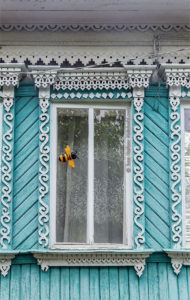
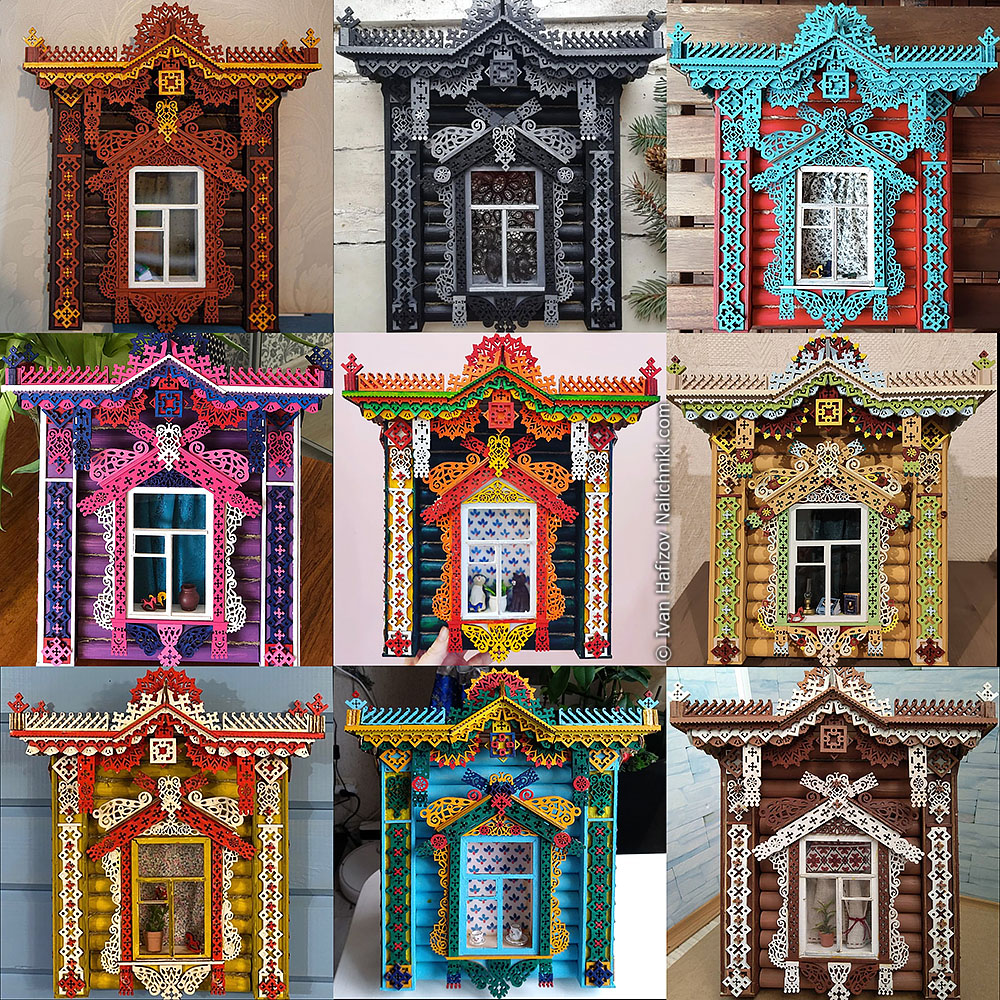
…Novokhopyorsk has a lot of merchant buildings with carved work — both the nalichniki and the framing above them. The buildings themselves are fairly plain, a common enough form, but the carving is wonderful; nothing like it in neighboring Borisoglebsk, nor in Voronezh itself. I shoot until sunset, while I can still hold the camera at long exposures. Then I set up the tripod and keep shooting. The lanes are narrow, not a soul around — but then three guys with beer round the corner into my alley. The conversation I could hear even before they appeared goes quiet. They come closer, look.
The camera clicks three times on the tripod; the last frame runs about twenty seconds — now you just wait and swat mosquitoes. I turn around.
— So… what are you shooting? — the nearest one asks. Said with attitude, but not aggressively, it seems to me.
— Nalichniki, — I say. And I think to myself: Now he's going to ask to see his house, and I've got the whole building in the frame, not just the nalichniki! Why did I say that?
— Oh, old stuff… — you can feel the conversation dying for him right there. He says something to his friends, they answer. Not far from me, but sparrows are going absolutely berserk overhead and I can't make out a word. At that moment the camera clicks; I turn back to it, adjust the settings…
Meanwhile the guys say their goodbyes, two of them head off down the street, and the one who'd asked stays behind, moves a little closer.
— Can I see?
— Sure, — I wave him over: the camera has just finished its exposure and the result is glowing on the screen.
— Not bad, — he nods. — Better than it actually looks. Can you send me that?
I look at him blankly; he clarifies:
— Like, it's a nice shot. Can you send it?
It clicks. I smile:
— Of course!
While I connect the camera to the phone, save the photo, open VKontakte, confirm the friend request — we talk.
He's not from here — came to see friends from Voronezh, heading to Borisoglebsk tomorrow. I tell him I was there just this morning, and that the city has changed a lot in ten years. Can't say I liked the changes: it used to be a small, quiet town, now there are two enormous malls, a boulevard of a main street, little cafés everywhere. Not that it's bad, exactly — I just liked what it was, and now it's a completely different city.
— Power changed there a few years back. New mayor, new rules.
— Really, — I say, — is the difference that dramatic? He gives a short laugh:
— You play Second Life?
— No, — I say. — Why?
— Doesn't matter. It's just… Basically, Borisoglebsk changed completely. New asphalt, cleaned everything up, at least it doesn't feel embarrassing now… You know Sims?
— Yeah, — I nod, — that one I know.
The guy perks up.
— Then you'll get it. Okay, so — like, you're the mayor, right, in a game, something like… At the start you've got basically a village, weeds everywhere and three sorry souls. Like how it works in Sims: you have some resources and you figure out where you'll get the most bang for your buck. You put down roads. Solid. Add some people. Then — what — three market stalls, you put those up. Something like a school, a community center. Done. Then residents start dying without a clinic, so you clear some abandoned lots for it — might as well. Then you put in a Pyatyorochka, a Magnit — basically you follow me, right?
I can picture what he's describing — I've thought about how cities develop in roughly the same terms myself. I like the analogy, I just can't see where it's going yet. I nod.
— Then — what else — you need a park, so residents' morale goes up. Built it. Then a hotel, whatever else, auto shop, the usual. Then you've maxed out your city limits, but now you can build three-story buildings. Resettlement, all that business, again. Right?
— Not quite yet, — I say honestly.
He patiently runs through the last few items in our abstract city again, looks at me. I still don't get it.
— I mean, look: you've built all this stuff — auto shop, city hall, housing authority, whatever else… Fire station, I don't know… You've got traffic jams. What are you going to do?
— You mean widen the roads? — I guess.
— What other options do you have? You tear everything down and widen the roads. And all your culture goes straight to hell.
He takes a thoughtful swig of beer, offers the bottle to me; I notice with surprise the 0% label. I shake my head, he takes another sip.
— You could make a solid game out of this… Close to real life, like. Where you can build houses for a hundred rubles — like garages, basically. Or brick, or — like you were saying — preserve the look, but for a thousand. Your call, matter of taste… That'd be a solid game… And then, — I watch him generating the idea in real time, — you know, like, as a random event, the contractors screw you over—
— And you've got an unfinished shell in the middle of town for twenty years? — I jump in with a grin. A good game, I think — just a bit on the nose.
— Could be, but I'm talking about something else… Like, residents build their own houses, but the kindergarten — jack squat. And you're like: "What the hell?" … Or like what we have — you've probably heard — they find some god-forsaken nickel deposit, and you've got a choice: give the green light to dig it up. Actually not a bad option: taxes for two hundred years and you get your kindergarten. Or leave it as-is and scramble for money every year. Which would you pick?
— I'd leave it as-is and figure something out.
— And that's exactly why you lose, — he laughs, — because they'll just replace you with a different mayor.
He switches the beer to his other hand and sticks out his palm.
— Alright, I'm out. Later.
And already a few steps away, he turns back, raises the bottle, and calls out cheerfully:
— Hey — that would actually be a solid game!